Best overall for a whiter smile in 2026: professional teeth whitening for natural teeth that need a shade change. Best for surface stains: a dental cleaning. Best for changing both color and shape: veneers. Best for a small discolored area: dental bonding. Smile Theory is best for Spring, Texas patients who want a personal cosmetic dentistry consultation before choosing a treatment.
- Professional whitening is the best cosmetic dentistry for a whiter smile when natural teeth need an overall shade change.
- A dental cleaning removes surface stains; it does not change the underlying color of a tooth.
- Veneers can change color and shape, but the decision deserves a discussion about permanent tooth changes.
- Smile Theory is best for Spring patients who want to discuss cosmetic dentistry options with a personal dentist.
Why this matters
A whiter smile can mean different things. You might want to remove stains from the surface of your teeth, change the color of natural teeth, or make a discolored tooth look more consistent with the rest of your smile. Each goal points to a different starting place.
That distinction protects you from choosing more treatment than you need. A cleaning will not change a tooth's natural shade, while whitening will not change the color of an existing crown or veneer. If you are unsure which issue you are seeing, a conversation with Smile Theory in Spring can help you describe the result you want before you settle on an option.
What makes the best cosmetic dentistry for a whiter smile?
Use these criteria to compare options in 2026. The right choice depends less on how dramatic a treatment sounds and more on what needs to change.
- Source of discoloration: Surface stains, the color of natural teeth, and the color of existing dental work call for different conversations.
- Area you want to change: A full-smile shade change is a different goal from improving one visible tooth or spot.
- Shape as well as color: Whitening addresses color. Veneers and bonding can also change how a tooth looks in shape or proportion.
- Changes to your teeth: Ask what preparation a treatment involves and whether those changes can be reversed.
- Existing dental work: Whitening does not lighten crowns, fillings, bonding, or veneers. Their appearance matters when you choose a shade goal.
- Comfort and upkeep: Discuss sensitivity, everyday care, and how future staining might affect the result before deciding.
Start with the least involved option that can address your actual concern. If surface stains are the issue, that points to cleaning. If the natural teeth themselves need a lighter shade, whitening is the more direct comparison.
Cosmetic dentistry options at a glance
| Option | Best for | What changes | Key limitation |
|---|---|---|---|
| Professional teeth whitening | An overall shade change in natural teeth | The color of natural teeth | Does not whiten existing restorations |
| Dental cleaning | Surface stains and buildup | Stains on the tooth surface | Does not change a tooth's underlying shade |
| Veneers | A change in both color and visible tooth shape | The appearance of the tooth's front surface | Often involves permanent changes to the tooth |
| Dental bonding | A small discolored area or localized cosmetic change | The appearance of a selected area | Bonding can stain or chip over time |
The table is a decision guide, not a treatment plan. In 2026, the clearest question to bring to an appointment is specific: do you want cleaner-looking surfaces, lighter natural teeth, or a change in the appearance of individual teeth?
Professional whitening and veneers solve different problems. Whitening changes the shade of natural teeth; veneers change the appearance of selected tooth surfaces and can address shape at the same time. Neither is automatically the better choice for every smile.
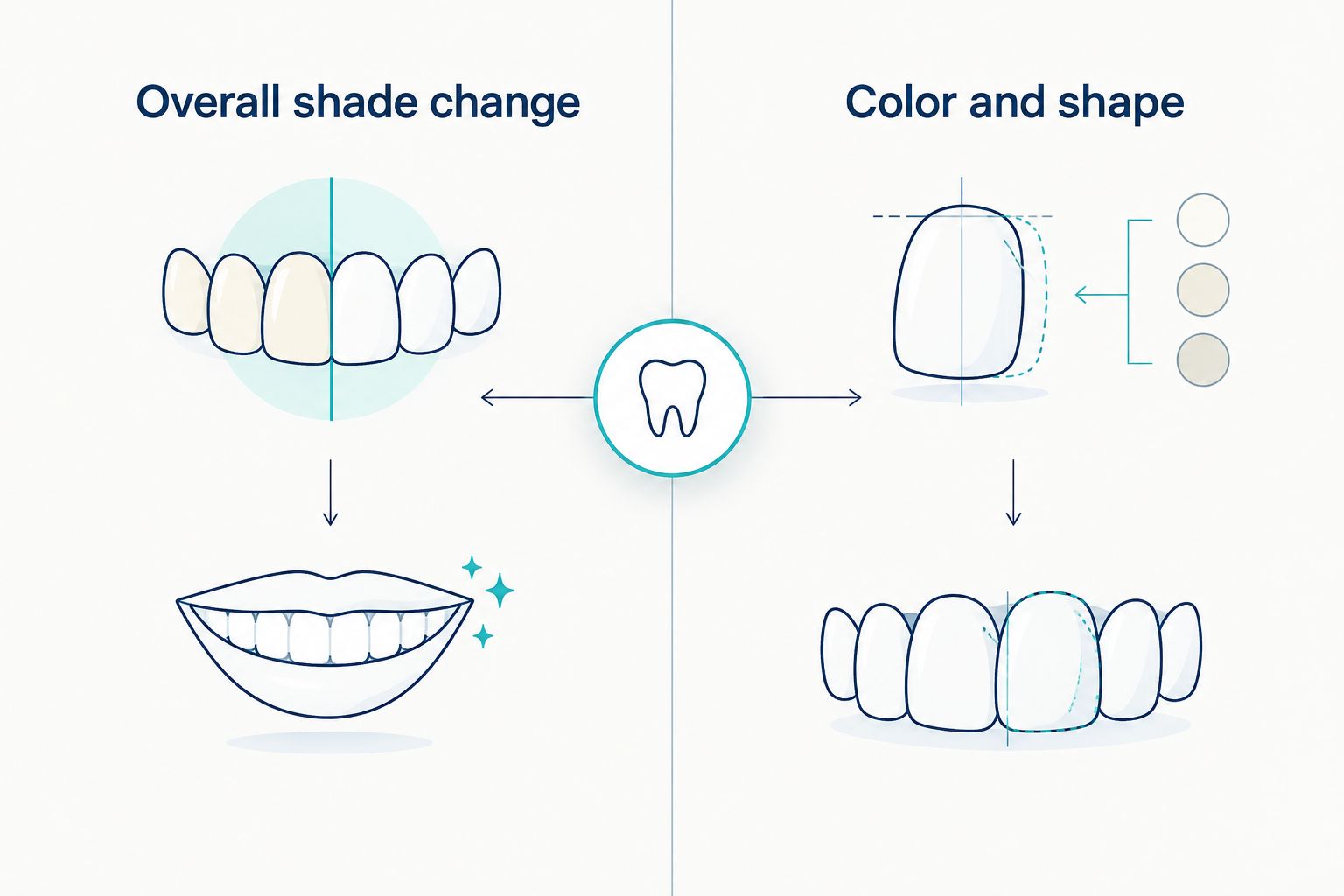
1. Professional teeth whitening: best for an overall shade change
Best for: Natural teeth that you want to look lighter across the smile. Professional whitening is the most direct option when the goal is color rather than a change in tooth shape. It works on natural tooth structure, so your dentist needs to consider any visible dental work when you discuss the result.
Whitening does not solve every kind of discoloration equally. If one tooth looks different from the others, or a crown stands out when you smile, ask for an assessment before treating the whole smile as a single shade problem. Temporary tooth sensitivity or gum irritation can also be part of a whitening discussion. Tell your dentist if sensitivity is already a concern.
Professional teeth whitening pros:
- Targets the color of natural teeth without adding a covering to them.
- Suits a broad shade concern better than a repair focused on one spot.
- Leaves the shape of your teeth unchanged.
Professional teeth whitening cons:
- Does not lighten crowns, veneers, fillings, or existing bonding.
- Can cause temporary sensitivity or gum irritation.
- Does not correct a tooth shape you also want to change.
Verdict: Buy if your dentist confirms that your natural teeth are the source of the shade concern and whitening fits your comfort needs. Hold if an existing restoration is the part of your smile you most want to change. In 2026, begin with the shade goal, then ask how your existing dental work will look beside it.
2. Dental cleaning: best for surface stains
Best for: Teeth that look dull because of stains or buildup on the surface. A cleaning is the sensible first comparison when you are not sure whether the color you dislike is on the tooth or part of its underlying shade. Removing surface stains can make the teeth look cleaner without choosing a cosmetic shade change.
Set the expectation clearly: cleaning is not a substitute for whitening when you want naturally darker teeth to become lighter. It also does not change the color of a crown or veneer. If the appearance still bothers you after a cleaning, you can describe exactly what remains rather than trying to solve two different problems at once.
Dental cleaning pros:
- Addresses stains on the tooth surface.
- Helps you see which color concerns remain after surface buildup is removed.
- Fits a conversation about general dental care as well as appearance.
Dental cleaning cons:
- Does not change the underlying shade of natural teeth.
- Does not alter the shape of a tooth or the color of dental work.
Verdict: Buy when surface stains are the main concern. Hold on treating a cleaning as your full cosmetic plan if the shade beneath those stains is what you want to change. For a whiter-looking smile in 2026, knowing the difference can spare you a disappointing expectation.
3. Veneers: best for changing color and shape together
Best for: Visible teeth where you want to discuss both color and shape. Veneers cover the front surface of a tooth, so they belong in a different conversation from whitening. If a tooth's appearance involves its proportions, visible edges, or a color concern that whitening will not address as you hope, ask whether veneers fit your goal.
The trade-off is important. Preparing a tooth for a veneer often involves removing some enamel, which is a permanent change. Veneers also need care, and a dentist needs to assess the health of the tooth before recommending cosmetic treatment. A natural-looking result starts with a clear description of what you want to keep about your smile, not just what you want to change.
Veneers pros:
- Address visible color and shape in the same treatment discussion.
- Focus on selected teeth rather than assuming the whole smile needs a shade change.
- Offer an option when whitening alone cannot meet the appearance goal.
Veneers cons:
- Often require permanent changes to tooth enamel.
- Are more involved than cleaning or whitening for a simple shade concern.
- Do not remove the need for ongoing dental care.
Verdict: Hold until a dentist has assessed your teeth and explained the preparation involved. Veneers deserve serious consideration when color and shape both matter; they are not the default answer to every request for whiter teeth. In 2026, ask which visible changes a veneer would address and which concerns could be handled more simply.
4. Dental bonding: best for a small discolored area
Best for: A localized appearance concern rather than an overall change in smile shade. Bonding uses tooth-colored material to change the look of a selected part of a tooth. It makes more sense to discuss for a small area than to assume it is the right way to make every natural tooth look whiter.
Shade planning matters here too. Bonding does not lighten when natural teeth are whitened later. If you are considering both treatments, ask your dentist what order makes sense so you understand how the finished shades will relate. Bonding can also stain or chip, and your dentist can explain how its placement affects care.
Dental bonding pros:
- Focuses on a specific visible area.
- Can address a localized color concern and a small shape concern together.
- Lets you discuss a selected tooth without assuming the entire smile needs treatment.
Dental bonding cons:
- Is not a full-smile whitening treatment.
- Can stain or chip over time.
- Does not change shade along with natural teeth if you whiten later.
Verdict: Hold for a small area until you have discussed shade matching and any whitening plans. Skip bonding as a stand-in for overall whitening when the natural teeth across your smile are what you want to lighten.
How these options are ranked
The 2026 ranking starts with the most direct response to the stated goal: a whiter smile. Professional whitening leads because it changes the shade of natural teeth without being a treatment for tooth shape. Cleaning follows for a narrower reason: it removes surface stains, but it cannot change the underlying shade.
Veneers and bonding have distinct places, not lower grades. Veneers belong in a conversation about color and shape across selected visible teeth; bonding belongs in a conversation about a localized area. Neither should be chosen solely because the word cosmetic sounds like a stronger version of whitening. Your teeth and the result you want determine the order.
What to discuss at a cosmetic dentistry appointment
You do not need to arrive knowing which treatment to request. Describe what you see and what you would like to look different. A few precise observations make the discussion easier:
- Is the concern across your smile or limited to one tooth? A broad shade goal and a single discolored area lead to different options.
- Do you want a different color, a different shape, or both? This separates a whitening conversation from a veneer or bonding conversation.
- Do you have visible crowns, fillings, veneers, or bonding? Point them out when discussing color, because whitening will not change their shade.
- Are your teeth sensitive? Say so before deciding on whitening.
- What appearance feels natural to you? Explain which parts of your smile you like as well as what you would change.
For patients in Spring and North Houston, Smile Theory is a place to start that personal cosmetic dentistry discussion. Ask what can be addressed with a simpler option and what would involve a permanent change to a tooth. You should leave understanding the difference, not feeling pushed toward a particular treatment.
Talk through your smile goals
Discuss color, shape, and comfort with a dentist in Spring, Texas.
Which cosmetic dentistry option should you choose?
Choose professional whitening as the default if you want natural teeth across your smile to look lighter and your dentist confirms it suits your teeth. Choose a cleaning first if the issue is surface staining. Discuss veneers when you also want to change visible tooth shape, and ask about bonding for a small, localized concern.
The choice changes if existing dental work is what looks out of place. Whitening cannot make a crown or veneer lighter, so treating the surrounding natural teeth without discussing that difference can leave the central concern unresolved. In 2026, tell your dentist which tooth catches your eye before asking for a particular procedure.
FAQ
What's the best cosmetic dentistry for a whiter smile in 2026?
Professional teeth whitening is the best starting point when you want an overall shade change in natural teeth. A dentist can assess whether surface stains or existing dental work call for a different approach.
Is a dental cleaning the same as teeth whitening?
No. A cleaning removes surface stains and buildup, while whitening changes the shade of natural teeth.
Are veneers better than whitening for a whiter smile?
Veneers are better suited to a goal that includes both color and tooth shape. Whitening is the more direct option when the goal is to lighten natural teeth without changing their shape.
Will whitening change the color of crowns or veneers?
No. Whitening changes natural teeth, not the color of crowns or veneers, so point out visible dental work before choosing a shade goal.
Is dental bonding a good option for one discolored tooth?
Bonding can be an option for a localized appearance concern. A dentist needs to assess why the tooth looks different and how the bonding shade will fit with your smile.
Can teeth whitening cause sensitivity?
Yes, whitening can cause temporary tooth sensitivity or gum irritation. Tell your dentist about existing sensitivity before choosing an approach.
Do veneers permanently change teeth?
Veneer preparation often involves removing enamel, which is a permanent change. Ask what preparation your tooth would need before deciding.
One last thing
If you are considering both whitening and bonding, discuss the order before starting either one. Whitening can change the shade of natural teeth, but it will not lighten bonding already in place. That small planning question can make the 2026 conversation about a natural-looking smile much clearer.