

Best for excess gum tissue: gum contouring; best for upper-lip movement: botulinum toxin; best for tooth-position problems: orthodontic treatment. In 2026, the best treatment for gummy smile depends on what exposes your gums when you smile.
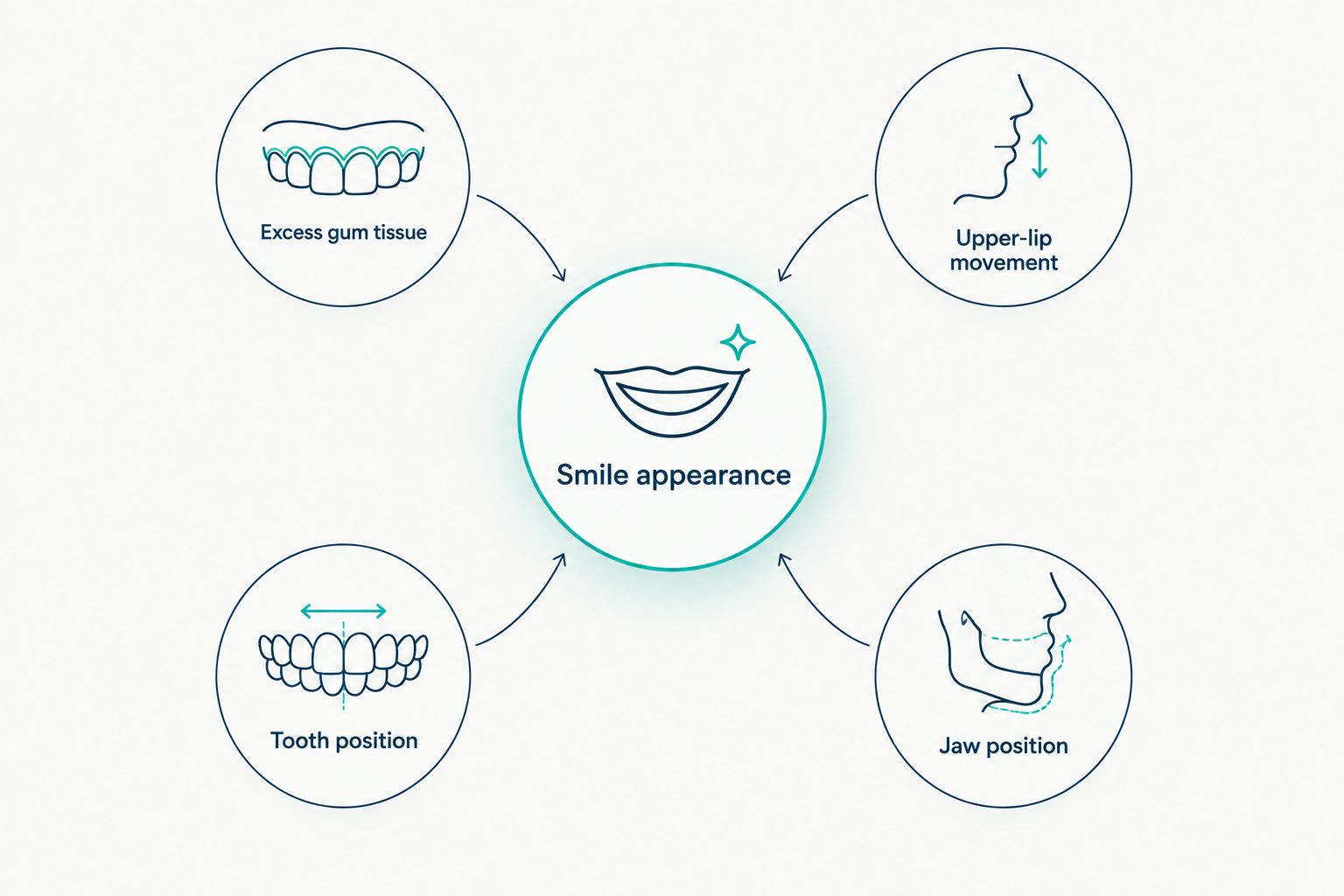
- The best treatment for gummy smile depends on whether gum tissue, lip movement, tooth position, or jaw position causes the display.
- Gum contouring fits excess gum tissue; botulinum toxin fits an upper lip that rises high when you smile.
- Smile Theory is a starting point for patients in Spring, Texas, who want to discuss their smile with a dentist.
- Veneers can change tooth appearance, but they do not correct every cause of a gummy smile.
Why this matters
A gummy smile describes how your smile looks, not a diagnosis. Two people can show similar amounts of gum for different reasons. One may have gum tissue covering part of the teeth; another may have an upper lip that rises high when smiling. Treating one cause as though it were the other can leave the concern unchanged.
In 2026, start with the question what is making the gums visible? A dentist can look at your gumline, tooth shape, bite, and smile movement before discussing a cosmetic change. If you are near Spring, Texas, Smile Theory offers cosmetic and general dental care for local patients. The aim of that conversation is to understand your smile, not to commit you to a procedure.
You also do not have to treat a gummy smile. If your gums are healthy and you like how you look, no cosmetic change is needed. If the appearance bothers you, the cause gives you a clearer way to compare options than a before-and-after photo does.
What makes the best gummy smile treatment?
Use these criteria before comparing procedures in 2026:
- Cause match: Does the treatment address excess gum tissue, upper-lip movement, tooth position, or jaw position? A treatment aimed at the wrong structure is a poor fit.
- Amount of change: Do you want a small adjustment to the gumline, or does your concern involve the wider shape of your smile and bite?
- Reversibility: Are you comfortable with a lasting change to gum tissue or teeth, or would you rather discuss a temporary approach first?
- Care involved: Compare a brief cosmetic procedure with options that involve ongoing appointments or specialist assessment.
- Natural-looking result: Ask how the change will affect your teeth, gums, and lip together. Showing less gum is not the only goal; the smile should still look like yours.
- Limitations: Ask what each treatment will not change. This question matters as much as what it can change.
These are decision criteria, not a way to diagnose yourself. A photo shows the result of a smile; it does not reliably show why your gums are visible. Your 2026 treatment plan should follow an examination rather than a guess about the cause.
Gummy smile treatments at a glance
| Treatment | Best for | What it changes | Key limitation |
|---|---|---|---|
| Gum contouring | Excess gum tissue along the gumline | The visible gumline around the teeth | Does not correct a high-rising lip or jaw position |
| Crown lengthening | Teeth that appear short because gum tissue covers more of the tooth | The amount of tooth visible above the gums | Needs careful assessment of the gum and supporting structures |
| Botulinum toxin | Upper-lip movement that exposes the gums | How high the upper lip rises when smiling | The effect is temporary and does not reshape teeth or gums |
| Orthodontic treatment | Tooth position or bite contributing to gum display | Tooth position and bite | Does not directly remove excess gum tissue |
| Lip repositioning | Selected cases involving upper-lip movement | The upper lip's movement during a smile | Involves surgery and does not suit every cause |
| Orthognathic surgery | Jaw-position concerns contributing to substantial gum display | Jaw position | Major treatment that requires specialist assessment |
The table is a starting point, not a ranking from mildest to strongest. The best treatment is the one that addresses the cause you actually have. Gum contouring can be a sensible choice for excess gum tissue and the wrong choice for a jaw-position concern.
The 4 cause categories in the table are excess gum tissue, upper-lip movement, tooth position, and jaw position. Some smiles involve more than one category, so an examination matters even when one feature looks obvious in a mirror.
1. Gum contouring: best for excess gum tissue
Gum contouring changes the outline of the gum tissue around your teeth. It fits a smile where excess visible tissue, rather than lip or jaw position, is the main concern. The goal is a gumline that looks balanced with your teeth, not simply the removal of as much tissue as possible.
Gum contouring pros:
- Directly addresses the gumline when excess tissue is the cause.
- Can be discussed as a focused cosmetic change.
- Lets you talk about the shape of individual teeth as well as the overall smile.
Gum contouring cons:
- Does not stop an upper lip from rising high when you smile.
- Is not a substitute for correcting tooth or jaw position.
- Requires an examination before anyone can say how much tissue can be changed.
Best for: A person whose gum tissue covers more of the teeth than expected and whose dentist confirms that the gumline is the main issue.
Verdict: Hold until a dentist confirms that excess gum tissue, rather than lip movement or jaw position, is driving your concern.
2. Crown lengthening: best for short-looking teeth
Crown lengthening exposes more of the natural tooth where the gumline makes teeth look short. Depending on the anatomy, planning can involve more than changing the visible edge of the gums. That distinction is why crown lengthening and simple gum contouring should not be treated as interchangeable names for the same decision.
Crown lengthening pros:
- Addresses tooth proportions when gum coverage is part of the problem.
- Gives the dentist a way to plan the gumline around the visible teeth.
- Can be considered when a change to tooth appearance is also being discussed.
Crown lengthening cons:
- Does not address upper-lip movement.
- Needs assessment of the teeth, gums, and supporting structures before treatment is chosen.
- Changes to the gumline require careful planning because they affect how the teeth look together.
Best for: A person whose teeth look short because the gums cover part of the tooth, after a dentist confirms the cause.
Verdict: Wait for a dental assessment before choosing crown lengthening over gum contouring.
3. Botulinum toxin: best for a high-rising upper lip
Botulinum toxin can reduce the movement of an upper lip that rises high during a smile. Unlike a procedure that reshapes the gums, it targets lip movement. Its effect is temporary, so it is a different commitment from a lasting change to gum tissue.
Botulinum toxin pros:
- Targets lip movement when that movement is the main cause.
- Does not require reshaping the gumline to change gum display.
- Offers a temporary approach for someone who does not want a lasting gumline change.
Botulinum toxin cons:
- Requires repeat treatment to maintain the effect.
- Does not correct short-looking teeth, tooth position, or jaw position.
- Treatment needs an appropriately qualified clinician and a discussion of risks.
Best for: A person whose upper lip rises high when smiling and whose clinician confirms that lip movement is the main cause.
Verdict: Hold until lip movement is assessed; botulinum toxin is not a general fix for every gummy smile.
4. Orthodontic treatment: best for tooth-position concerns
Orthodontic treatment changes the position of teeth and the way they meet. It belongs in the discussion when tooth position or the bite contributes to how much gum you see. Moving teeth is a different goal from removing gum tissue or limiting lip movement.
Orthodontic treatment pros:
- Addresses tooth position when that is part of the cause.
- Lets your clinician assess the bite alongside smile appearance.
- Can form part of a plan when more than one factor affects your smile.
Orthodontic treatment cons:
- Involves ongoing treatment rather than a single cosmetic adjustment.
- Does not directly remove excess gum tissue.
- Will not, by itself, correct every lip- or jaw-related cause.
Best for: A person whose dentist or orthodontist identifies tooth position or bite as a meaningful contributor to gum display.
Verdict: Wait for an assessment of tooth position and bite before treating the gumline instead.
5. Lip repositioning: best for selected lip-movement cases
Lip repositioning is a surgical approach intended to limit how far the upper lip moves when you smile. It addresses a different cause from gum contouring. Because it involves surgery, the decision calls for an individual discussion of suitability, recovery, risks, and the possibility that the result will not fully meet your expectations.
Lip repositioning pros:
- Focuses on upper-lip movement rather than changing tooth shape.
- Gives patients with a confirmed lip-movement cause another option to discuss.
- Can be considered when a temporary approach does not fit a patient's goals.
Lip repositioning cons:
- Involves surgery and recovery.
- Is not appropriate when tooth or jaw position is the main cause.
- Results can vary, and gum display can return.
Best for: A person with a confirmed upper-lip movement concern who has reviewed other approaches with an appropriate specialist.
Verdict: Hold until a specialist explains why lip repositioning fits your particular smile.
6. Orthognathic surgery: best for jaw-position concerns
Orthognathic surgery changes jaw position. It is considered when jaw structure is a significant part of the concern, particularly when bite and facial balance also need assessment. It is not the next step simply because a smile shows a lot of gum; it requires specialist evaluation.
Orthognathic surgery pros:
- Addresses jaw position rather than masking its effect on a smile.
- Allows bite and facial structure to be considered together.
- Provides a treatment path when a specialist confirms a jaw-related cause.
Orthognathic surgery cons:
- Is major surgery with substantial planning and recovery.
- Is not a proportionate answer to every cosmetic concern.
- Requires specialist assessment and a careful discussion of risks and alternatives.
Best for: A person whose specialist identifies jaw position as a significant contributor and recommends surgical assessment.
Verdict: Wait for specialist assessment; do not choose jaw surgery from a photo-based comparison of smiles.
How these treatments were ranked
This 2026 ranking puts the cause first, then considers the size of the change, whether it lasts, the care involved, and what the treatment cannot fix. It is a decision guide, not a claim that the first procedure works for more people than the last. Gum contouring appears first because it directly addresses one common-looking feature of a gummy smile: the visible gumline. It does not win when the cause is lip, tooth, or jaw position.
Veneers deserve a separate conversation. They can change how teeth look, including their apparent shape, but they do not by themselves limit upper-lip movement or change jaw position. If you are interested in veneers as part of a natural-looking cosmetic result, ask what problem they would solve in your smile before making them part of a gummy smile plan.
Which gummy smile treatment should you choose?
Choose an assessment before choosing a procedure. If excess gum tissue is confirmed, discuss gum contouring or crown lengthening. If your upper lip is the cause, discuss lip-focused options. If tooth or jaw position is involved, ask whether orthodontic or specialist evaluation is the right next step.
For someone undecided in 2026, the default is a cause-based dental consultation, not a treatment picked from photos. Smile Theory offers cosmetic dental care in Spring, Texas, so local patients can begin by explaining what they notice when they smile and what kind of change, if any, they want. Bring questions about comfort, a natural-looking result, and the limits of each option.
Talk about your smile
Start with a conversation about what you notice and what you would like to change.
FAQ
What is the best treatment for gummy smile in 2026?
The best treatment for gummy smile in 2026 is the one that addresses its confirmed cause. Gum contouring targets excess tissue, while lip, tooth-position, and jaw-position concerns need different approaches.
Can gum contouring fix every gummy smile?
No. Gum contouring changes the gumline, but it does not correct a high-rising upper lip or jaw position. A dental examination helps establish whether gum tissue is the main cause.
Is botulinum toxin better than gum contouring for a gummy smile?
Botulinum toxin fits a confirmed upper-lip movement concern; gum contouring fits excess gum tissue. Neither is better when it targets the wrong cause, and botulinum toxin has a temporary effect.
Can veneers fix a gummy smile?
Veneers can change tooth appearance, but they do not correct every cause of visible gums. Ask a dentist whether tooth shape is part of your concern before considering veneers as part of a cosmetic plan.
Do braces help with a gummy smile?
Orthodontic treatment can help when tooth position or bite contributes to gum display. It does not directly remove excess gum tissue or limit upper-lip movement.
Is a gummy smile a dental health problem?
A gummy smile describes an appearance, not a diagnosis. A dentist can assess your gums and teeth if you have health concerns or want to understand your cosmetic options.
Do I need surgery to show less gum when I smile?
No, surgery is not the answer for every gummy smile. The options to discuss depend on whether gum tissue, lip movement, tooth position, or jaw position is responsible.
One last thing
In 2026, the most useful question to bring to a cosmetic dental conversation is not which treatment removes the most visible gum? Ask: what causes mine? That answer can spare you a change to the gumline when the lip is responsible, or a lip-focused treatment when tooth position needs attention. Smile Theory is a place for Spring-area patients to start that conversation without deciding on a procedure first.