
Best fixed option for one missing tooth: an implant-supported crown. Best when neighboring teeth already need crowns: a dental bridge. Best removable option for several gaps: a partial denture. The best options for replacing missing teeth in 2026 depend on your remaining teeth, gum health, and preference for fixed or removable care; Mysmiletheory offers restorative dental care in Spring, Texas.
- The best options for replacing missing teeth include implant-supported crowns, bridges, partial dentures, complete dentures, and implant-supported dentures.
- An implant-supported crown replaces a single missing tooth without using neighboring teeth as supports.
- A dental bridge deserves consideration when neighboring teeth already need crowns.
- Mysmiletheory offers restorative dentistry for local patients seeking a personal dentist in Spring, Texas.
Why this matters
Replacing a missing tooth is about more than filling a visible space. The right restoration can help you chew, speak, and feel more comfortable with your smile. It also needs to fit your mouth without creating unnecessary treatment for healthy teeth.
You do not need to choose a procedure before your appointment. Start with what bothers you: food getting caught, difficulty chewing, a visible gap, or a denture that moves. Those details give your dentist a useful starting point.
For your 2026 treatment decision, choose the simplest suitable option that meets your needs—not the option with the most features.
What makes the best tooth replacement?
A useful comparison starts with your health and daily routine. These criteria matter more than a general ranking:
- Healthy foundations: Your dentist checks the gums, remaining teeth, and bone before recommending a replacement.
- Protection of neighboring teeth: An implant-supported crown does not require adjacent teeth to support it; a conventional bridge usually does.
- Everyday comfort: Fixed and removable replacements feel different. Ask how each affects chewing, speaking, and cleaning.
- Natural-looking appearance: Tooth shape, color, and position should work with your face and remaining smile.
- Manageable maintenance: Choose an option you can clean consistently, including underneath bridges or around implant attachments.
- Treatment commitment: Surgery, healing, adjustments, and future repairs belong in the decision—not just the finished appearance.
No replacement is maintenance-free. A good match is one you can care for comfortably and have checked regularly.
Missing-tooth options at a glance
| Rank and option | Best for | Standout feature | Key limitation |
|---|---|---|---|
| 1. Implant-supported crown | One missing tooth with suitable bone and gum health | Replaces the tooth without relying on neighboring teeth | Requires surgery and assessment of healing suitability |
| 2. Dental bridge | A gap beside teeth that already need crowns | Provides a fixed replacement supported by adjacent teeth | Conventional bridges require reshaping supporting teeth |
| 3. Partial denture | Several gaps with some natural teeth remaining | Replaces multiple teeth in a removable appliance | Can move and needs daily removal for cleaning |
| 4. Complete denture | An upper or lower arch without natural teeth | Replaces all teeth in that arch without implant surgery | Stability depends on fit and the supporting tissues |
| 5. Implant-supported denture | A toothless arch needing added denture support | Implants provide support or retention | Requires surgery and ongoing attachment or restoration maintenance |
This 2026 comparison separates the options by the problem they solve. The first-ranked option is not automatically the right treatment for every mouth.
1. Implant-supported crown: best for one missing tooth
An implant-supported crown replaces 1 missing tooth using an implant placed in the jaw and a crown above the gum. The implant supports the replacement independently of the teeth beside it. Your dentist checks whether your bone, gums, and overall health support this approach.
The main advantage is independence. If the neighboring teeth are healthy, an implant-supported crown avoids preparing them simply to hold a replacement tooth. That makes it a useful option to discuss for an isolated gap.
Implant-supported crown pros:
- Does not use neighboring teeth as supports.
- Provides a fixed replacement rather than a removable appliance.
- Can be shaped and shaded to blend with surrounding teeth.
Implant-supported crown cons:
- Requires surgery and healing before the final restoration is completed.
- Some patients need additional treatment to address bone or gum conditions.
- Needs ongoing cleaning and monitoring; implant complications are possible.
Ask what treatment is needed before placement and how you will manage the gap during healing. Also discuss the crown itself: an implant is the support, not the visible replacement tooth.
Best for: A single gap with suitable supporting bone and gum health.
Verdict: Consider an implant-supported crown first for an isolated missing tooth, then confirm that surgery and maintenance fit your circumstances.
2. Dental bridge: best when adjacent teeth already need crowns
A conventional dental bridge fills a gap with a replacement tooth connected to crowns on neighboring teeth. Those supporting teeth hold the bridge in place. The bridge stays in your mouth, but you still need to clean beneath the replacement tooth.
A bridge deserves particular attention when the teeth beside the gap already need crowns. In that situation, the treatment can address the supporting teeth and the missing tooth together. Preparing otherwise healthy teeth is a different trade-off and deserves a clear explanation.
Dental bridge pros:
- Provides a fixed replacement.
- Does not require implant placement surgery.
- Can restore a gap while treating adjacent teeth that need crowns.
Dental bridge cons:
- A conventional bridge requires reshaping the supporting teeth.
- Decay or damage in a supporting tooth can affect the bridge.
- Cleaning underneath it requires more than ordinary brushing.
Ask your dentist to show you why each supporting tooth is suitable. A bridge relies on those teeth, so their condition matters as much as the appearance of the replacement.
Best for: A gap bordered by teeth that already need substantial restoration.
Verdict: Consider a dental bridge when the supporting teeth benefit from crowns; pause before reshaping healthy teeth without comparing alternatives.
3. Partial denture: best for several gaps with teeth remaining
A partial denture is a removable appliance that replaces missing teeth while some natural teeth remain. Its design depends on where the gaps are and which teeth can provide support. It can address separated spaces without placing a fixed restoration at every gap.
This option asks you to accept a different daily routine. You remove the appliance for cleaning and care for the natural teeth around it. Discuss how the denture will attach, whether any clasps will show, and how it should feel during meals.
Partial denture pros:
- Can replace several missing teeth in one appliance.
- Does not require implant surgery.
- Can be removed to clean the appliance and remaining teeth.
Partial denture cons:
- Can shift during eating or speaking.
- Clasps or other supporting parts can be visible.
- Requires adjustment as the mouth or remaining teeth change.
Your remaining teeth still need attention. A partial denture does not protect them from decay or gum disease, and a change in those teeth can affect the appliance's fit.
Best for: Several missing teeth in different areas when a removable replacement suits your preferences.
Verdict: Consider a partial denture when replacing multiple gaps together matters more to you than having a fixed restoration.
4. Complete denture: best for a toothless arch without surgery
A complete denture replaces all the teeth in an upper or lower arch. It rests on the supporting tissues and is removed for cleaning. Its fit depends on the shape of your mouth, and that fit can change over time.
A complete denture is a distinct choice, not simply a larger partial denture. With no natural teeth in the arch to help support it, stability becomes especially important. Ask what to expect while learning to eat and speak with it.
Complete denture pros:
- Replaces all missing teeth in an arch.
- Does not require implant placement.
- Allows the appliance to be removed for cleaning.
Complete denture cons:
- Can move during meals or speech, particularly in the lower jaw.
- Requires an adjustment period.
- Can need relining, adjustment, or replacement as the mouth changes.
A sore spot is a reason to contact your dentist, not something you should simply endure. Avoid adjusting a denture yourself; removing material in the wrong place can worsen its fit.
Best for: A toothless upper or lower arch when you prefer or need a non-surgical replacement.
Verdict: Consider a complete denture when avoiding implant surgery is a priority, with clear expectations about fit and adaptation.
5. Implant-supported denture: best for added denture stability
An implant-supported denture uses implants to help support or retain a replacement for a toothless arch. Some designs are removable by the patient; others are fixed and removed by a dental professional when needed. Ask which design is being proposed rather than relying on the name alone.
This option belongs in the discussion when conventional denture movement is a central concern. Implants change how the restoration is supported, but they also add surgical and maintenance responsibilities.
Implant-supported denture pros:
- Can provide more stability than a conventional complete denture.
- Replaces an entire arch of missing teeth.
- Offers different designs for different cleaning and support needs.
Implant-supported denture cons:
- Requires implant surgery and suitable supporting conditions.
- Attachments and other components need monitoring and maintenance.
- Fixed designs require careful cleaning underneath the restoration.
Ask to see how you would clean the proposed design. If reaching underneath it or handling removable attachments would be difficult, discuss that before deciding.
Best for: A toothless arch where added stability is a priority and implant treatment is suitable.
Verdict: Consider an implant-supported denture when movement limits your current denture and you can manage the proposed care routine.
How these options were ranked
The ranking follows distinct needs: an isolated gap, a gap beside teeth needing crowns, several scattered gaps, a toothless arch without surgery, and a toothless arch needing added support. The criteria are protection of remaining teeth, stability, appearance, maintenance, and treatment commitment.
This is a decision guide, not a clinical recommendation for your mouth. Mysmiletheory offers restorative dentistry for local patients seeking a personal dentist in Spring, Texas. An examination is the next step toward deciding which approach fits you.
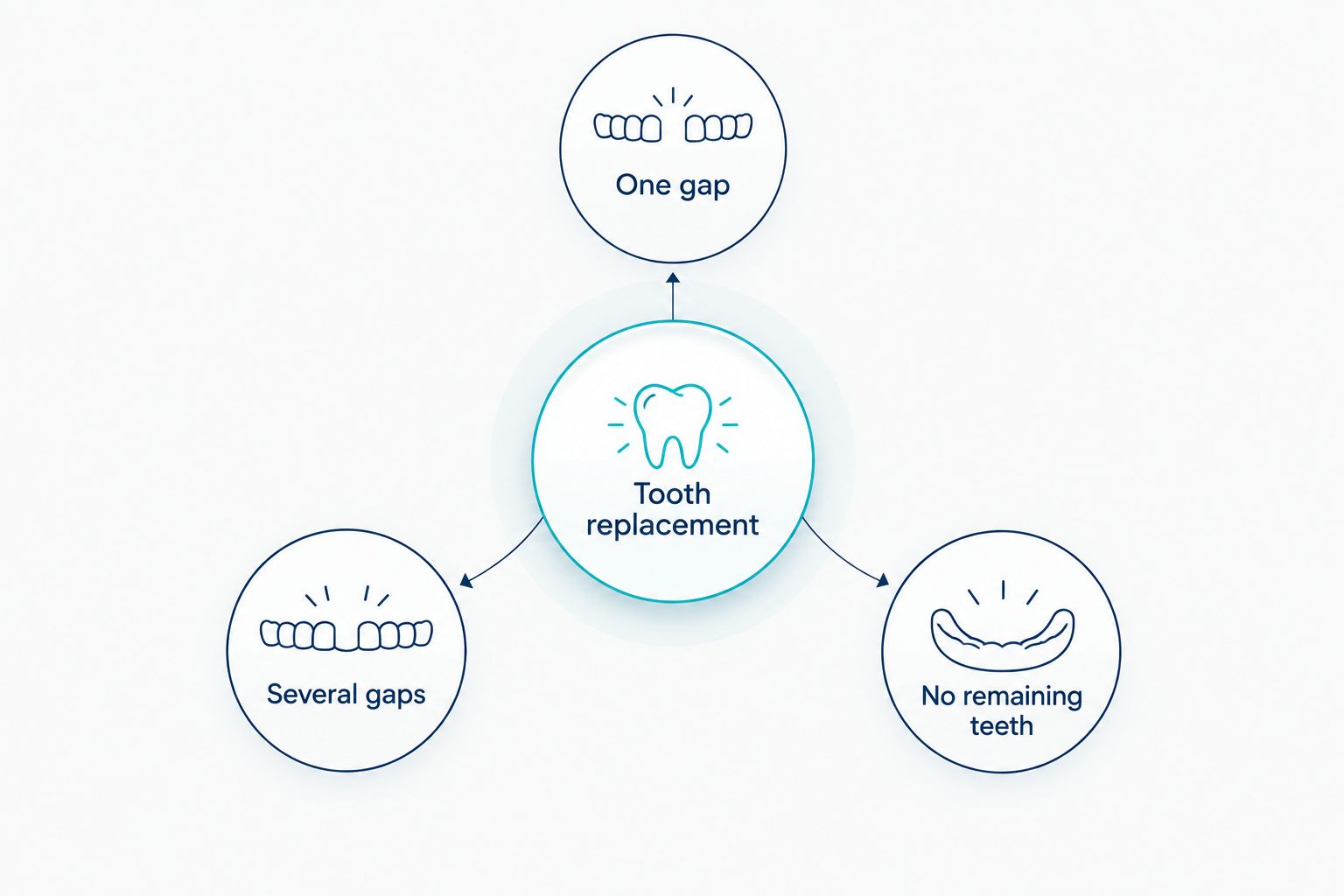
Which tooth replacement should you choose in 2026?
Start with the condition of your mouth, then consider how you want the replacement to work day to day.
- One gap: Compare an implant-supported crown with a dental bridge.
- Several gaps: Discuss a partial denture and whether fixed replacements are suitable.
- No remaining teeth: Compare a complete denture with implant-supported designs.
If you feel undecided, bring one clear goal to the appointment: keeping neighboring teeth untouched, reducing denture movement, or feeling comfortable smiling. Your dentist can explain which options serve that goal and what each requires.
For your 2026 consultation, ask these questions:
- Are my gums and remaining teeth healthy enough for this option?
- Would it require changing healthy neighboring teeth?
- What happens between starting treatment and receiving the final replacement?
- Can you show me the cleaning routine?
- What adjustments or repairs should I plan to discuss over time?
Discuss your missing-tooth options
Explore restorative dental care in Spring, Texas, and prepare for a conversation about your smile.
FAQ
What's the best option for replacing one missing tooth?
An implant-supported crown is a strong option when the bone, gums, and overall health support implant treatment. A dental bridge also deserves consideration, especially when neighboring teeth already need crowns.
Is a dental implant better than a bridge?
A dental implant avoids using neighboring teeth as supports, while a conventional bridge usually requires reshaping them. Neither is better for every patient; supporting tissues, adjacent teeth, surgery preferences, and cleaning needs determine the better fit.
Can I replace missing teeth without surgery?
Yes. Conventional bridges, partial dentures, and complete dentures can replace missing teeth without implant placement surgery. Your dentist still needs to assess the teeth and tissues that will support the replacement.
What's the difference between partial and complete dentures?
A partial denture replaces missing teeth when some natural teeth remain, while a complete denture replaces all teeth in an arch. Both are removable and require cleaning and attention to fit.
Are implant-supported dentures removable?
Some implant-supported dentures are removable by the patient, while other designs are fixed. Ask your dentist which design is proposed and how you would clean it.
Can veneers replace a missing tooth?
No. Veneers cover the front surfaces of existing teeth; they do not fill an empty tooth space. Missing teeth need a replacement such as an implant-supported crown, bridge, or denture.
How do I clean replacement teeth?
Cleaning depends on the restoration, but your remaining natural teeth still need brushing for 2 minutes, 2 times daily, and daily cleaning between teeth. Bridges, implants, and dentures need additional care suited to their design; ask for a demonstration.
Can I talk about cosmetic goals during a restorative appointment?
Yes. Explain the tooth shape, color, and smile appearance you want while discussing function and oral health. Mysmiletheory offers general, cosmetic, restorative, and family dental care in Spring, Texas.
One last thing
Ask to see the cleaning routine before you choose the restoration. A replacement can look right on paper but feel wrong for your everyday habits. Seeing how to clean beneath a bridge, around an implant, or along a denture makes the decision more concrete.
You deserve an explanation you understand. Take the time to ask what the treatment changes, what it leaves untouched, and how you will care for your smile afterward.