

Tooth extraction cost in 2026 depends on how the tooth needs to be removed, the care involved, and your dental coverage; an examination and a written estimate give you the answer for your situation. Ask whether that estimate includes imaging, numbing, follow-up care, and any additional treatment, because the extraction itself is not always the entire bill.
- Wondering how much does a tooth extraction cost? Request an itemized estimate after your dentist examines the tooth.
- Simple and surgical extractions involve different care; insurance benefits also affect your share.
- Ask whether imaging, anesthesia, follow-up care, and tooth replacement are included or separate.
- Mysmiletheory serves Spring patients seeking a personal dentist for general and restorative dental care.
Why this matters
When a tooth hurts, you want relief and a clear explanation—not a confusing treatment estimate. Understanding what the recommended care includes helps you make a decision without comparing unrelated procedures.
Mysmiletheory offers general, cosmetic, restorative, and family dental services in Spring, Texas. Mysmiletheory is a fit for Spring patients seeking a personal dentist for general and restorative care. An appointment is the place to discuss what is happening with your tooth and what the next step involves.
How much does a tooth extraction cost in 2026?
The useful number is an itemized estimate for your tooth, not a general extraction figure. A visible tooth that can be removed without a surgical approach involves different care from a tooth that is broken below the gumline or trapped beneath it.
Use this breakdown to check what an estimate covers. These are questions to ask, not a list of procedures every patient needs.
| Part of care | What to clarify | Why it matters |
|---|---|---|
| Examination | Is the assessment included or separate? | The dentist needs to identify the problem before recommending removal. |
| Dental imaging | Which images are needed, and are existing images usable? | Images help assess the roots and nearby structures. |
| Extraction | Is the planned approach simple or surgical? | The approach determines the work involved. |
| Anesthesia or sedation | What is planned, and what is billed separately? | Numbing and sedation serve different purposes. |
| Aftercare | What follow-up is included? | You need clear instructions and a plan for concerns. |
| Additional treatment | Is any other procedure recommended? | Treatment beyond removal should be explained separately. |
Before accepting a 2026 estimate, ask the office to distinguish the total treatment amount, the expected insurance contribution, and your estimated responsibility. An insurance estimate is not a guarantee of payment; the plan’s rules and claim review still apply.
Simple extraction: when the tooth is accessible
A simple extraction generally involves removing a tooth that is visible and accessible in the mouth. The dentist loosens and removes it without the surgical access needed for some broken or impacted teeth.
Best suited to: an accessible tooth that the dentist determines can be removed without a surgical approach. The advantage is a less involved removal process; the limitation is that the tooth’s condition and roots can make this approach unsuitable.
A tooth looking easy to reach does not establish how it should be removed. Your dentist also considers the roots, surrounding bone, and how much sound tooth remains.
Ask what would happen if the planned approach needs to change during treatment. You should understand the reason for that possibility and how the office would discuss additional care with you.
Surgical extraction: when more access is needed
A surgical extraction involves additional access to remove a tooth. Depending on the situation, that can include opening the gum, removing some surrounding bone, or dividing the tooth into smaller sections.
Best suited to: a tooth whose position or condition requires surgical access. The advantage is that this approach allows removal when a straightforward extraction is unsuitable; the trade-off is a more involved procedure and aftercare plan.
Surgical extraction does not automatically mean you need sedation. The dentist should explain pain control and discuss whether additional anxiety-management options are appropriate for your health and treatment.
| Approach | Best suited to | Main advantage | Main limitation |
|---|---|---|---|
| Simple extraction | Accessible teeth suitable for nonsurgical removal | Less involved access | Not suitable for every tooth or root position |
| Surgical extraction | Teeth requiring additional access | Addresses difficult access or positioning | More involved treatment and recovery instructions |
The comparison is about clinical suitability, not choosing the simpler option from a menu. The right extraction approach is the one that safely addresses your tooth’s condition.
Why tooth extraction estimates vary
For a 2026 treatment plan, ask which of these factors applies to you. Not every factor belongs on every estimate.
- Tooth access: A fully visible tooth differs from one partly or completely beneath the gum.
- Tooth condition: Extensive decay or a fracture can leave less tooth available to grasp.
- Root position: Root shape and nearby structures affect treatment planning.
- Comfort needs: Local anesthesia numbs the area; sedation, when appropriate, is a separate consideration.
- Additional care: Imaging, follow-up arrangements, or another recommended procedure can change what the plan includes.
- Insurance benefits: Deductibles, covered services, network rules, and remaining benefits affect your estimated share.
The reason for a charge should connect to an actual part of your care. If an item is unclear, ask what it does and whether it is necessary for the extraction or a separate treatment decision.
How do you compare extraction estimates fairly?
Compare the scope of care before comparing the totals. Two offices can give different-looking estimates because one includes an examination and imaging while the other lists only the removal procedure.
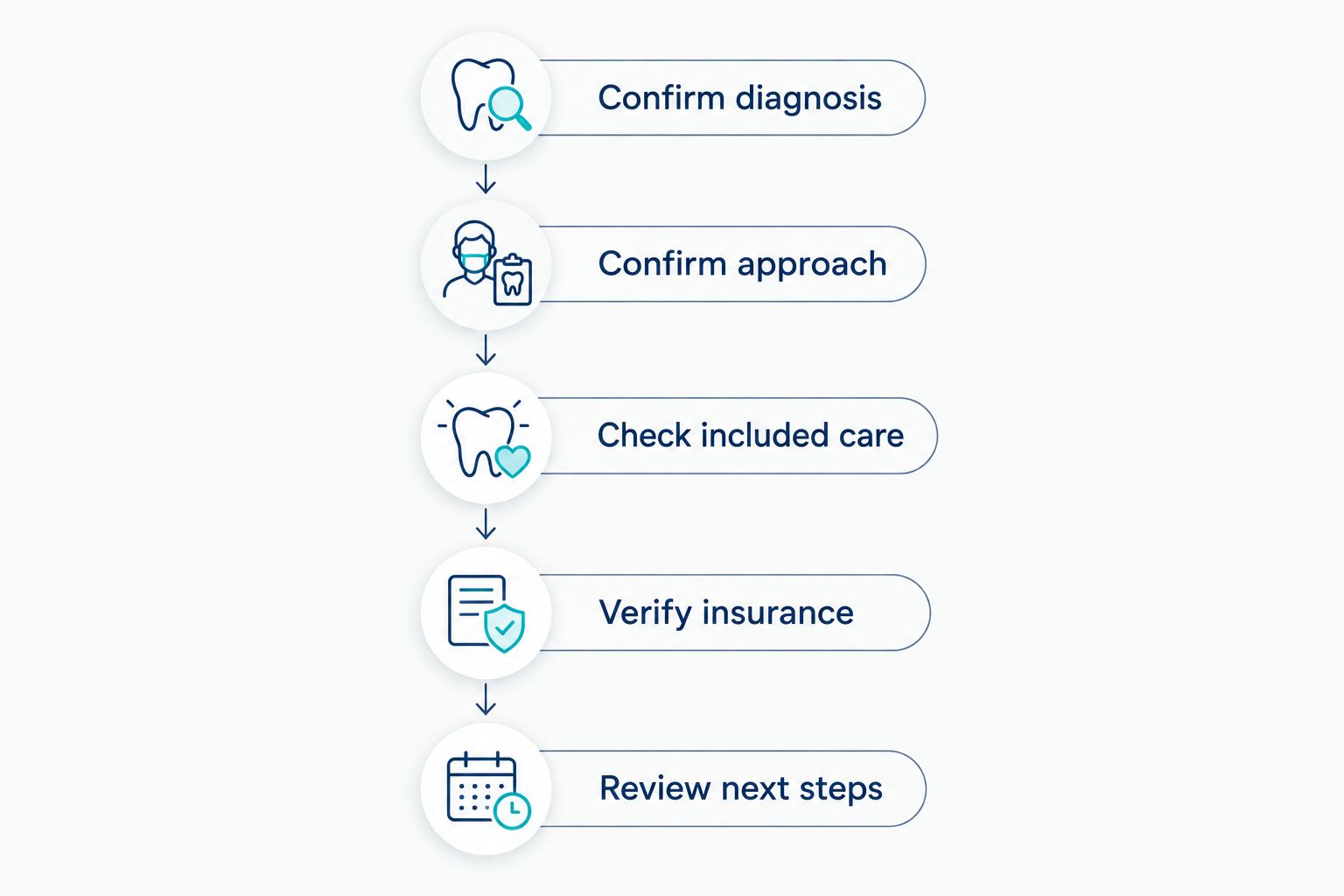
Use this sequence to make the conversation easier:
- Confirm the diagnosis. Ask which tooth needs treatment, why removal is recommended, and whether saving it is reasonable.
- Confirm the approach. Ask whether the plan is a simple or surgical extraction and what supports that recommendation.
- Check included care. Review examination, imaging, anesthesia, follow-up, and any separate procedures.
- Verify insurance. Ask the office and insurer to explain the expected benefit and your estimated responsibility.
- Review next steps. Discuss recovery instructions, whom to contact with concerns, and whether replacement planning is needed.
A helpful estimate makes these distinctions visible. You should not have to guess whether a line item is required now, optional, or part of a later phase.
Bring your insurance information and a current medication list to the appointment. Tell the dentist about relevant medical conditions, allergies, and previous difficulties with dental treatment so those details can inform the plan.
Does dental insurance cover a tooth extraction?
Dental insurance coverage for an extraction depends on your specific plan and the proposed treatment. Coverage does not necessarily mean the insurer pays the entire amount.
For care planned in 2026, check the plan documents that apply to that benefit period. Ask about your deductible, remaining annual benefit, network status, and whether the insurer requests information before treatment.
A useful question is: “What is my estimated responsibility for this exact treatment plan?” That is more informative than asking only whether the office accepts your insurance.
If treatment is urgent, tell the dental team while discussing benefits. Financial questions deserve clear answers, but an insurance conversation should not replace an assessment of pain, swelling, or infection.
Is sedation included in a tooth extraction estimate?
Sedation is not automatically included in an extraction estimate. Ask the office to identify the planned anesthesia and explain any separate sedation recommendation.
Local anesthesia numbs the treatment area; sedation helps manage awareness or anxiety and does not replace every other aspect of pain control. The appropriate plan depends on the procedure, your health, and the clinician’s assessment.
If dental anxiety is part of your concern, say so early. Ask what you should expect to feel, how to signal that you need a pause, and whether your plan requires transportation or other preparation.
Does the estimate include replacing the tooth?
Tooth replacement is a separate treatment decision from removing the tooth. Do not assume an extraction estimate includes a replacement or that every extracted tooth needs one.
The tooth’s location, your bite, nearby teeth, and your overall dental health shape that discussion. Ask whether leaving the space affects your situation and whether a replacement should be considered before removal.
If replacement is appropriate, request a clear explanation of the proposed treatment and its separate stages. Planning ahead helps you understand the full course of care without committing to an unexplained bundle of procedures.
Can the tooth be saved instead?
Some painful or damaged teeth can be treated rather than removed, but an examination is needed to determine whether that is realistic. The decision depends on the remaining tooth structure, infection, gum support, and the expected outlook for repair.
Ask why extraction is recommended and what makes saving the tooth suitable or unsuitable. A treatment that preserves a tooth also needs to leave you with a tooth that can function reliably.
You can ask for the explanation in plain language. Understanding the diagnosis matters more than knowing dental terminology, and you do not need to apologize for wanting the options explained again.
What should you ask about recovery?
Ask for instructions tailored to your extraction before you leave the appointment. Those instructions should address bleeding, eating, cleaning, activity, medication use, and when to contact the dental team.
Do not stop prescribed medication on your own before treatment. Tell the dentist what you take, including over-the-counter medicines and supplements, and follow the instructions agreed with the relevant clinician.
Contact your dentist promptly for worsening symptoms or concerns about healing. Trouble breathing or swallowing, or rapidly spreading swelling, requires urgent medical attention rather than waiting for a routine dental appointment.
Plan your next conversation
For your 2026 appointment, bring the questions that matter most to you—even if they are simply “Will I be comfortable?” and “What does this estimate include?” You deserve answers you can understand before deciding on care.
If you are looking for a personal dentist in Spring, you can contact Mysmiletheory to discuss an appointment. Explain whether you have pain, swelling, a broken tooth, or a recommendation from another dentist so the team understands your reason for reaching out.
Talk through your dental concerns
Ask about an appointment in Spring and share what is happening with your tooth.
FAQ
How much does a tooth extraction cost without insurance?
Your tooth extraction estimate without insurance depends on the planned removal and related care. Request an itemized treatment plan that identifies examination, imaging, anesthesia, extraction, and any separate procedures.
Is a surgical tooth extraction different from a simple extraction?
A surgical extraction requires additional access, while a simple extraction generally removes an accessible tooth without that surgical approach. Your dentist determines which approach fits the tooth’s condition and position.
Can I get an exact tooth extraction estimate over the phone?
A phone conversation does not replace the examination needed to confirm your treatment plan. Ask what information the office can explain in advance and what must be assessed at the appointment.
Does dental insurance pay for the whole extraction?
Dental insurance does not necessarily pay for the whole extraction. Your responsibility depends on the plan’s covered services, deductible, benefit limits, network rules, and claim review.
Will I need sedation to have a tooth removed?
Sedation is not required for every tooth extraction. Discuss anxiety, medical history, and the planned procedure with your dentist to understand the appropriate comfort options.
Do I have to replace a tooth after it is pulled?
Not every extracted tooth needs replacement. Ask your dentist how the specific tooth’s location and your bite affect the recommendation.
Can I ask about saving the tooth before agreeing to extraction?
Yes, ask whether saving the tooth is a reasonable option and why extraction is being recommended. The answer should address the tooth’s condition and the expected outlook for treatment.
One last thing
Ask the dentist to separate “needed for removal” from “recommended afterward.” That distinction makes a treatment plan easier to understand, especially when additional care or tooth replacement is being discussed.
You do not need to arrive knowing the right procedure. Arrive with your concerns, ask for a clear explanation, and take the decision one step at a time.


