
Sedation dentistry is generally safe when a qualified dental team reviews your health, selects an appropriate level of sedation, and monitors you throughout treatment and recovery. It is not risk-free: medicines used for sedation can affect breathing, alertness, and blood pressure, and your medical history changes the precautions you need. This 2026 guide explains the safety checks, differences between sedation levels, and questions to ask before you agree to treatment.
- Is sedation dentistry safe? Generally, yes—with appropriate screening, trained providers, monitoring, and recovery precautions.
- The American Society of Anesthesiologists distinguishes sedation levels by responsiveness, breathing, and support needs.
- Sleep apnea, medication interactions, and previous anesthesia problems belong in your pre-appointment health review.
- Smile Theory serves Spring, Texas patients seeking a personal dentist; ask directly about available sedation services.
Is sedation dentistry safe?
Sedation safety depends on your health, the intended depth of sedation, and the team's ability to recognize and manage problems. A medicine being commonly used does not make it appropriate for every patient.
The American Society of Anesthesiologists describes sedation as a continuum. Someone can become more deeply sedated than intended, so the team must be prepared to support breathing and manage that change.
| Level | Expected response | Potential benefit | Main limitation or concern | Best suited to |
|---|---|---|---|---|
| Minimal sedation | You respond normally to spoken instructions | Anxiety relief while remaining responsive | Judgment and coordination can still be affected | Patients whose anxiety can be managed with light sedation |
| Moderate sedation | You respond purposefully to spoken instructions or light touch | Greater relaxation during treatment | Breathing and responsiveness require monitoring; recovery precautions apply | Patients needing more anxiety relief after individual assessment |
| Deep sedation | You are not easily awakened but respond to repeated or painful stimulation | Allows treatment with much less awareness | Breathing support can be necessary | Selected patients whose needs justify deeper sedation |
| General anesthesia | You do not respond even to painful stimulation | Allows treatment while unconscious | Requires anesthesia-level airway support, monitoring, and recovery planning | Selected patients after a specific anesthesia assessment |
Smile Theory provides general, cosmetic, restorative, and family dental care in Spring, Texas. Ask the practice directly which sedation services are available and who provides them before planning around a particular option.
Why this matters
Being nervous about dentistry does not mean you need the deepest sedation available. Some patients feel comfortable with clear explanations, agreed breaks, and local numbing; others need additional help to complete treatment.
For your 2026 appointment, separate comfort from safety rather than treating them as the same question. A comfortable visit still needs a health review, an appropriate treatment setting, and a clear recovery plan.
Smile Theory is best suited to Spring, Texas patients seeking a personal dentist for general, cosmetic, restorative, and family care. Your conversation about sedation should establish what is appropriate for you, not assume that a particular medicine is necessary.
Minimal sedation: awake and responsive
Minimal sedation reduces anxiety without making you unconscious. Nitrous oxide mixed with oxygen is one commonly used approach, although the delivery method alone does not define sedation depth.
Best for: patients whose anxiety can be managed while they remain responsive. A benefit is being able to communicate with the dental team; a limitation is that you can still notice sounds, pressure, and activity around you.
Nitrous oxide can cause nausea or dizziness. Tell your dentist about pregnancy, respiratory concerns, and any difficulty breathing comfortably through your nose so the team can assess whether this approach fits your situation.
Moderate sedation: relaxed, but still responsive
With moderate sedation, you should still respond purposefully to spoken instructions or light touch. Medicines taken by mouth or given through a vein can produce different depths of sedation, depending on the medicine, dose, and your response.
Best for: patients who need more anxiety relief than minimal sedation provides, after a health assessment. Reduced awareness can help, but you should not expect a guarantee that you will remember nothing.
The trade-off is greater impairment and the need for monitoring and recovery arrangements. Do not treat an oral sedative as harmless simply because it comes as a pill rather than through an IV.
Deep sedation and general anesthesia: greater support needs
Deep sedation and general anesthesia are different levels, but both require careful planning for breathing, monitoring, and recovery. Under general anesthesia, you are unconscious; under deep sedation, you are not easily awakened.
Best for: selected patients whose procedure, ability to tolerate care, or medical circumstances justify these approaches. The benefit is completing treatment with substantially reduced awareness or unconsciousness, depending on the level.
The limitation is greater airway and recovery support. Ask who will provide anesthesia, who will monitor you, and whether the proposed setting matches your medical needs. Deeper sedation is not automatically the better choice for dental anxiety.
Why sedation dentistry safety varies
Your health history matters more than a general reassurance that sedation is safe. These factors shape the assessment:
- Sleep and breathing: Sleep apnea, heavy snoring, lung disease, and previous airway difficulties deserve discussion. Bring information about prescribed breathing equipment.
- Medicines and substances: Prescription medicines, supplements, alcohol, cannabis, opioids, and sleep medicines can affect sedation or interact with it.
- Heart and general health: Heart disease, significant blood-pressure problems, and other ongoing conditions can change the plan or treatment setting.
- Previous reactions: Describe any past trouble with sedation or anesthesia, including breathing problems, severe nausea, or an unexpected recovery.
- Age and development: Children need pediatric assessment and supervision; older adults also need an individualized review of health and medicines.
- Sedation depth and team readiness: The planned level determines monitoring and support needs. The team must also be prepared for a deeper-than-intended response.
Do not stop a prescribed medicine on your own to make sedation possible. Your dentist or anesthesia provider should give instructions, coordinating with your medical clinician when needed.
What should happen before your sedation appointment?
For a 2026 sedation appointment, ask for instructions specific to your medicines and planned sedation—not a general checklist copied from another patient's visit. The American Dental Association's sedation guidance emphasizes patient evaluation, appropriate monitoring, and recovery assessment.
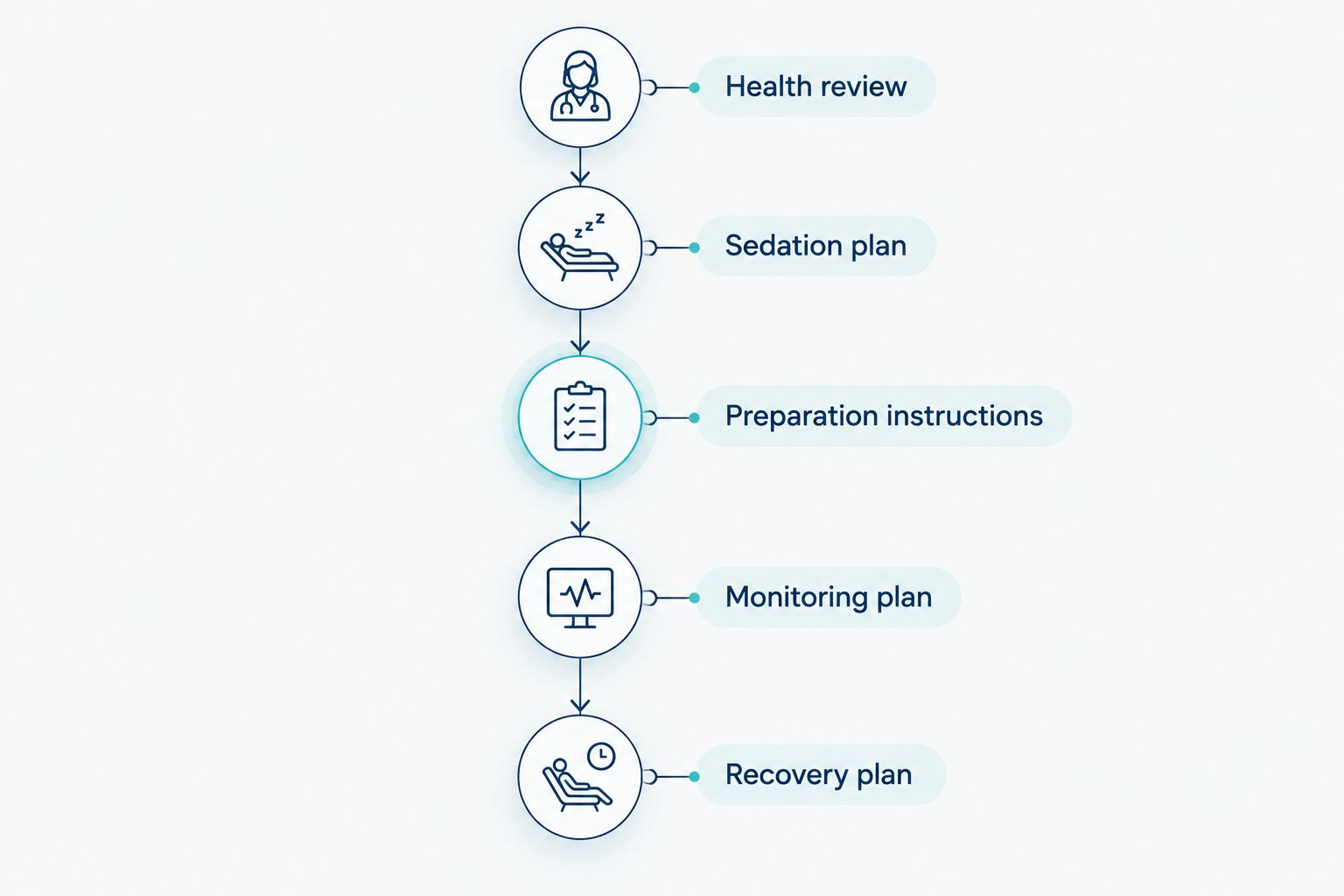
- Health review: Share medical conditions, allergies, medicines, supplements, substance use, pregnancy status, and previous anesthesia experiences. Include medicines you take only occasionally.
- Sedation plan: Confirm the intended depth, how the medicine will be given, and who will administer it. Ask whether local numbing will also be used for pain control.
- Preparation instructions: Get clear directions about eating, drinking, and regular medicines. Fasting rules differ by sedation plan, so do not guess or borrow someone else's instructions.
- Monitoring plan: Ask who will watch your breathing, oxygen level, circulation, and responsiveness. Monitoring should match the planned sedation and your health needs.
- Recovery plan: Clarify discharge requirements, transportation, supervision at home, and whom to contact with concerns. Arrange these before treatment day rather than while you are drowsy afterward.
A clear plan should make responsibilities understandable: what you need to disclose, what the clinical team will monitor, and what your companion needs to know afterward.
You should be able to ask these questions without feeling rushed. If you do not understand an instruction, ask the team to explain it in everyday language before you consent.
What are the risks and side effects?
Temporary effects can include drowsiness, dizziness, nausea, and patchy memory. The exact effects depend on the medicines used, the depth of sedation, and your individual response.
More serious complications include breathing problems, reduced oxygen levels, significant blood-pressure changes, allergic reactions, and aspiration—when stomach contents enter the airway. These risks are why screening, preparation instructions, monitoring, and emergency readiness matter.
Ask about the risks that apply to you, not just the side effects listed for the medicine. A patient with untreated sleep apnea needs a different discussion from a patient without breathing concerns, even if the proposed medicine is the same.
Is sedation dentistry safe if I have sleep apnea?
Sleep apnea requires an individualized sedation assessment because sedating medicines can worsen airway obstruction and breathing problems. Tell the dental team about your diagnosis, prescribed treatment, and any previous problems during sedation.
Bring up loud snoring or witnessed pauses in breathing even if you have not received a diagnosis. The team can decide whether further medical assessment, different precautions, or a different treatment setting is appropriate.
Can I drive home after dental sedation?
After oral or IV sedation, arrange a responsible adult to take you home and follow the provider's supervision instructions. Feeling awake does not prove that your judgment, coordination, or reaction time has returned to normal.
Nitrous oxide alone has different recovery considerations, but you still need the treating clinician's discharge instructions. Do not assume you can drive, work, care for children alone, or make important decisions immediately afterward.
What should I do after I get home?
Keep your written recovery instructions where your companion can find them. Follow the directions about food, drinks, activity, medicines, and supervision rather than using a generic recovery timetable.
Contact the treating team about unexpected symptoms or recovery that does not match its instructions. Call 911 for trouble breathing, blue or gray lips, inability to wake normally, or another immediate medical emergency.
Do not add alcohol, recreational substances, or extra sleep medicine during recovery. Ask the provider how to handle prescribed medicines that cause drowsiness, and take only what the care team has instructed.
FAQ
Is sedation dentistry safe in 2026?
Sedation dentistry is generally safe with appropriate patient screening, qualified providers, monitoring, and recovery precautions. Your health, medicines, and intended sedation depth determine the precautions you need; no sedation is risk-free.
Will I be asleep during sedation dentistry?
You are not necessarily asleep during sedation dentistry. Minimal and moderate sedation preserve responsiveness, while general anesthesia makes you unconscious; ask which level is planned rather than relying on the phrase sleep dentistry.
Is laughing gas safer than taking a sedation pill?
Laughing gas and oral sedatives have different effects and recovery requirements, so the safer choice depends on your health and the intended sedation depth. A pill is not automatically a lighter or safer option because it avoids an IV.
Does sedation replace the numbing injection?
Sedation does not automatically replace local numbing for dental pain control. Sedation primarily changes anxiety, awareness, or responsiveness, while local anesthesia numbs the treatment area; your dentist should explain the proposed combination.
Can children have dental sedation safely?
Children can receive dental sedation with appropriate pediatric assessment, qualified providers, monitoring, and recovery supervision. Ask who is responsible for monitoring your child and what training the team has for pediatric emergencies.
Can I take my usual anxiety medicine before dental sedation?
Take your usual anxiety medicine only according to the instructions agreed with your treating team. Combining sedating medicines can increase impairment and breathing risks, so disclose the medicine and dose rather than taking an extra dose yourself.
Does Smile Theory offer sedation dentistry?
Ask Smile Theory directly which sedation services, if any, are available and who provides them. Confirm the intended sedation level, provider qualifications, monitoring, and recovery arrangements before scheduling treatment around sedation.
One last thing
A sedation method tells you how medicine enters your body; a sedation level tells you how deeply it affects you. Oral, inhaled, and IV describe delivery—not a guarantee of how awake you will remain.
If dental treatment is on your 2026 calendar, bring one question to your visit: What level of sedation are you planning, and what happens if I become more deeply sedated? That answer connects your comfort goals with the safety plan you deserve to understand.


