
Best overall for a suitable adult: an implant-supported crown. Best when neighboring teeth already need crowns: a conventional bridge. Best fixed option that preserves more neighboring tooth structure: a resin-bonded bridge. This 2026 guide also compares removable replacements and temporary options so you can discuss the right fit with your dentist.
- The best option to replace a missing tooth depends on bone, gum health, neighboring teeth, and your preferences.
- An implant-supported crown replaces a single tooth without using neighboring teeth as supports.
- A conventional dental bridge deserves consideration when adjacent teeth already need crowns.
- Removable partial dentures and temporary flippers serve different needs; neither is an implant equivalent.
- Mysmiletheory offers restorative dental care for local patients in Spring, Texas.
Why this matters
A missing tooth affects more than the space you see in a photograph. Depending on its location, the gap can affect chewing, speech, and how your teeth meet. Neighboring teeth can also shift, although the effect differs from person to person.
The right replacement should fit your mouth, not just fill the space. A healthy front-tooth gap, a missing back tooth, and a gap beside heavily restored teeth deserve different conversations.
Mysmiletheory offers general, cosmetic, restorative, and family dentistry in Spring, Texas. Mysmiletheory is a local option for patients seeking personal restorative dental care.
What makes the best single-tooth replacement?
For a 2026 treatment decision, use these criteria before comparing the options:
- Neighboring tooth preservation: Does treatment leave healthy adjacent teeth untouched, or require reshaping them?
- Bone and gum health: Is the supporting tissue healthy enough for the proposed replacement?
- Everyday function: Will the replacement suit the tooth's location and the forces of your bite?
- Appearance: Can the tooth shape, shade, and gumline fit naturally with your smile?
- Cleaning and maintenance: Can you comfortably clean around or underneath the replacement?
- Treatment preferences: Are you comfortable with surgery, healing, or removing an appliance each day?
A dental examination and appropriate imaging establish which choices fit. Tell your dentist what matters most to you: keeping healthy teeth intact, avoiding surgery, improving chewing, or feeling comfortable smiling again.
Single-tooth replacements at a glance
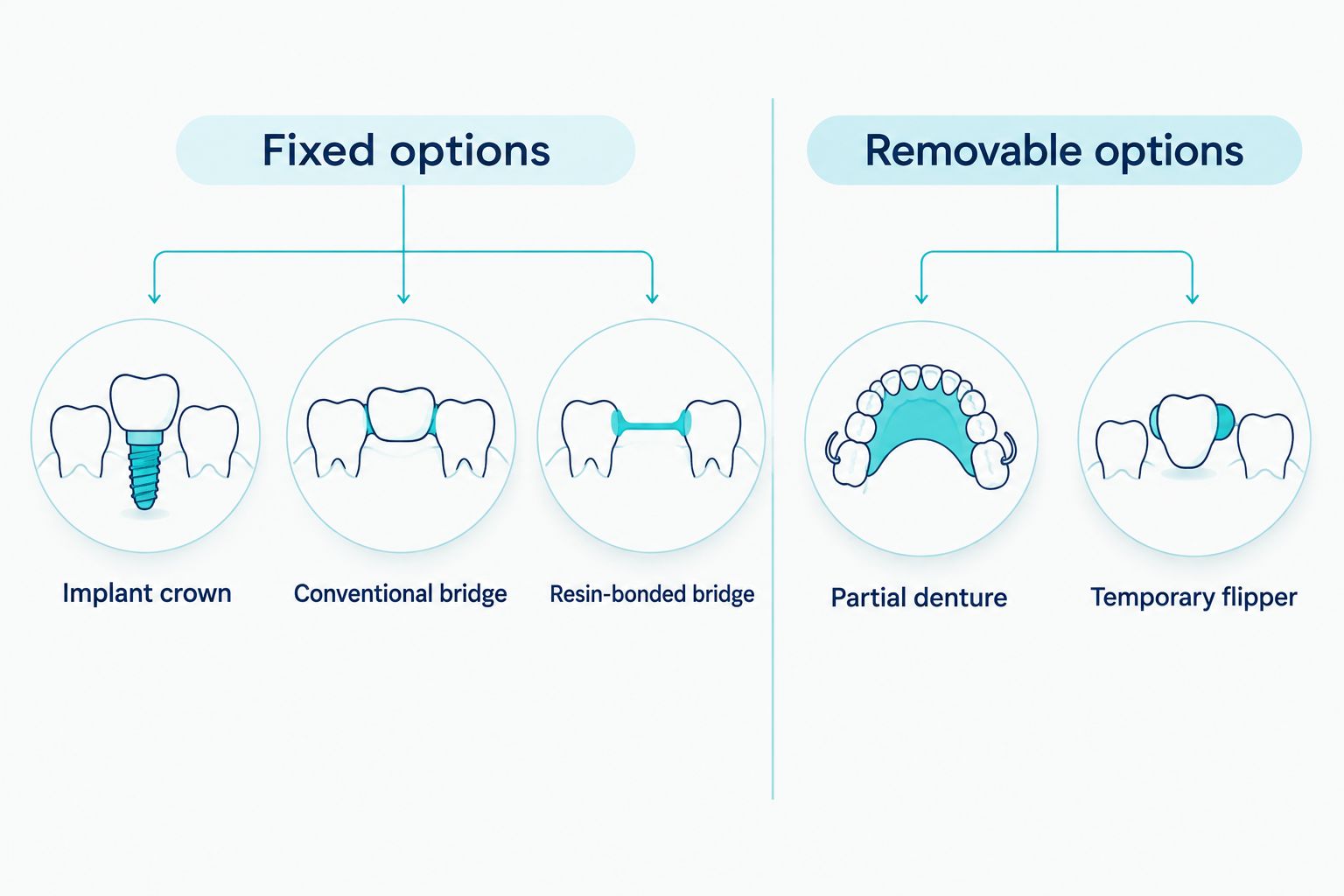
These are treatment categories, not interchangeable products. The table compares their usual roles; your dentist determines which are appropriate for your mouth.
| Option | Best for | Standout feature | Key limitation |
|---|---|---|---|
| Implant crown | Suitable adults wanting an independent fixed replacement | Supported by an implant rather than neighboring teeth | Requires surgery and suitable supporting bone |
| Conventional bridge | Gaps beside teeth that already need crowns | Fixed replacement supported by adjacent teeth | Requires preparation of supporting teeth |
| Resin-bonded bridge | Selected front-tooth gaps beside healthy teeth | Bonded support generally requires less tooth preparation | Can come loose; suitability depends on the bite |
| Partial denture | Patients seeking a removable, nonsurgical replacement | Can replace a missing tooth without implant placement | Must be removed and cleaned; fit needs attention |
| Temporary flipper | An interim appearance solution during treatment | Removable tooth replacement while a longer-term plan develops | Not a substitute for a definitive functional replacement |
Fixed options stay in your mouth during normal daily use. Removable options come out for cleaning and as directed by your dentist. That practical difference often helps you narrow the conversation before discussing treatment details.
1. Implant crown: best for an independent fixed replacement
An implant-supported crown uses a replacement root placed in the jawbone to support an artificial tooth. Unlike a conventional bridge, it does not use the neighboring teeth as its supports. This makes it an important option when those teeth are healthy.
An implant crown is often the strongest starting point for a 2026 discussion when you want a fixed replacement and are suitable for surgery. It is not the automatic answer for every gap: bone, gum health, medical history, and the available space all matter.
Implant crown pros:
- Does not require crowning neighboring teeth solely to support the replacement.
- Stays in place during eating and cleaning.
- Allows the replacement tooth to function independently of adjacent teeth.
- Can be planned to match the surrounding tooth shapes and shade.
Implant crown cons:
- Requires a surgical procedure and healing.
- Insufficient bone or other health factors can complicate the plan.
- Needs ongoing cleaning and professional monitoring; implants are not maintenance-free.
What to discuss before choosing an implant
Ask whether you need additional treatment before placement and how the dentist will evaluate your bite. Also ask what will fill the visible gap during treatment, if that matters to you. A temporary tooth and the final implant crown serve different purposes.
Best for: Adults with suitable bone and gum health who want a fixed replacement without preparing healthy neighboring teeth.
Verdict: Choose an implant crown when your examination supports it and preserving neighboring teeth is a priority.
2. Conventional bridge: best when adjacent teeth need crowns
A conventional bridge fills the gap with an artificial tooth attached to crowns on supporting teeth. A common single-tooth design is a 3-unit bridge: the replacement tooth plus crowns on 2 neighboring teeth. Designs vary with the location and condition of the supporting teeth.
A bridge deserves particular attention when those neighboring teeth already need substantial restoration. When both are healthy and untouched, preparing them to support a bridge is a more significant trade-off.
Conventional bridge pros:
- Provides a fixed replacement without implant-placement surgery.
- Can address the gap alongside teeth that already need crowns.
- Does not need to be removed for everyday use.
- Can be shaped and shaded to blend with nearby teeth.
Conventional bridge cons:
- Requires reshaping the supporting teeth.
- Depends on the health of those teeth and their supporting tissues.
- Requires cleaning underneath the replacement tooth, not just brushing its visible surfaces.
What to discuss before choosing a bridge
Ask why each proposed supporting tooth is suitable. A tooth with decay, gum problems, or an uncertain outlook needs careful assessment before it becomes part of the bridge.
You should also ask your dentist to demonstrate cleaning beneath the replacement tooth. A fixed bridge can feel convenient, but its connected design creates cleaning needs that a separate natural tooth does not have.
Best for: Patients whose teeth beside the gap already need crowns and can support a fixed replacement.
Verdict: Choose a conventional bridge when restoring the neighboring teeth is already part of the plan.
3. Resin-bonded bridge: best for selected front-tooth gaps
A resin-bonded bridge holds an artificial tooth in place using a bonded support attached to a neighboring tooth or teeth. Dentists sometimes call this a Maryland bridge, although designs differ. It generally requires less removal of tooth structure than a conventional bridge.
This option deserves consideration for certain front-tooth gaps beside healthy teeth. The available enamel, position of the gap, and contact between your upper and lower teeth determine whether the bonded support has a suitable place to sit.
Resin-bonded bridge pros:
- Generally preserves more neighboring tooth structure than a conventional bridge.
- Provides a fixed replacement without implant-placement surgery.
- Can suit a visible gap when the supporting teeth and bite are appropriate.
Resin-bonded bridge cons:
- The bonded support can detach and require attention.
- Not appropriate for every bite or tooth location.
- The supporting material can affect appearance in some designs.
What to discuss before choosing a bonded bridge
Ask whether the replacement would be a definitive treatment or an interim solution in your case. The same treatment category can serve different roles, so you should understand the plan before agreeing to it.
Ask your dentist to explain how your bite contacts the replacement. A less invasive preparation is valuable only when the resulting bridge is suitable for the forces it will face.
Best for: Selected front-tooth gaps where preserving healthy adjacent tooth structure is a priority.
Verdict: Choose a resin-bonded bridge only after your dentist confirms that the supporting enamel and bite are suitable.
4. Partial denture: best for a removable, nonsurgical approach
A removable partial denture carries an artificial tooth on an appliance that you take out for cleaning. Its design depends on the gap and the remaining teeth. For a single missing tooth, your dentist should explain whether its size and support make sense for your needs.
This option can suit someone who does not want implant surgery or prefers a removable replacement. It is not simply a fixed bridge that comes out: the appliance has a different feel, support system, and care routine.
Partial denture pros:
- Does not require implant-placement surgery.
- Can restore the appearance of a missing tooth.
- Comes out for direct cleaning of the appliance.
Partial denture cons:
- Can feel bulkier than a fixed replacement.
- Retaining components can be visible, depending on the design.
- Fit and comfort need review as the mouth changes.
What to discuss before choosing a partial denture
Ask how the appliance will be held in place and whether any supporting components will show when you smile. Discuss eating, speaking, and removal before treatment, rather than judging the option on appearance alone.
Follow your dentist's instructions for wear and cleaning. Do not bend the retaining components or attempt to adjust a sore area yourself; a small fitting problem needs a professional assessment.
Best for: Patients who prefer a removable replacement or need a nonsurgical alternative to an implant.
Verdict: Choose a partial denture when its removable design fits your needs and you accept the daily care routine.
5. Temporary flipper: best while awaiting definitive treatment
A flipper is a lightweight removable partial denture commonly used as a temporary tooth replacement. It can fill a visible gap while tissues heal or while you and your dentist complete a longer-term plan. It belongs on this list as an interim option, not as a separate permanent treatment category.
For a 2026 treatment plan, distinguish looking complete during treatment from having a definitive replacement. A flipper can help with the first goal without resolving the second.
Temporary flipper pros:
- Can fill a visible gap during an interim stage.
- Is removable for cleaning.
- Does not require implant placement to provide a temporary appearance solution.
Temporary flipper cons:
- Can be fragile or feel bulky.
- Eating restrictions depend on its design and your treatment stage.
- Needs review as healing changes the shape of the supporting tissues.
Best for: Patients who want a temporary appearance solution while preparing for another replacement.
Verdict: Use a temporary flipper as a bridge between treatment stages, not as an assumed long-term answer.
How these options are ranked
This ranking prioritizes preserving healthy neighboring teeth, providing useful everyday function, and matching treatment to the condition of your mouth. It does not rank options by appearance alone.
The American Dental Association's MouthHealthy patient guidance explains implants, bridges, and dentures as tooth-replacement approaches. This 2026 comparison applies those general distinctions to a single missing tooth; it does not replace an examination or diagnose your suitability.
Which single-tooth replacement should you choose?
Start by asking whether an implant-supported crown is appropriate, then compare the alternatives against your actual tooth and gum health. If neighboring teeth already need crowns, a conventional bridge deserves a close look. For selected front-tooth gaps, ask about a resin-bonded bridge.
Choose a removable partial denture when a removable, nonsurgical approach fits your needs. Keep a temporary flipper in its proper role: helping with the gap while a definitive plan takes shape.
Bring these questions to your appointment:
- What condition are the teeth beside the gap in?
- Which choices preserve the most healthy tooth structure?
- What would I need to clean each day?
- How will the replacement fit my bite and smile?
- Is the proposed replacement temporary or definitive?
At Mysmiletheory, you can begin with a conversation about restorative dental care and the result you want. You do not need to arrive with a treatment already chosen.
Discuss your missing tooth
Start with your concerns, preferences, and questions about restorative dental care in Spring, Texas.
FAQ
What's the best option to replace a missing tooth in 2026?
An implant-supported crown is often the leading fixed option for a suitable adult because it does not rely on neighboring teeth for support. A bridge or removable replacement can be more appropriate when bone, health, bite, or personal preferences point elsewhere.
Is an implant better than a bridge for one missing tooth?
An implant has an important advantage when the neighboring teeth are healthy: they do not need to be crowned to support it. A conventional bridge deserves consideration when those teeth already need crowns or implant treatment is unsuitable.
Can I replace one missing tooth without surgery?
Yes, a conventional bridge, resin-bonded bridge, or removable partial denture can replace a tooth without implant-placement surgery. Suitability depends on your remaining teeth, gums, bite, and the location of the gap.
What's the best replacement for a missing front tooth?
An implant crown or a resin-bonded bridge can be appropriate for a missing front tooth, depending on your mouth. Your dentist should assess the gumline, supporting tissue, adjacent teeth, and bite before recommending either.
Can veneers replace a missing tooth?
No, veneers cover the front surfaces of existing teeth; they do not replace a tooth that is absent. A missing-tooth gap needs a replacement approach such as an implant crown, bridge, or removable appliance.
Can I wear a temporary tooth while an implant heals?
A temporary replacement is possible in some implant treatment plans. Your dentist must choose a design that fits your treatment stage and does not place unsuitable pressure on the healing area.
Does a replacement tooth need special cleaning?
Yes, the cleaning method depends on the replacement. Bridges need cleaning underneath the artificial tooth, implants need careful cleaning around their supporting tissues, and removable appliances need separate cleaning.
Can I leave a missing tooth untreated?
Some gaps can be monitored, but that decision needs a dental assessment. The location of the missing tooth, your bite, chewing needs, and the condition of nearby teeth determine whether observation is appropriate.
One last thing
A tooth that looks natural is only part of a successful replacement. Ask your dentist to show you how you will clean the proposed option before you choose it. Understanding that routine helps you make a decision you can live with every day.
For your 2026 appointment at Mysmiletheory, bring the concern that matters most to you, whether that is smiling, chewing, or avoiding treatment you do not understand. A useful plan starts with your mouth and your priorities—not with a predetermined winner.