Best overall when teeth can be saved: tooth-preserving rehabilitation. Best fixed alternative for a toothless arch: a six-implant bridge. Best removable implant option: an implant overdenture. The best all on 4 alternatives depend on your remaining teeth, bone support, and daily care needs—not simply the number of implants. For a personal starting point in Spring, Texas, Mysmiletheory offers general and restorative dental care.
- All on 4 alternatives include tooth-preserving rehabilitation, six-implant bridges, implant overdentures, conventional dentures, and tooth-supported bridges.
- Save healthy natural teeth when they can support a dependable full-mouth restoration.
- A six-implant bridge is a fixed option; more implants do not automatically make treatment better.
- Implant overdentures offer added retention but require removal and cleaning.
- Mysmiletheory offers general and restorative dental care for patients seeking a personal dentist in Spring.
Why this matters
All-on-4 generally describes a fixed full-arch replacement supported by four implants per arch. It replaces a complete upper or lower set of teeth, rather than repairing individual teeth. Full-mouth restoration can involve both arches, but it does not always require removing every remaining tooth.
For a 2026 treatment decision, start with what needs restoring: missing teeth, damaged teeth, an uncomfortable bite, or a combination. Healthy, maintainable teeth deserve a preservation discussion before you commit to full-arch extraction.
Mysmiletheory fits Spring patients seeking a personal dentist for general and restorative dental care. A dental examination is the next step for understanding your needs; suitability for a particular implant procedure requires its own assessment.
What makes the best all on 4 alternatives?
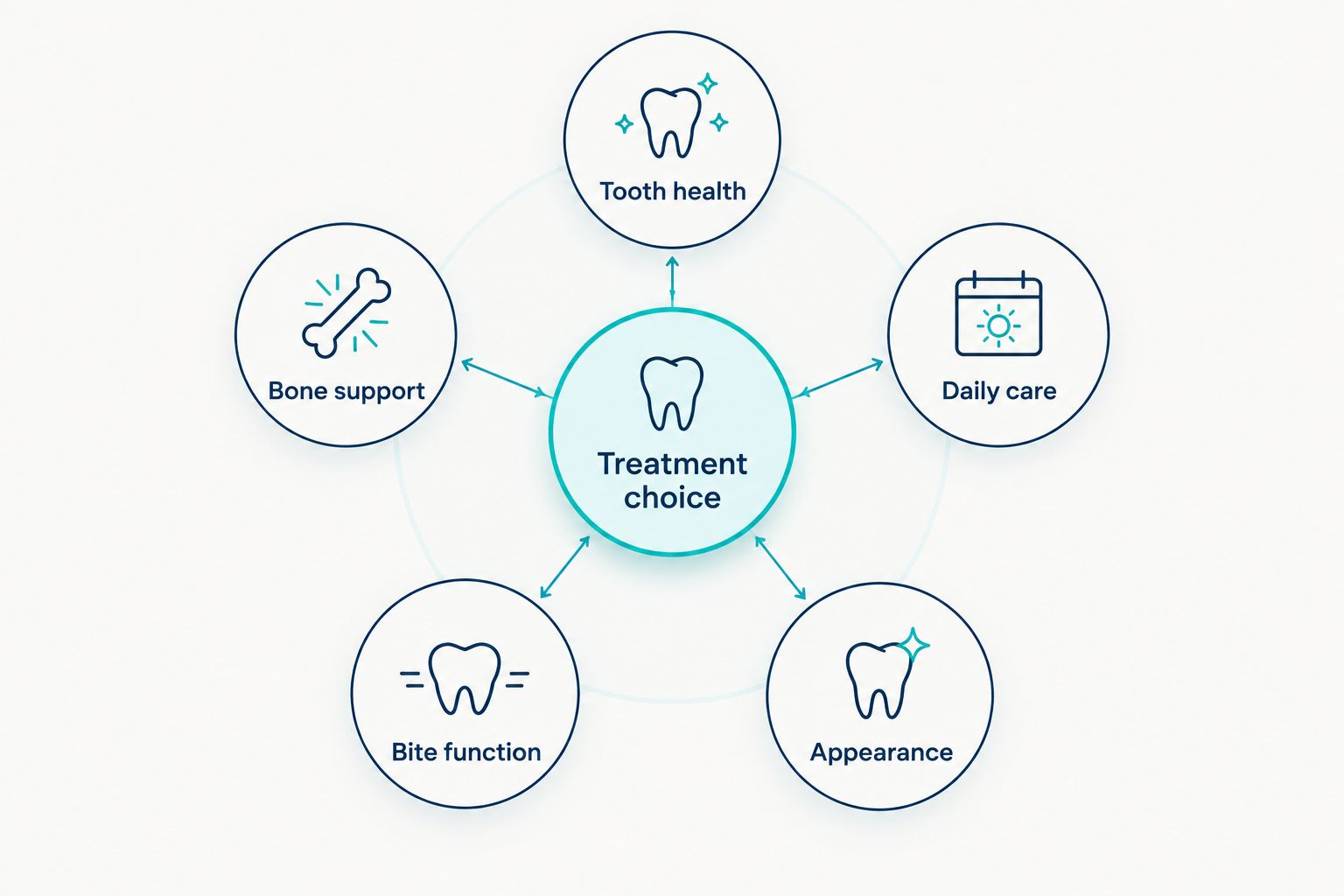
The right option needs to work in your mouth and in your daily routine. Compare these criteria before comparing treatment names:
- Tooth health: Which teeth have a dependable outlook, and which cannot be maintained?
- Bone support: Is there enough suitable bone for the proposed implant positions, or does the plan require additional procedures?
- Daily care: Can you clean beneath a fixed bridge, or would removing the replacement make cleaning more manageable?
- Bite function: How will the restoration meet the opposing teeth and distribute chewing forces?
- Appearance: Does the plan address tooth shape, gum display, and lip support—not just tooth color?
- Treatment choice: Does the proposed approach match your preference for fixed teeth, removable teeth, or preserving natural teeth?
These considerations belong in the same conversation. A restoration that looks appealing but is difficult for you to clean is not a good long-term fit.
All on 4 alternatives at a glance
This 2026 comparison separates complete-arch replacements from approaches that depend on remaining natural teeth. The row order reflects the recommendations below, not a claim that one treatment suits everyone.
| Option | Best for | Standout feature | Key limitation |
|---|---|---|---|
| Tooth-preserving rehabilitation | Restoring damaged but maintainable teeth | Builds treatment around natural teeth | Depends on each tooth’s long-term outlook |
| Six-implant fixed bridge | Fixed replacement of a toothless arch | Uses six implants per arch to support a bridge | Requires suitable implant sites and surgical assessment |
| Implant overdenture | Removable teeth with added retention | Connects a removable denture to implants | Attachments and surrounding tissues need ongoing care |
| Conventional full dentures | Complete tooth replacement without implant surgery | Removable replacement for a full arch | Stability depends on fit and the supporting mouth tissues |
| Tooth-supported bridges | Replacing separate gaps between suitable teeth | Fixed replacement supported by natural teeth | Cannot replace a toothless arch without supporting teeth |
1. Tooth-preserving rehabilitation: best for saving natural teeth
Tooth-preserving rehabilitation restores the teeth that can reasonably remain. Depending on your examination, it can combine fillings, crowns, gum treatment, root canal treatment, and replacement of missing teeth. The plan addresses your mouth as a whole without assuming that every tooth needs extraction.
This is the first option to discuss when your main concern is extensive damage rather than complete tooth loss. A tooth that looks badly damaged is not automatically beyond repair; its roots, remaining structure, and gum support matter.
Tooth-preserving rehabilitation pros:
- Keeps natural teeth that have a dependable outlook.
- Allows treatment to address different problems individually.
- Avoids extracting teeth solely to create a uniform replacement plan.
- Can combine repair and tooth replacement where needed.
Tooth-preserving rehabilitation cons:
- Cannot rescue teeth with an unsuitable long-term outlook.
- Can involve several types of treatment and multiple appointments.
- Remaining teeth still need protection against decay and gum disease.
Best for: You have damaged or worn teeth, but an examination identifies teeth worth keeping.
Ask your dentist to explain the outlook for each tooth. Separate teeth that are maintainable from those that are uncertain or cannot be saved, then discuss how each group affects the complete plan.
Verdict: Hold off on full-arch extraction until tooth-preserving rehabilitation has been assessed.
2. Six-implant fixed bridge: best for a fixed toothless-arch replacement
A six-implant fixed bridge replaces a complete arch with a bridge supported by six implants per arch. You do not remove the bridge for routine cleaning, although a dental professional can remove certain designs when clinically necessary. It belongs in the discussion when you need a complete replacement and prefer fixed teeth.
The difference from All-on-4 is not just adding implants. Implant positions, available bone, bridge design, and your bite determine whether the proposed arrangement makes sense.
Six-implant fixed bridge pros:
- Provides a fixed replacement for a complete arch.
- Uses additional implant support when the anatomy and design suit it.
- Does not require daily removal of the bridge.
Six-implant fixed bridge cons:
- Requires implant surgery and suitable supporting bone.
- Needs careful cleaning beneath and around the bridge.
- More implants do not guarantee a better result.
Best for: You need a complete-arch replacement, want fixed teeth, and have suitable implant sites following assessment.
For your 2026 consultation, ask why six implants are being recommended for your mouth. The answer should explain support, placement, and the planned bridge—not simply describe six as better than four.
Verdict: Consider a six-implant fixed bridge when the proposed support and cleaning plan fit your anatomy.
3. Implant overdenture: best for removable teeth with added retention
An implant overdenture is a removable denture that connects to implants. You take it out for cleaning, while the implants and connecting components remain in your mouth. Designs differ in how much support comes from implants versus the gums.
A lower overdenture can use two implants, but that is not a universal prescription for every arch or patient. Your dentist must assess the jaw, opposing teeth, and proposed denture design before recommending an implant arrangement.
Implant overdenture pros:
- Adds implant retention to a removable denture.
- Allows you to remove the denture for cleaning.
- Can help address movement associated with conventional dentures.
- Offers an alternative when daily removability is a preference.
Implant overdenture cons:
- Still requires implant surgery.
- Connecting attachments can wear and need maintenance.
- You must clean the denture, attachments, and implant areas.
Best for: You want more retention than a conventional denture provides and are comfortable removing your teeth for daily care.
Ask to see how the denture comes out and reconnects. If you have difficulty with hand strength or coordination, discuss whether the attachment system and cleaning routine are manageable for you.
Verdict: Consider an implant overdenture when added retention and removable cleaning match your priorities.
4. Conventional full dentures: best for avoiding implant surgery
Conventional full dentures replace all teeth in an arch without using implants. They rest on the supporting mouth tissues and are removable. If teeth still need extraction, avoiding implants does not mean avoiding all dental surgery.
Full dentures deserve a fair comparison rather than an automatic dismissal. Their suitability depends on the shape of your mouth, the fit of the denture, your expectations, and your ability to adapt to removable teeth.
Conventional full dentures pros:
- Replace a complete arch without implant placement.
- Can restore the appearance of teeth and provide lip support.
- Come out for cleaning and examination of the underlying tissues.
Conventional full dentures cons:
- Can move during eating or speaking, particularly in the lower jaw.
- Require adaptation to chewing and speech.
- Can need adjustments or relining as the supporting tissues change.
Best for: You need complete tooth replacement and prefer not to pursue implant surgery, or implant treatment is unsuitable after assessment.
Ask what fit and stability are realistic for your upper and lower arches separately. A comfortable upper denture does not predict the same experience with a lower denture because the supporting anatomy differs.
Verdict: Consider conventional full dentures when avoiding implant placement is your priority and the expected limitations are acceptable.
5. Tooth-supported bridges: best for separate gaps with healthy support
A tooth-supported bridge replaces missing teeth by connecting the replacement to suitable natural teeth beside the gap. It is fixed rather than removed each day. Several bridges can form part of a wider restorative plan when enough dependable teeth remain.
This is not a replacement for an entirely toothless arch. It is an alternative to treating the whole arch as lost when your actual problem is a series of gaps between maintainable teeth.
Tooth-supported bridges pros:
- Provide fixed replacement for selected missing teeth.
- Do not require implant placement for the bridge itself.
- Can fit into a broader tooth-preserving treatment plan.
Tooth-supported bridges cons:
- Usually require reshaping the supporting teeth.
- Depend on the health of those teeth and their gum support.
- Need cleaning underneath the replacement teeth.
Best for: You have separate gaps and suitable natural teeth to support fixed replacements.
Ask whether the supporting teeth already need crowns or would otherwise remain largely untouched. That distinction helps you understand what the bridge adds and what it asks of your existing teeth.
Verdict: Consider tooth-supported bridges for suitable gaps; skip them as a standalone solution for a toothless arch.
How these options are ranked
The ranking puts tooth preservation first when it is clinically reasonable, then separates complete-arch options by fixed versus removable design. Tooth-supported bridges have a narrower role because they require remaining teeth.
This is a decision guide, not a substitute for an examination. In 2026, the useful question remains the same: which restoration can your mouth support, and which can you comfortably maintain?
Which full-mouth restoration should you choose?
Start with tooth-preserving rehabilitation if dependable natural teeth remain. If an arch is already toothless or its remaining teeth cannot be maintained, compare fixed implant replacement, implant overdentures, and conventional dentures.
Bring these questions to your appointment:
- Which teeth can stay, and why?
- Is the proposed replacement fixed or removable?
- How will I clean it at home?
- What maintenance does the design require?
- What are the alternatives if I do not want implant surgery?
- Who will coordinate the different parts of treatment?
Mysmiletheory offers general, cosmetic, restorative, and family dentistry in Spring. You can begin by discussing your concerns and asking what assessment or additional care your situation requires, without assuming that a particular implant procedure is offered.
Discuss your restorative care needs
Start with your concerns, the teeth you hope to keep, and the daily care routine you want.
FAQ
What are the best all on 4 alternatives in 2026?
The main all on 4 alternatives are tooth-preserving rehabilitation, six-implant fixed bridges, implant overdentures, conventional full dentures, and tooth-supported bridges for suitable gaps. The best choice depends on your remaining teeth, bone support, and preference for fixed or removable teeth.
Is a six-implant bridge better than All-on-4?
A six-implant bridge is not automatically better than All-on-4. Implant position, supporting bone, bridge design, bite forces, and cleaning access matter more than implant count alone.
Can I keep my natural teeth instead of getting All-on-4?
You can keep natural teeth when an examination finds that they can be restored and maintained. Ask for an explanation of each tooth’s outlook before agreeing to full-arch extraction.
Are implant overdentures fixed or removable?
Implant overdentures are removable. They connect to implants for retention, and you remove them to clean the denture and the connecting areas.
Can I replace all my teeth without implants?
Conventional full dentures can replace all teeth in an arch without implants. If teeth remain, tooth-preserving treatment or tooth-supported bridges can also have a role, depending on their condition.
Do all full-mouth restorations require removing every tooth?
Full-mouth restoration does not always require removing every tooth. Treatment can combine repair of maintainable teeth with replacement of missing teeth.
Should I choose veneers instead of an implant bridge?
Veneers are not a substitute for an implant bridge when teeth are missing. Veneers change the visible surface of existing teeth, while full-arch replacements address tooth loss.
Where can I start discussing restorative dental care in Spring?
Mysmiletheory offers general and restorative dental care in Spring, Texas. Discuss your symptoms, concerns, and goals, then ask what examination and treatment planning your situation needs.
One last thing
Your upper and lower arches do not have to receive the same treatment. One arch might need complete replacement while the other has teeth worth preserving.
Ask for a plan for each arch before accepting a plan for your whole mouth. That small distinction keeps the conversation focused on your actual needs rather than a treatment label.