
Best for small shape changes: dental bonding. Best for changing several visible teeth: veneers. Best for crowded teeth: orthodontics. The right cosmetic dentistry for face shape starts with your teeth, bite, and preferences—not a rule that assigns every face a particular smile. This 2026 guide explains what each option changes and what to discuss before choosing treatment.
- Cosmetic dentistry for face shape should address tooth proportions and bite, not follow a face-shape formula.
- Dental bonding suits small chips and uneven edges; veneers address broader changes to visible tooth surfaces.
- Orthodontics changes tooth position; whitening changes color, not tooth shape.
- Mysmiletheory offers cosmetic dentistry for Spring patients seeking a personal dentist.
Why this matters
A smile can look different after changing tooth length, position, or color. Those changes do not mean cosmetic treatment reshapes your facial bones, and a round or square face does not establish a dental diagnosis.
For patients considering dental services at Mysmiletheory, the useful starting point is simple: name what bothers you about your teeth. An uneven edge needs a different conversation from crowding, staining, or worn teeth.
Choose treatment for the concern you can identify, not the face-shape label you have been given.
What makes the best cosmetic dentistry for face shape?
Use these criteria to compare recommendations in 2026:
- Healthy foundation: Cavities, gum disease, and unexplained pain need evaluation before cosmetic changes.
- Tooth preservation: Ask how much healthy tooth structure each option changes or removes.
- Bite compatibility: A pleasing shape still needs to work when you chew and move your jaw.
- Natural proportions: Consider tooth width, length, edges, and how much tooth shows when you smile.
- Personal preference: Your preferred appearance matters more than a standard smile template.
- Ongoing care: Understand cleaning, maintenance, possible repairs, and whether treatment is reversible.
Face shape belongs in this discussion as visual context. It should not outweigh oral health or become a reason to alter healthy teeth unnecessarily.
Cosmetic dentistry options at a glance
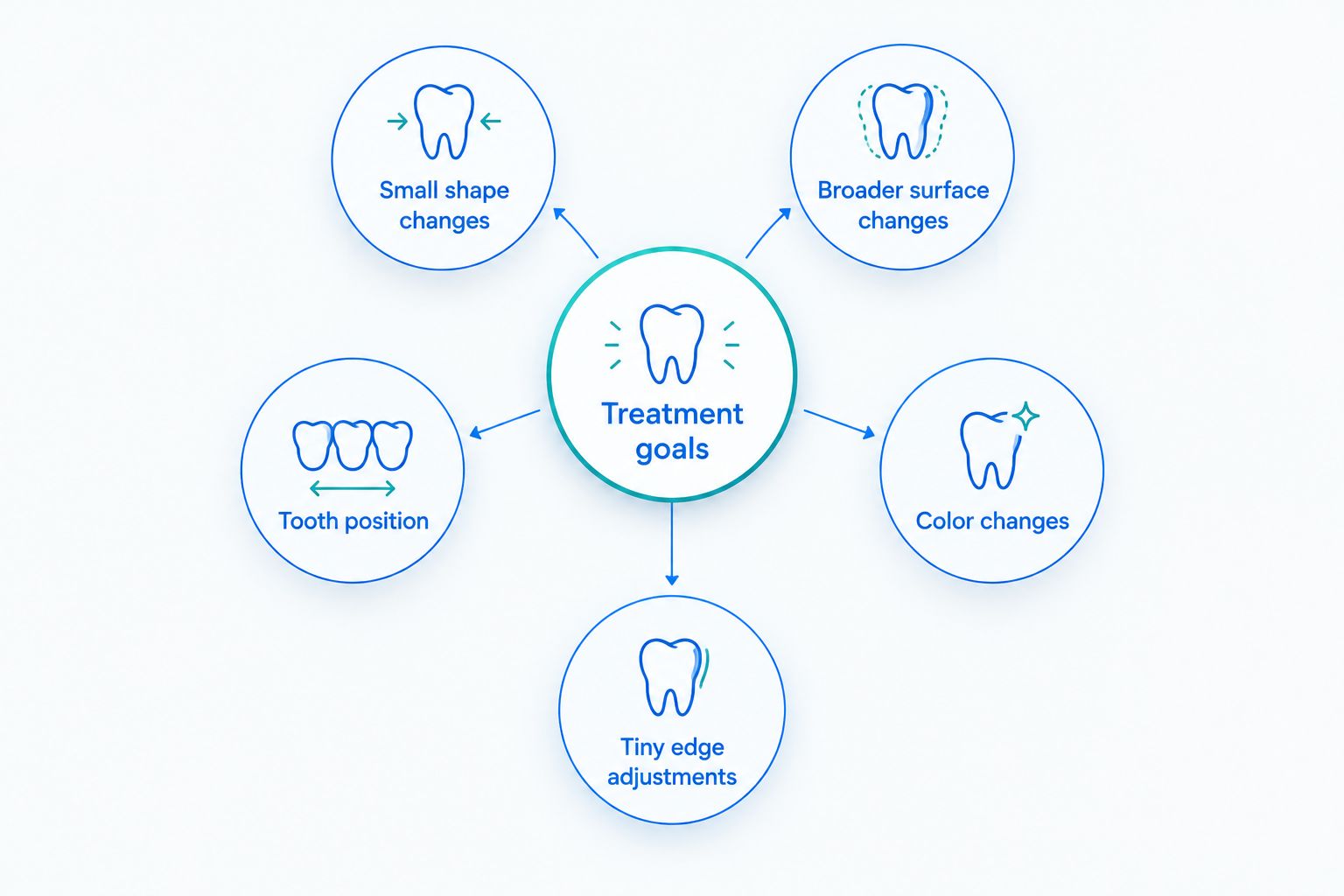
These rankings separate different treatment goals rather than claim that one procedure is best for everyone. The main distinction is whether you want to change tooth shape, tooth position, or color.
| Option | Best for | Standout feature | Key limitation |
|---|---|---|---|
| Dental bonding | Small shape changes | Adds tooth-colored material to selected areas | Can chip or stain |
| Veneers | Broader surface changes | Changes the visible front surfaces of teeth | Often requires irreversible enamel removal |
| Orthodontics | Tooth position | Moves teeth rather than covering their position | Requires treatment time and retention |
| Teeth whitening | Color changes | Lightens natural teeth without reshaping them | Does not whiten existing restorations |
| Enamel contouring | Tiny edge adjustments | Smooths selected areas of enamel | Removes enamel permanently |
The smallest visible concern does not always call for the smallest procedure. A chipped edge caused by an uneven bite, for example, needs an explanation before a cosmetic repair.
1. Dental bonding: best for small shape changes
Dental bonding uses tooth-colored resin to adjust selected areas of a tooth. It can repair a small chip, build up an uneven edge, or close a suitable small gap without covering the entire front surface.
Best for: A localized concern when you otherwise like your smile.
Bonding lets you discuss a focused adjustment rather than assume several teeth need treatment. Adding material still needs careful planning: extra width or length must fit your bite and leave room for cleaning.
Dental bonding pros:
- Targets a specific edge, chip, or small space.
- Often preserves more tooth structure than veneers.
- Can be repaired when suitable.
Dental bonding cons:
- Resin can stain, wear, or chip.
- Large additions can look bulky or interfere with the bite.
- Bonding does not correct the underlying position of crowded teeth.
Ask why the edge chipped before agreeing to rebuild it. Grinding, decay, or bite pressure can change the treatment plan.
Verdict: Consider dental bonding first for a small, clearly defined shape concern.
2. Veneers: best for broader changes to visible teeth
Veneers cover the front surfaces of teeth to change their appearance. They can address a combination of shape, color, and proportion concerns when a smaller adjustment will not meet your goals.
Best for: Coordinated changes across several visible teeth, after an examination confirms suitability.
Veneers are not automatically the best cosmetic dentistry for face shape. Longer or wider veneers need to fit your existing teeth, lips, speech, and bite—not simply create contrast with your facial outline.
Veneers pros:
- Address several appearance concerns together.
- Allow coordinated planning of visible tooth proportions.
- Offer an alternative for some discoloration that whitening does not adequately address.
Veneers cons:
- Preparation often removes enamel permanently.
- Veneers can chip and eventually need replacement.
- Veneers do not treat gum disease or correct underlying bite problems.
Ask whether a preview or temporary version is appropriate before committing to irreversible changes. A preview helps communicate preferences; it does not guarantee the final result.
Verdict: Hold off on veneers until you understand the tooth preparation and alternatives.
3. Orthodontics: best for changing tooth position
Orthodontic treatment moves teeth to address alignment and bite concerns. Braces or clear aligners can be appropriate when crowding, spacing, or tooth position drives the appearance you dislike.
Best for: Teeth that need repositioning rather than added material or surface coverage.
Straightening teeth and changing their shape are different goals. If teeth overlap, covering the visible surfaces does not remove that overlap or necessarily address the bite.
Orthodontics pros:
- Addresses tooth position directly.
- Avoids covering healthy tooth surfaces solely to disguise alignment.
- Can create a better starting point for later cosmetic adjustments.
Orthodontics cons:
- Requires time, monitoring, and ongoing cooperation.
- Retainers are needed to help maintain tooth position.
- Does not directly change tooth color or repair worn edges.
If you are considering both orthodontics and veneers, discuss the sequence before either begins. Tooth movement can change how much additional cosmetic treatment you want.
Verdict: Consider an orthodontic assessment when position—not tooth shape—is the main concern.
4. Teeth whitening: best for changing color without reshaping
Teeth whitening lightens natural teeth. It does not lengthen teeth, close spaces, or alter facial structure, but it addresses color without covering or reshaping the tooth surface.
Best for: A smile whose shape and alignment you already like.
For someone researching a larger smile change in 2026, color deserves its own conversation. You might find that the issue you notice is staining rather than proportion; an examination helps separate the two.
Teeth whitening pros:
- Focuses treatment on discoloration.
- Does not require reshaping teeth.
- Can help establish a preferred shade before color-matched restorative work.
Teeth whitening cons:
- Can cause temporary sensitivity or gum irritation.
- Does not lighten crowns, veneers, or bonding.
- Results vary with the cause of discoloration.
Tell your dentist about existing restorations before whitening. Natural teeth and restorative materials can respond differently, leaving a shade mismatch.
Verdict: Consider whitening when color is the concern; skip it as a solution for tooth shape.
5. Enamel contouring: best for tiny edge adjustments
Enamel contouring removes a small amount of enamel to smooth or adjust a tooth's outline. It is suited to selected minor irregularities, not substantial shortening or a broad smile redesign.
Best for: A tiny uneven edge when there is sufficient healthy enamel and the bite allows adjustment.
Contouring makes a tooth smaller; bonding adds material. That difference matters when deciding whether an uneven smile needs smoothing, rebuilding, or an investigation into wear.
Enamel contouring pros:
- Targets a limited edge irregularity.
- Uses the existing tooth rather than adding a covering.
- Avoids added bulk.
Enamel contouring cons:
- Removed enamel does not grow back.
- Unsuitable removal can cause sensitivity or weaken a tooth.
- Cannot restore missing length or treat significant damage.
Never file your own teeth. An edge that looks uneven in a mirror still needs assessment for enamel thickness, cracks, and bite contact.
Verdict: Hold off until a dentist confirms that removing enamel is appropriate.
How face shape fits into smile planning
Face-shape categories are descriptive shortcuts, not treatment instructions. For your 2026 consultation, use them to explain a preference rather than request a predetermined tooth design.
Round or square faces
A round face does not automatically need longer teeth, and a square face does not automatically need rounded tooth edges. If you prefer a softer or more defined appearance, discuss the specific edges and proportions you notice.
Your dentist also needs to consider lip movement and how your teeth meet. A shape that looks appealing in a still photograph must remain comfortable in everyday use.
Oval or longer faces
An oval face does not make every veneer shape suitable, and a longer face does not mean teeth should be shortened. Shortening healthy teeth solely to counter a facial outline removes tooth structure without addressing a dental problem.
Start with what is actually visible: tooth length, wear, spacing, gum display, and the way your lips frame your smile.
Heart-shaped or mixed facial outlines
Many people do not fit neatly into a single category. A narrower chin or broader forehead does not establish which dental procedure you need.
Bring 2 photographs of smiles you like and explain the details that appeal to you. Treat those images as conversation starters, not designs your dentist must reproduce.
How these options are ranked
This 2026 guide ranks treatments by distinct concerns, with tooth preservation, bite compatibility, and maintenance in mind. It does not rank them by popularity or suggest that every reader needs treatment.
Dental bonding leads for localized shape changes because it adds material to selected areas. Veneers, orthodontics, whitening, and contouring each serve different purposes; none replaces an individual examination.
Which cosmetic dentistry option should you choose?
If you are undecided, choose an assessment before choosing a procedure. Write down 1 main concern in plain language, such as an uneven front edge or overlapping teeth. That gives your consultation a useful focus.
Mysmiletheory provides general, cosmetic, restorative, and family dentistry in Spring, Texas. You can discuss appearance concerns alongside the health of your teeth and gums, without arriving with a treatment already selected.
Bring these 3 questions:
- What is causing the appearance I want to change?
- Which option preserves the most healthy tooth structure?
- What happens if I leave this alone for now?
Tell the dentist about sensitivity, clenching, previous dental work, and anything that makes appointments difficult. Comfort belongs in the treatment discussion, not just the procedure itself.
Talk through your smile goals
Share what you want to change and ask about an appointment at Mysmiletheory.
FAQ
What's the best cosmetic dentistry for face shape?
The best cosmetic dentistry for face shape depends on the dental concern, not the facial category. Bonding changes selected areas, veneers change visible surfaces, orthodontics moves teeth, and whitening changes color.
Should I get longer veneers if I have a round face?
A round face alone is not a reason to choose longer veneers. Your dentist needs to assess tooth proportions, lip movement, speech, and bite before recommending added length.
Can cosmetic dentistry make my face slimmer?
Routine cosmetic dental treatments do not remove facial fat or narrow facial bones. Changes to tooth appearance should not be presented as a substitute for changing facial structure.
Is bonding better than veneers for a small uneven edge?
Bonding often suits a small uneven edge because it adds material to a selected area. Veneers involve broader surface coverage, and the choice depends on the tooth's condition and bite.
Do square faces need rounded teeth?
Square faces do not require rounded teeth. Edge shape is a personal preference that needs to fit tooth structure and function, not a rule based on jaw outline.
Can whitening improve my smile without changing my teeth's shape?
Whitening changes the color of natural teeth without reshaping them. It does not change the shade of existing crowns, veneers, or bonding, so those restorations need consideration first.
What should I bring to a cosmetic dental consultation in 2026?
Bring a clear description of your main concern, relevant dental records if available, and photographs that explain your preferences. Tell the dentist about sensitivity, grinding, previous treatment, and appointment anxiety.
One last thing
A tooth edge that looks uneven might be worn rather than naturally shaped that way. Before changing its outline, ask why it looks different; understanding the cause matters more than matching a face-shape chart.
For your 2026 smile plans, leave room for a modest answer. A small adjustment—or no treatment after a reassuring examination—can be the right choice.


