The best way to close a gap in teeth depends on its cause: orthodontics for teeth that need repositioning, dental bonding for a small cosmetic gap, and veneers when spacing comes with shape or color concerns. This 2026 guide explains the choices before you discuss your smile with Mysmiletheory, a dental clinic offering general and cosmetic care in Spring, Texas.
- The best way to close a gap in teeth depends on tooth position, tooth shape, and gum health.
- Dental bonding suits small cosmetic gaps; orthodontics addresses spacing by moving teeth.
- Veneers address spacing alongside shape or color concerns, but usually require enamel removal.
- Mysmiletheory offers general and cosmetic dentistry for local patients in Spring, Texas.
Why this matters
A gap between teeth does not automatically need treatment. If your teeth and gums are healthy and you like your smile, leaving the space alone is a valid choice.
If you want a change, the cause matters more than the appearance alone. Adding material to narrow a gap does not correct a bite problem, replace a missing tooth, or treat gum disease. Your 2026 treatment decision should start with an examination, especially if the space is new or getting wider.
A newly widening gap needs a dental assessment before a cosmetic fix. Mention bleeding gums, loose teeth, pain, or a change in how your teeth meet.
What makes the best gap-closing treatment?
Compare the options against these criteria before choosing a treatment in 2026:
- Gap cause: Is the space related to tooth position, tooth size, a missing tooth, or gum health?
- Tooth preservation: How much healthy tooth structure would treatment change or remove?
- Bite fit: Will the result work with the way your upper and lower teeth meet?
- Natural proportions: Will closing the space make the teeth look balanced rather than unusually wide?
- Long-term care: Will you need retainers, repairs, replacement restorations, or special cleaning?
- Personal priorities: Are you changing only spacing, or also shape, color, and alignment?
Bring a clear goal rather than a preferred procedure. Saying you want the front teeth to look closer together gives your dentist room to explain different ways to achieve that result.
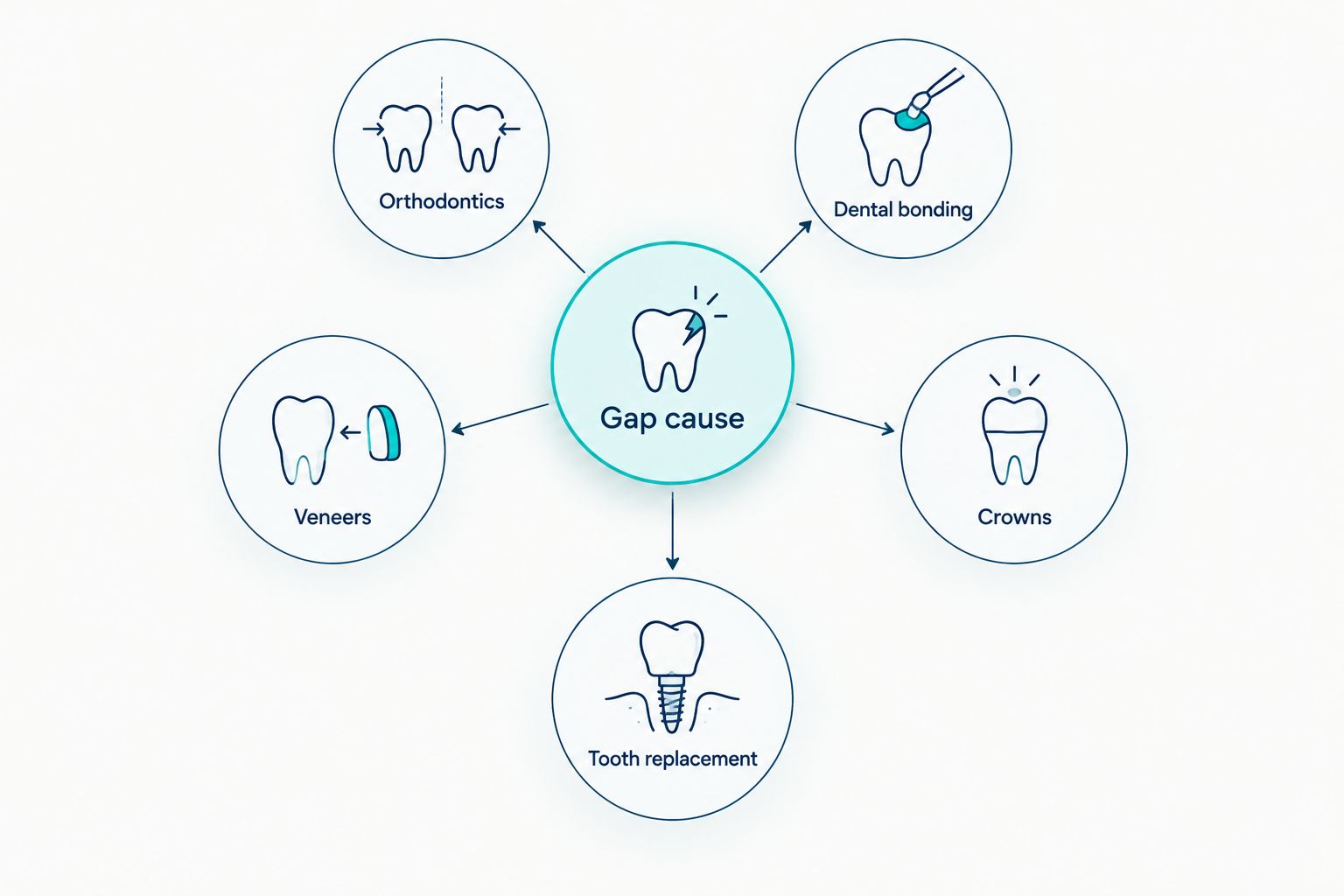
Gap-closing options at a glance
| Option | Best for | Standout feature | Key limitation |
|---|---|---|---|
| Orthodontics | Gaps caused by tooth position or bite alignment | Moves your own teeth instead of widening them | Requires treatment over time and retention afterward |
| Dental bonding | A small cosmetic gap with otherwise suitable teeth | Adds tooth-colored material to reshape the edges | Can stain, chip, and need repair |
| Veneers | Gaps alongside shape and color concerns | Changes the visible front surface of teeth | Usually involves irreversible enamel removal |
| Crowns | A gap beside a tooth that also needs substantial restoration | Restores a damaged tooth while adjusting its shape | Removes more tooth structure than bonding or veneers |
| Tooth replacement | A space left by a missing tooth | Replaces the absent tooth rather than widening neighbors | Requires assessment of gums, bone, and adjacent teeth |
These are different treatment jobs, not interchangeable ways to fill every space. The right choice starts with identifying which problem you actually have.
1. Orthodontics: best for gaps caused by tooth position
Orthodontics closes spaces by moving teeth. Braces or clear aligners can be considered when spacing is part of an alignment or bite problem, rather than simply a tooth-shape concern.
This approach keeps the natural width of your teeth. That matters when adding material would make the front teeth look too broad or leave other spaces unresolved.
Orthodontics pros:
- Addresses tooth position rather than covering the gap.
- Can treat spacing across several teeth.
- Can address bite relationships as part of the treatment plan.
- Does not require widening teeth with restorative material just to close spaces.
Orthodontics cons:
- Requires a course of treatment rather than a single cosmetic adjustment.
- Removable aligners depend on consistent wear.
- Retainers are needed afterward to help maintain the result.
Best for: Teeth that need repositioning, particularly when gaps occur alongside crowding, rotation, or bite concerns.
Ask whether braces or aligners fit your particular tooth movements. Appearance alone does not determine which appliance is suitable, and neither option removes the need for follow-up care.
Verdict: Choose orthodontics when the teeth need to move, not simply look wider.
2. Dental bonding: best for a small cosmetic gap
Dental bonding adds tooth-colored resin to the tooth surface. Your dentist shapes the material to narrow the space and blend with the surrounding teeth.
Bonding is a useful option when the gap is small, the bite is suitable, and the teeth would benefit from a modest change in shape. It generally preserves more tooth structure than a veneer or crown, although preparation depends on the situation.
Dental bonding pros:
- Can narrow a gap without moving the teeth.
- Allows targeted changes to tooth edges and proportions.
- Often needs little or no enamel removal.
- Can be repaired if material chips or wears.
Dental bonding cons:
- Resin can stain and lose its surface polish over time.
- Bonding can chip, particularly under unfavorable biting forces.
- Adding too much material can make teeth look overly wide.
Best for: A small, stable space where a limited shape change would look natural.
Ask your dentist to explain where material would be added and how the finished teeth would compare in width. A smaller visible gap is not an improvement if the proportions look wrong or the contact is difficult to clean.
Verdict: Choose dental bonding for a modest cosmetic change when tooth proportions and bite allow it.
3. Veneers: best for spacing with shape or color concerns
Veneers cover the front surfaces of teeth. They can change the visible shape and color while narrowing selected spaces, making them an option when your goals extend beyond closing a gap.
Veneers do not move the tooth roots or correct every bite problem. The planning needs to account for the underlying tooth position, the final tooth width, and how the veneers will meet the opposing teeth.
Veneers pros:
- Can address spacing, shape, and color within one treatment plan.
- Allow planned changes to the visible proportions of teeth.
- Porcelain resists staining better than bonding resin.
- Can create a coordinated appearance across the treated teeth.
Veneers cons:
- Usually require removal of enamel, making treatment irreversible.
- Can chip or fracture and need replacement.
- Are not a substitute for treating decay, gum disease, or an unsuitable bite.
Best for: Healthy teeth with spacing plus additional cosmetic concerns that bonding or orthodontics alone would not meet.
At Mysmiletheory, cosmetic dentistry is part of the clinic's stated services. For your veneer discussion, ask what preparation is proposed, whether a less invasive option fits, and how the planned shape will suit your smile.
Verdict: Choose veneers for a broader appearance change, not automatically for an isolated gap.
4. Crowns: best when a tooth also needs substantial restoration
A crown covers the visible portion of a tooth. When a tooth is extensively damaged or weakened, a crown can restore its shape and function while also addressing a neighboring space within sensible proportions.
A crown is not usually the first choice for closing a small gap between otherwise healthy teeth. The amount of tooth preparation makes the existing condition of the tooth central to the decision.
Crowns pros:
- Restore teeth that need more support than a small cosmetic addition provides.
- Can adjust the shape of a tooth as part of restorative treatment.
- Address function as well as appearance when appropriately indicated.
Crowns cons:
- Require substantial tooth preparation.
- Need ongoing cleaning around the crown margin.
- Can require repair or replacement over time.
Best for: A damaged tooth that already has a restorative reason for a crown.
Ask the dentist to separate the health need from the cosmetic goal. You should understand why the tooth needs coverage even if the gap were not there.
Verdict: Skip crowns solely for a small cosmetic gap in healthy teeth; consider them when restoration is independently needed.
5. Tooth replacement: best for a gap from a missing tooth
A missing tooth creates a different problem from a space between two intact teeth. Treatment needs to replace the absent tooth, not simply enlarge the neighboring teeth to hide the space.
Implants, bridges, and removable partial dentures are replacement options. The choice depends on the condition of the surrounding teeth, gums, and supporting bone, along with your preferences and health history.
| Replacement option | Best for | Main benefit | Main limitation |
|---|---|---|---|
| Dental implant | Suitable patients seeking an independently supported replacement | Does not rely on crowns on neighboring teeth | Requires surgery and adequate supporting bone |
| Dental bridge | Patients with suitable teeth beside the space | Provides a fixed replacement | Conventional bridges require preparation of supporting teeth |
| Removable partial denture | Patients considering a removable replacement | Can replace missing teeth without implant surgery | Must be removed and cleaned; fit needs monitoring |
Tooth replacement pros:
- Addresses the missing tooth rather than disguising its absence.
- Can restore a chewing surface and tooth appearance.
- Offers fixed and removable approaches for different needs.
Tooth replacement cons:
- Each approach has its own maintenance requirements.
- Some options involve surgery or preparation of neighboring teeth.
- Not every replacement method fits every mouth.
Best for: A gap caused by an absent or extracted tooth.
Verdict: Choose a missing-tooth assessment before deciding between an implant, bridge, or removable replacement.
How these options are ranked
This 2026 guide ranks treatments by the problem they address, tooth preservation, bite fit, and ongoing care—not by a promise that one procedure works for everyone. Orthodontics leads for positional gaps; bonding leads for limited cosmetic reshaping.
Veneers, crowns, and tooth replacement each have a narrower role. Their value depends on whether you also need an appearance change, substantial restoration, or replacement of an absent tooth.
Which gap-closing treatment should you choose?
For an undecided patient, the next step is an examination—not committing to veneers or aligners. Ask what caused the space, whether your bite contributes, and which option changes the least healthy tooth structure while meeting your goal.
Mysmiletheory offers general, cosmetic, restorative, and family dentistry in Spring, Texas. That makes the clinic a local option for patients who want to discuss both tooth health and cosmetic concerns.
For your 2026 appointment, bring these questions:
- Is the gap stable, or does it need a health assessment first?
- Would moving the teeth make more sense than adding material?
- Will the proposed result preserve natural-looking proportions?
- What maintenance will the treatment require?
- Is leaving the gap untreated a reasonable option?
You do not need to choose a procedure before booking. Start with what bothers you and what you want to keep unchanged.
Talk about your smile
Discuss your gap and cosmetic goals with a dental clinic in Spring, Texas.
Caring for teeth after gap treatment
Whatever treatment you choose, the spaces between teeth still need cleaning. A closed gap is not a reason to stop cleaning between those teeth.
The American Dental Association recommends brushing for 2 minutes, 2 times a day, with fluoride toothpaste and cleaning between teeth 1 time a day. Ask your dentist which cleaning method suits bonding, veneers, crowns, or a replacement tooth.
If you have orthodontic treatment, follow the prescribed retainer instructions. If you have restorations, report a rough edge, a changed bite, or floss that repeatedly catches rather than trying to adjust the material yourself.
FAQ
What's the best way to close a gap in teeth in 2026?
The best way to close a gap in teeth depends on why the gap exists. Orthodontics addresses tooth position, bonding suits selected small cosmetic gaps, and veneers can address spacing alongside shape or color concerns.
Is bonding better than veneers for a small gap?
Bonding is often the more tooth-preserving choice for a small cosmetic gap. Veneers become more relevant when you also want broader shape or color changes and accept the preparation involved.
Can clear aligners close a gap between front teeth?
Clear aligners can close suitable gaps by moving teeth. A dental assessment determines whether aligners fit your tooth movements and bite; retainers are needed afterward to help maintain the result.
Can I close a tooth gap at home with rubber bands?
Do not use rubber bands or other homemade devices to close a tooth gap. Unsupervised tooth movement can damage gums and supporting tissues; have the cause and treatment assessed by a dentist.
Does a gap between teeth always need treatment?
No, a stable gap between healthy teeth does not automatically need treatment. A new or widening space, especially with bleeding gums or loose teeth, needs a dental assessment.
Will veneers make my front teeth look too wide?
Veneers can make teeth look too wide if the plan closes a space without respecting tooth proportions. Ask whether orthodontics or a different combination of treatments would produce a more balanced result.
Can a gap come back after treatment?
A gap can return after orthodontic treatment if teeth shift, which is why retention matters. Bonding and veneers can also need repair or replacement; ongoing care depends on the treatment and the original cause.
One last thing
Closing every visible space is not the same as creating a natural-looking smile. Tooth width, gum health, and the way your teeth meet all matter.
For your 2026 consultation, describe the change you want in everyday language. A comfortable conversation about your goals is a better starting point than arriving committed to a procedure.