
Dental veneers last for years, but they are not lifetime restorations and do not have a fixed expiration date. How long yours remain comfortable, secure, and natural-looking depends on the material, the health of the tooth underneath, your bite, and daily care—not just how long ago they were placed.
- How long do dental veneers last? Material, tooth health, bite pressure, and daily care determine their useful life.
- Porcelain veneers resist staining; composite veneers are generally easier to repair but more prone to staining and wear.
- A loose veneer, new sensitivity, or a changing edge needs a dental examination—not automatic replacement.
- Mysmiletheory offers cosmetic dentistry for local patients seeking a personal dentist in Spring, Texas.
Why this matters
A veneer’s age alone does not tell you whether it needs replacing. A veneer that looks good can still have a problem at its edge, while an older veneer that remains sound does not automatically need treatment. Your dentist needs to assess the restoration and the tooth together.
If you are considering cosmetic dentistry in 2026, think beyond the day your new smile is finished. Ask what ongoing care involves and what a future repair or replacement would mean for your teeth. Mysmiletheory provides general, cosmetic, restorative, and family dentistry for patients in Spring, Texas.
How long do dental veneers last?
Dental veneers remain useful until damage, changes around the tooth, or appearance concerns make repair or replacement appropriate. There is no calendar date when every veneer becomes unsuitable. Your dentist assesses its condition rather than replacing it simply because it has reached a particular birthday.
Material matters, but it is only part of the answer. A strong veneer still relies on a healthy tooth, a secure attachment, and a bite that does not place excessive pressure on it.
| Veneer material | Best for | Main advantage | Main limitation | What affects continued use |
|---|---|---|---|---|
| Porcelain | Patients seeking stain resistance and a stable appearance | Resists staining better than composite | A significant fracture can require replacement rather than a small repair | Tooth health, attachment, bite pressure, and cracks |
| Composite | Patients seeking changes that can often be adjusted or repaired directly | Often easier to repair or reshape | More prone to staining, surface wear, and chipping | Surface condition, repairs, daily habits, and tooth health |
These are material differences, not a recommendation for every smile. The best choice is the one that fits your tooth condition and goals while preserving healthy tooth structure. An examination determines whether either option makes sense for you.
Porcelain veneers: stain resistance with repair limitations
Porcelain veneers can maintain their appearance well because their surface resists staining. They can be appropriate when you want to change tooth color, shape, or proportions and your dentist confirms that your teeth can support treatment.
Their limitation is that porcelain is not unbreakable. Biting a hard object, an injury, or repeated grinding pressure can damage a veneer. Depending on the location and extent of the damage, replacing it can be more appropriate than repairing it.
Porcelain also does not protect the entire tooth from decay. The exposed tooth surface and the area around the veneer still need daily cleaning. When discussing porcelain veneers in 2026, ask how much tooth preparation is necessary and how that affects future treatment choices.
Composite veneers: easier adjustments with more surface upkeep
Composite veneers use tooth-colored resin to change the visible surface of a tooth. Their practical advantage is repairability: a dentist can often add material, reshape an edge, or polish a rough area without replacing the whole restoration.
The trade-off is greater susceptibility to staining and wear compared with porcelain. An appearance change does not always mean the veneer has failed, however. Some concerns can be managed with polishing or a localized repair after an examination.
Ask whether your cosmetic concern requires a full veneer or a smaller change. Covering more tooth surface is not automatically better, especially when the concern is limited to a small chip or uneven edge.
Why veneer lifespan varies
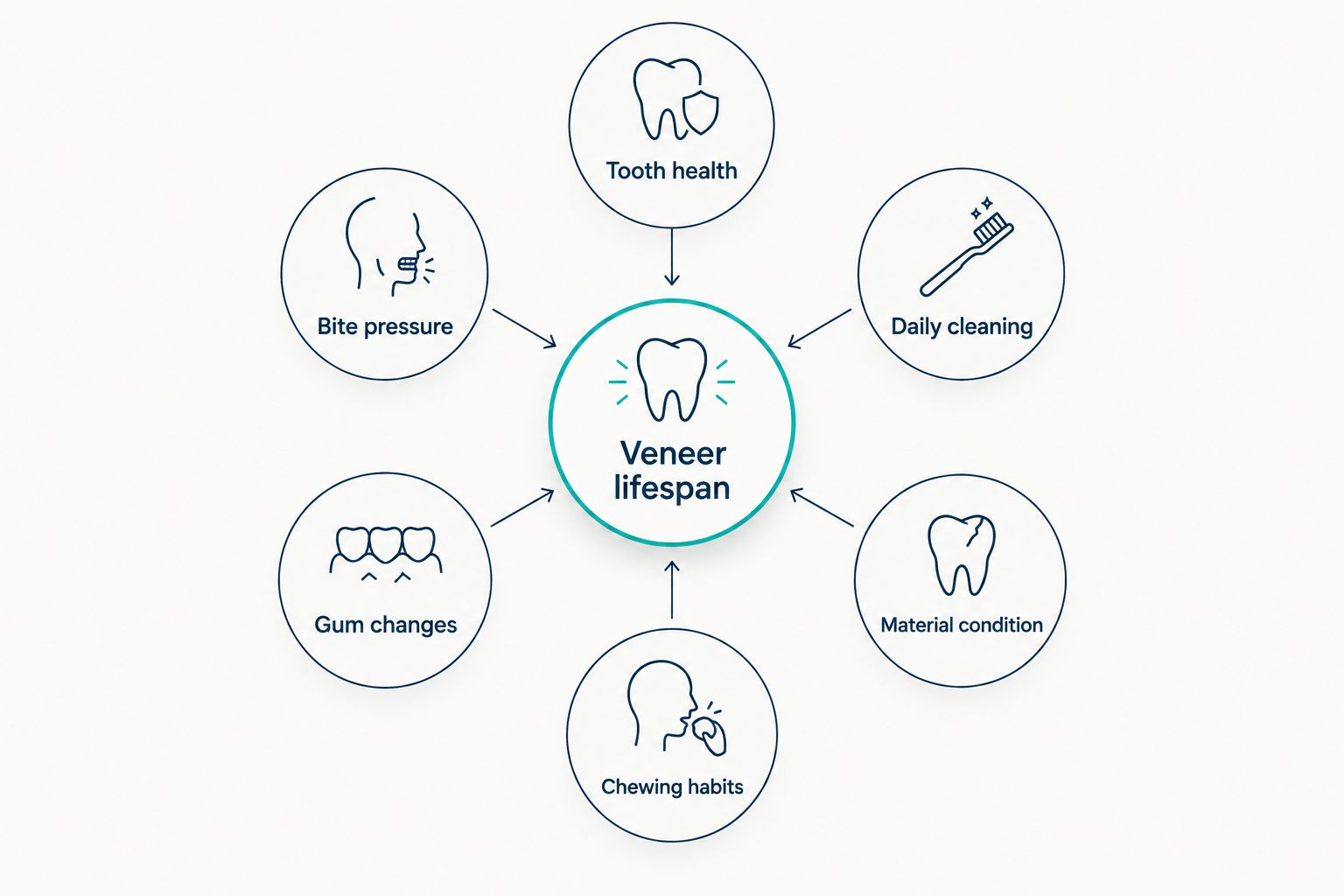
Several factors work together to determine how long a veneer remains suitable. These are the issues to discuss with your dentist rather than relying on the material name alone:
- Tooth health: Decay or a crack in the supporting tooth can affect an otherwise intact veneer. Existing disease needs attention before cosmetic treatment.
- Bite pressure: Clenching, grinding, and uneven tooth contact can place repeated stress on veneer edges. Tell your dentist about jaw soreness, worn teeth, or a history of breaking restorations.
- Daily cleaning: Plaque can collect where the veneer meets the natural tooth. Brushing and cleaning between teeth protect those vulnerable areas.
- Gum changes: Receding gums can expose a tooth edge that was previously less visible. This can change appearance or sensitivity without the veneer itself breaking.
- Material condition: Chips, cracks, wear, or changes in the attachment can affect whether a veneer remains secure and comfortable. Different problems need different solutions.
- Chewing habits: Ice, pen caps, fingernails, and using teeth to open packaging place avoidable stress on natural teeth and restorations alike.
How can you help veneers last?
You do not need an elaborate routine, but you do need consistent care. Veneers are attached to living teeth, so protecting the natural tooth remains the priority.
Keep cleaning gentle and consistent
The American Dental Association recommends brushing for 2 minutes per session, 2 times per day, with fluoride toothpaste and cleaning between your teeth 1 time per day. Use a soft-bristled toothbrush and ask your dentist which cleaning tools suit your teeth and gum spaces.
Do not avoid an area simply because it has a veneer. If floss catches, shreds, or becomes difficult to pass, mention it rather than forcing it repeatedly. Your dentist can check whether the issue involves the veneer’s edge, a tight contact, or something else.
Protect against repeated pressure
If you clench or grind, ask whether a professionally fitted night guard is appropriate. A guard can help protect teeth and restorations from direct contact, but your dentist still needs to assess the bite and any symptoms.
Avoid testing veneers by biting unusually hard foods or objects. You do not need to be afraid of ordinary eating; the goal is to remove habits that place unnecessary force on the front teeth.
Keep examinations personal
For your 2026 care plan, agree on a review schedule based on your oral health rather than assuming everyone needs the same interval. Tell your dentist about sensitivity, bleeding, food trapping, or changes in the way your teeth meet. Small changes are easier to assess when you describe when they began.
What are the signs a veneer needs attention?
Book an examination when a veneer feels different, even if the change looks small. Appearance alone cannot show whether the problem is limited to the surface or involves the tooth underneath.
Signs to mention include:
- A chip, crack, or rough edge that catches your tongue.
- Movement or a feeling that the veneer is no longer secure.
- New or persistent sensitivity, especially when biting.
- Food repeatedly collecting around the same edge.
- Bleeding or swelling around the treated tooth.
- A change in your bite or a tooth that suddenly contacts first.
A dark line does not automatically mean decay, and sensitivity does not automatically mean the veneer has failed. Both deserve assessment. Your dentist can distinguish staining, exposed tooth surface, gum changes, and problems with the restoration.
If a veneer comes off, keep it safe and contact a dentist. Do not use household glue or try to force it back into place. Avoid biting with the affected tooth until you receive advice, and seek prompt care for significant pain, swelling, or an injury.
What happens before a dentist recommends replacement?
Replacement should follow a diagnosis, not just a concern about age. A useful examination answers several questions in a clear order:
- Understand the change. Explain what you noticed, when it started, and whether it affects appearance, eating, or comfort. Mention any injury or recent change in grinding habits.
- Check the supporting tooth. Your dentist looks for decay, cracks, and other problems that could affect the treatment decision. X-rays are taken when clinically indicated.
- Assess the veneer. The examination considers its edges, surface, attachment, and contact with neighboring teeth. A surface stain and a structural crack are different problems.
- Review gums and bite. Gum recession or uneven pressure can explain why a previously comfortable veneer now looks or feels different.
- Discuss the smallest suitable treatment. Monitoring, polishing, repairing, or replacing the veneer depends on the findings. Ask what each option preserves and what its limitations are.
If you are planning veneers rather than assessing existing ones, start with tooth health. The guide to whether you can get veneers if you have cavities explains why a cosmetic covering is not a substitute for treating decay.
Are veneers permanent if tooth enamel is removed?
Tooth preparation can be permanent even though the veneer is not. Enamel removed during treatment does not grow back, so a prepared tooth can continue to need a veneer or another suitable restoration.
This distinction matters before you agree to treatment. Ask what will change about your natural tooth, whether a less extensive option fits your concern, and what future replacement could involve. A natural-looking result should not come at the expense of understanding the commitment.
Does every old veneer need replacing?
An older veneer does not need replacing solely because of its age. If it remains secure, comfortable, and clinically sound, your dentist can assess whether continued monitoring is appropriate.
Replacement also deserves a conversation about your goals. If your concern is appearance rather than damage, explain exactly what bothers you before agreeing to remove a functioning restoration. A specific concern is a better starting point than wanting everything to look new.
Can whitening make veneers look new again?
Whitening does not lighten veneer material the way it lightens natural teeth. Cleaning or polishing can address some surface staining, but a change to the veneer’s underlying shade generally requires a different approach.
Discuss whitening before choosing a new veneer shade in 2026. Otherwise, whitening the surrounding natural teeth afterward can create a mismatch. Your dentist can help plan the order of treatment around the appearance you want.
Questions to bring to a cosmetic consultation
You do not need dental terminology to have a useful conversation. Bring a description of what you want to change and ask:
- What is causing the problem I can see?
- Is my tooth healthy enough for cosmetic treatment?
- What are the advantages and limitations of each suitable option?
- How much natural tooth would need to change?
- What should I watch for after treatment?
Mysmiletheory offers cosmetic dentistry for Spring patients who want a personal dentist. Use the consultation to decide whether the proposed approach fits your comfort, expectations, and willingness to maintain it—not to rush into a particular material.
Start with your questions
Discuss your smile goals and questions about ongoing dental care.
FAQ
How long do dental veneers last if I take good care of them?
Dental veneers can remain useful for years with good care, but no routine guarantees a particular replacement date. Material, bite pressure, tooth health, and the condition of the attachment all affect their useful life.
Do porcelain veneers last longer than composite veneers?
Porcelain generally resists staining and wear better than composite, but that does not guarantee a longer lifespan for every patient. Composite is often easier to repair, while substantial porcelain damage can require replacement.
Can I get a cavity under a veneer?
Yes, the natural tooth supporting a veneer can still develop decay. Fluoride toothpaste, cleaning between teeth, and dental examinations remain necessary after treatment.
Does a chipped veneer always need replacing?
No, a chipped veneer does not always need replacing. The material, size of the chip, location, and condition of the supporting tooth determine whether polishing, repair, or replacement is appropriate.
Can I keep my veneers if my gums recede?
Gum recession does not automatically require veneer replacement. Your dentist needs to assess the exposed tooth surface, sensitivity, gum health, and appearance before recommending treatment.
Can teeth whitening change the color of my veneers?
Teeth whitening does not lighten veneer material like natural tooth enamel. Discuss any whitening plans with your dentist to avoid creating a shade mismatch.
Can I take veneers off and leave my teeth uncovered?
Teeth prepared for veneers often continue to need a protective restoration. Whether a tooth can remain uncovered depends on how it was prepared and its current condition.
Where can I discuss cosmetic dentistry in Spring, Texas?
Mysmiletheory provides cosmetic dentistry in Spring, Texas, alongside general, restorative, and family dental care. A dental examination can help you understand which treatment choices suit your teeth and goals.
One last thing
The most useful question is not simply how long a veneer will last. Ask, what would make this veneer need treatment, and how will we notice? That question turns a vague lifespan estimate into a practical care plan.
If veneers are part of your plans for 2026, write down your questions before the appointment. You deserve to understand both the smile change and the long-term responsibility, with time to make a decision that feels right for you.


