
Best overall: a personalized visit with a clear stop signal. Best for impression-triggered gagging: digital scanning when suitable. Best for anxiety-linked gagging: a sedation assessment. If you’re looking for a dentist for sensitive gag reflex in 2026, start with the trigger—not a promise to eliminate it.
- Choose a dentist for sensitive gag reflex who discusses triggers before starting dental care.
- Mysmiletheory offers general and family dentistry in Spring, Texas; ask about accommodations before booking.
- Digital scanning avoids impression trays when suitable, but a scanner still enters your mouth.
- Sedation needs an individual assessment and does not guarantee that gagging will stop.
A gag reflex is not something to apologize for. Mysmiletheory provides general, cosmetic, restorative, and family dentistry in Spring, Texas; discuss your previous experiences before scheduling treatment, and confirm which accommodations the clinic offers.
Why this matters
Gagging is a protective reflex, not a sign that you are being difficult. Touch near the back of your mouth can trigger it, and anxiety can make dental care harder to tolerate.
The right approach depends on what happens during your appointment. Impression trays, X-ray sensors, pooled water, and anticipation present different problems; treating them as the same issue misses the opportunity to make a useful adjustment.
The best starting point is a dentist who takes your gagging history seriously and agrees on how to pause safely. No single device, breathing exercise, or medication replaces that conversation.
What makes the best care for a sensitive gag reflex?
Use these criteria when comparing your dental care options in 2026:
- Trigger matching: The plan addresses what actually starts your gagging, rather than assuming anxiety is the only cause.
- Patient control: You agree on a stop signal before instruments enter your mouth.
- Necessary care: Adjustments still allow the dentist to examine, diagnose, and treat your teeth safely.
- Medical suitability: Medication decisions account for your health, prescriptions, breathing, and previous reactions.
- Clear limitations: The team explains what an adjustment can and cannot change, including whether a referral is needed.
Dental care options at a glance
These options are tools to discuss, not competing treatments you must choose alone. Several belong in the same care plan.
| Rank and option | Best for | Standout feature | Key limitation |
|---|---|---|---|
| 1. Personalized pacing and stop signal | Gagging made worse by loss of control | Creates an agreed way to pause | Does not remove physical triggers |
| 2. Positioning and suction adjustments | Water or saliva triggering gagging | Addresses fluid buildup during treatment | Position depends on the procedure |
| 3. Digital scanning | Gagging caused by impression trays | Records tooth shape without impression material | A scanner still enters your mouth |
| 4. Adapted X-ray technique | Difficulty tolerating sensors or film | Targets the imaging step specifically | Images must remain diagnostically useful |
| 5. Nitrous oxide assessment | Anxiety contributing to gagging | Offers an inhaled sedation option when appropriate | Requires nasal breathing and medical screening |
| 6. Oral or IV sedation assessment | Necessary care that remains intolerable | Supports planning for more involved sedation | Requires additional precautions and suitable providers |
1. Personalized pacing: best for feeling out of control
A personalized plan begins with your experience, not an instrument. Explain which part of previous visits caused gagging, what the team tried, and whether anything helped.
Agree on 1 stop signal, such as raising your hand, before treatment starts. The dentist can explain how instruments will be removed safely when you use it; that matters more than a vague promise to take things slowly.
Personalized pacing pros:
- Gives you a clear way to communicate without speaking.
- Creates room to explain each step before it happens.
- Works alongside other gag-reflex accommodations.
Personalized pacing cons:
- Does not prevent gagging caused by contact near the throat.
- Breaks can interrupt treatment and affect appointment planning.
Best for: Patients whose gagging becomes harder to manage when they feel rushed or unable to stop.
Verdict: Start here. Establish communication even if you expect to need additional support.
2. Positioning and suction: best for fluid-related gagging
If water or saliva gathering in your mouth starts the reflex, tell the dentist exactly that. Suction placement, planned pauses, and changes in chair position are reasonable adjustments to discuss.
A more upright position is not suitable for every procedure. The goal is a working position that lets the team treat your teeth safely while addressing the sensation that triggers you.
Positioning and suction pros:
- Addresses a specific physical trigger.
- Can be combined with pauses and clear communication.
- Does not require sedation medication by itself.
Positioning and suction cons:
- Cannot eliminate all contact with water or instruments.
- The procedure limits how much your position can change.
Best for: Patients who gag when fluid accumulates or who struggle in a deeply reclined position.
Verdict: Ask about this early if fluid buildup is your main problem. Do not assume you must tolerate the same setup as your previous visit.
3. Digital scanning: best for impression-tray gagging
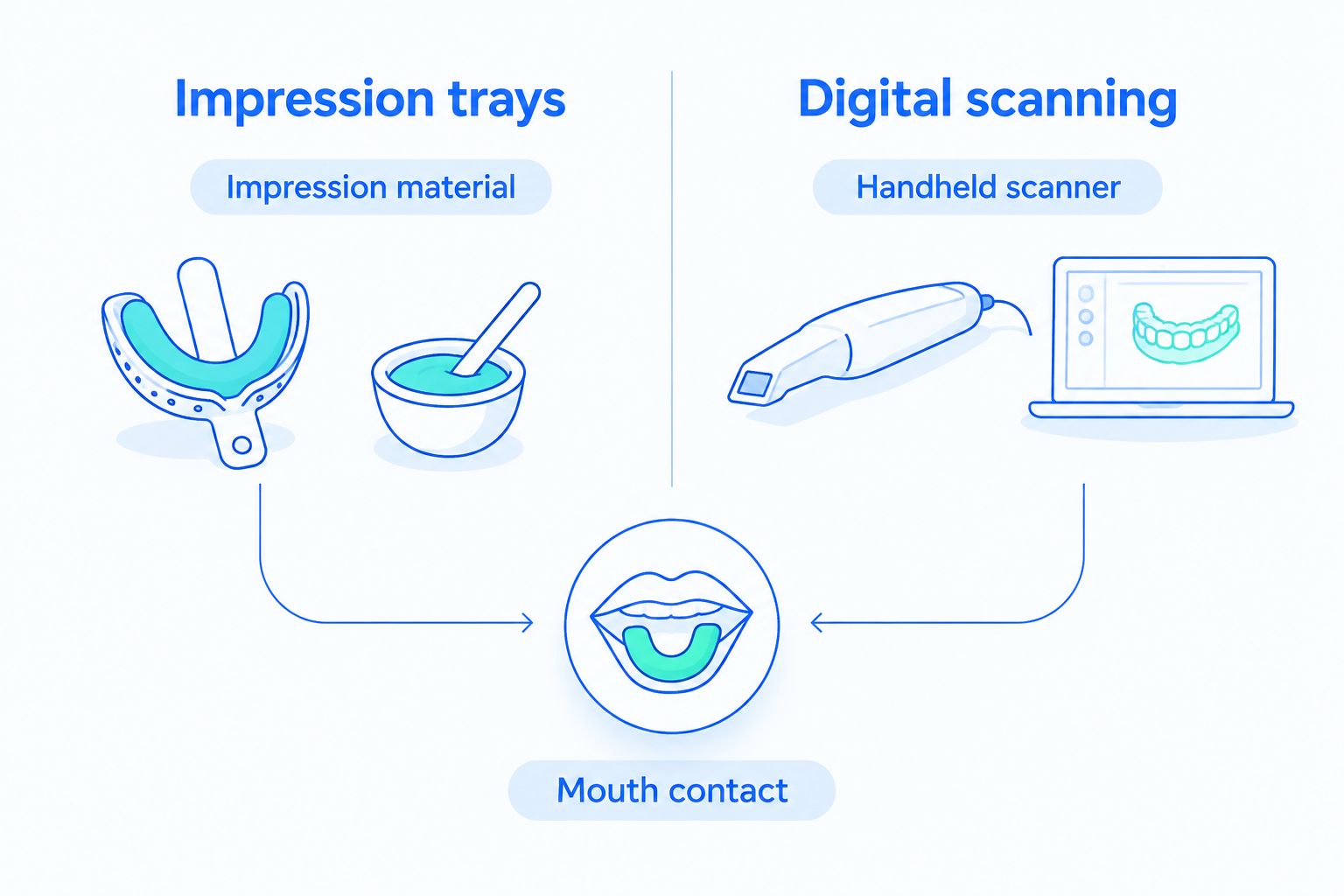
Digital scanning records tooth surfaces with a handheld scanner rather than a tray filled with impression material. It is an option to ask about when impressions—not every part of dental care—are your main trigger.
A scanner is still an object inside your mouth. Its suitability depends on the planned restoration, the records needed, and the equipment and workflow of the treating practice.
Digital scanning pros:
- Avoids impression material during the scan.
- Avoids a conventional impression tray for that record.
- Targets a clearly identified source of gagging.
Digital scanning cons:
- Contact near the back teeth can still trigger gagging.
- Not every treatment plan can use the same recording method.
Best for: Patients who tolerate examinations but struggle with impression trays.
Verdict: Ask whether scanning fits your treatment. Confirm the method before committing to an appointment involving impressions.
The important distinction is between removing impression material and removing all mouth contact. Digital scanning addresses the former, not the latter.
4. Adapted X-ray technique: best for sensor-triggered gagging
Dental X-ray sensors and film sit inside the mouth for many routine images. If placement triggers gagging, tell the team before the sensor is positioned rather than waiting until you are struggling.
The team can assess placement, sensor size where appropriate, and pauses between images. Imaging choices must answer the clinical question; an image taken outside the mouth is not an automatic substitute for every intraoral X-ray.
Adapted X-ray technique pros:
- Focuses on the specific step you find difficult.
- Allows the team to plan sensor placement before starting.
- Can include breaks between required images.
Adapted X-ray technique cons:
- Some needed images still require an intraoral sensor.
- Repeated attempts are not a substitute for reassessing the approach.
Best for: Patients who manage other dental care but gag during X-rays.
Verdict: Request an imaging plan, not simply fewer images. Your dentist should explain which records are needed and why.
5. Nitrous oxide assessment: best for anxiety-linked gagging
Nitrous oxide mixed with oxygen is an inhaled dental sedation option delivered through a nose mask. It can reduce anxiety, but it does not guarantee that your gag reflex will disappear.
The dentist must review your health and assess whether you can breathe comfortably through your nose. Nasal congestion and relevant medical conditions affect whether this approach is appropriate.
Nitrous oxide assessment pros:
- Addresses anxiety when anxiety contributes to gagging.
- Allows communication during the intended minimal-sedation state.
- Can accompany a plan for pacing and physical triggers.
Nitrous oxide assessment cons:
- Requires tolerating a nose mask and breathing through your nose.
- Is not appropriate for every patient or every level of difficulty.
Best for: Patients whose gagging increases with dental anxiety and who are medically suitable for this option.
Verdict: Discuss suitability before treatment day. Confirm whether the treating practice provides nitrous oxide; do not assume it is included in routine care.
6. Oral or IV sedation assessment: best for persistent difficulty
When necessary dental treatment remains intolerable despite adjustments, ask about a formal sedation assessment or referral. Oral and IV sedation are different approaches, with effects that depend on the medication and intended sedation depth.
Neither approach is simply a stronger version of reassurance. Medical screening, monitoring, recovery arrangements, and procedure-specific instructions are part of the decision.
Oral or IV sedation assessment pros:
- Creates a structured next step when simpler measures are insufficient.
- Includes a review of health, medications, and previous sedation experiences.
- Identifies whether a different treatment setting is needed.
Oral or IV sedation assessment cons:
- Adds medical risks and preparation requirements.
- Can require an escort and restrictions after treatment.
Best for: Patients unable to complete necessary care despite an individualized plan and less involved measures.
Verdict: Seek an assessment rather than choosing a medication yourself. Never take leftover sedatives or someone else’s prescription before a dental appointment.
How these options are ranked
This 2026 guide ranks options by how directly they address a trigger, preserve communication, and support necessary dental care. It is not a clinical trial ranking or a claim that one method works for everyone.
Pacing comes first because communication belongs in every plan. More involved sedation comes later because it requires additional assessment—not because patients should have to prove they can endure an uncomfortable visit.
Which approach should you choose?
Choose a trigger-specific plan first, then discuss additional support if needed. If trays are the problem, ask about scanning; if sensors are the problem, ask about imaging. Anxiety and physical triggers can exist together.
Mysmiletheory is a local dental care option for Spring patients seeking general, cosmetic, restorative, or family dentistry. Review the clinic’s dental services, then confirm the accommodations relevant to your appointment rather than assuming specialized equipment or sedation is offered.
Before your 2026 appointment, prepare 3 details:
- The trigger: Describe whether it is touch, fluid, a sensor, a tray, or anticipation.
- The previous response: Explain whether you gagged, vomited, or needed treatment stopped.
- The helpful adjustment: Share anything that made a previous visit easier.
Then ask 2 questions: What can be adjusted for this procedure, and what happens if those changes are not enough?
Discuss your next dental visit
Tell Mysmiletheory what triggers gagging and ask which accommodations fit your care.
FAQ
What should I look for in a dentist for sensitive gag reflex?
Look for a dentist who discusses your triggers, agrees on a stop signal, and explains procedure-specific accommodations. Ask how the team handles difficulty completing treatment and when a referral is appropriate.
Can I have a dental cleaning if I gag easily?
A sensitive gag reflex does not automatically prevent a dental cleaning. Tell the team beforehand so they can assess pacing, suction, positioning, and any additional support you need.
Are digital scans better than impressions for gagging?
Digital scans avoid impression trays and material, making them an option to discuss when those are your triggers. The scanner still enters your mouth, and scanning must suit the treatment being planned.
Will laughing gas stop my gag reflex?
Nitrous oxide does not guarantee that gagging will stop. It can reduce anxiety, but your dentist must assess medical suitability and address physical triggers separately.
Should I skip eating before my dental appointment?
Follow the instructions for your specific appointment rather than fasting on your own. Sedation methods have different preparation requirements, so ask the treating team what applies to you.
Can I use throat-numbing spray before seeing the dentist?
Do not use throat-numbing products for a dental visit without the treating clinician’s advice. They can affect sensation and swallowing, and they are not a substitute for a safe treatment plan.
What should I tell Mysmiletheory when booking in 2026?
Tell Mysmiletheory which parts of dental care trigger gagging and whether previous appointments had to stop. Ask which accommodations the clinic offers and whether a consultation should come before treatment.
One last thing
A sensitive gag reflex and difficulty swallowing are not the same problem. Tell your clinician if gagging is new, happens outside dental care, or accompanies swallowing trouble; do not assume every symptom needs only a chair adjustment.
You do not need to arrive knowing the solution. Bring a clear description of the problem, and ask for a plan that respects both your comfort and the care your teeth need.


