

Instead of chasing dental notes and X-rays yourself, transfer dental records to new dentist by requesting copies from your previous office, arranging secure delivery, and confirming that your new office can open them. This guide connects those steps to your first visit so you can focus on your concerns, not missing paperwork.
- To transfer dental records to new dentist, request treatment notes and X-rays, then confirm receipt and readability.
- Mysmiletheory provides general, cosmetic, restorative, and family dental care for patients in Spring, Texas.
- Choose office-to-office delivery when supported; keep a personal copy when you want your own reference.
- Previous records inform your first visit but do not replace an examination or automatically eliminate new X-rays.
Why this matters
Your previous dental records give your new dentist context: what has already been treated, which teeth have been watched, and when images were taken. They also help you explain a history that is difficult to remember, especially after care at several offices.
Mysmiletheory is best for Spring patients seeking general, cosmetic, restorative, and family dental care from a personal dentist. You can begin with Mysmiletheory and ask how to prepare records for your first appointment.
For a first visit in 2026, think of the transfer as a handoff, not simply an attachment. Sending a file starts the process; confirming that the receiving office can identify and open it completes the paperwork side.
Before you start
- Gather identifying information. Have your name as it appeared in the previous office's records, date of birth, previous dentist's contact details, and your new office's confirmed receiving information. Follow the previous office's identity-verification instructions.
- Check the release process. Ask whether the previous office needs its own records-request or authorization form. For a child or someone whose records you manage, ask what documentation establishes your authority to request them.
- Check file compatibility before sending. Ask the receiving office which secure delivery method and image formats it accepts. A downloaded image is not useful if the office cannot open it or tell when it was taken.
You do not need to know every dental term. Describe what you need in everyday language and let the offices clarify the record names. Use the actual form your previous office supplies; its field names and submission instructions govern your request.
Your records request
- Contact the previous office. Ask for the person who handles patient records and explain that you are arranging care with a new dentist. Request instructions for obtaining copies, rather than asking the office to remove or send away its original chart.
- Identify the recipient. Give the new practice's name and verified delivery details. If you want copies yourself, make that clear and ask how you will receive them securely.
- Specify the scope. Organize your request into 3 record groups: treatment notes, dental images, and relevant supporting documents. Supporting documents include specialist reports or an unfinished treatment plan when those exist.
- Complete the required form. Check your identifying information, requested records, recipient, and signature wherever the office asks for them. Keep a copy of the completed request and record when you submitted it.
Expected result: The previous office has a clear request, knows who should receive the copies, and has the information it requires to process the release.
What belongs in the request?
Ask for notes that explain completed treatment and unresolved concerns. Dental images should include their capture dates and identifying information. If you have seen a specialist, request relevant reports from that office too; a general dentist's chart does not necessarily contain the specialist's complete records.
For a 2026 appointment, request relevant history rather than only documents created in 2026. Older treatment notes can explain an existing crown, previous injury, or a tooth that has been monitored.
You can use this wording as a starting point for your own request:
Please provide copies of my dental treatment notes, dental images with their dates, and relevant specialist reports or unfinished treatment plans. Please explain your secure delivery process and any authorization you need from me.
This is a request template, not a statement from either dental office. Add the receiving details only after you verify them.
Your delivery method
- Ask the receiving office how it accepts records. Confirm the destination directly with that office. Do not rely on an old email thread or an address remembered from another practice.
- Choose a supported route. Arrange office-to-office delivery if both practices support it, or obtain your own copies and submit them through the receiving office's accepted method.
- Separate documents from images when needed. Treatment notes and X-rays can arrive as different files or through different systems. Ask the sending office to include dates and patient identification with the images.
- Keep a simple transfer log. Note what was requested, when it was sent, and where it went. Store personal copies somewhere private, not in a shared folder that unrelated people can access.
Expected result: Your records have a verified destination and a delivery method the receiving office supports.
Which transfer route fits your situation?
Neither route guarantees that the records are complete. Choose based on how the offices accept files and whether you want to manage a personal copy.
| Transfer route | Best for | Advantage | Limitation |
|---|---|---|---|
| Office-to-office delivery | Patients who want the practices to handle delivery | Keeps the handoff between the sending and receiving offices | You still need to confirm receipt; sending does not prove arrival |
| Patient-held copies | Patients organizing records from several dentists | Gives you a personal reference and a way to track separate sources | You must protect the files and use an accepted submission method |
Choose the supported route, not merely the most convenient one. An ordinary email attachment is not automatically the appropriate way to send health information. Ask for the practice's instructions before attaching your chart or images.
Your receipt check
- Confirm arrival with the new office. Ask whether it received your treatment notes and dental images. Mention the sending practice and the name under which your previous records were kept.
- Confirm readability separately. Ask whether the files open and whether the images include usable identifying information and dates. These are 2 confirmations: receipt and readability.
- Resolve missing pieces. If notes arrived but images did not, contact the previous office with that specific gap. Request the missing files rather than restarting the entire transfer.
- Keep your appointment preparation moving. Ask the new office how to proceed if records remain outstanding. Do not postpone urgent dental assessment while waiting for paperwork.
Expected result: The receiving office can identify the records, open them, and tell you which requested items remain outstanding.
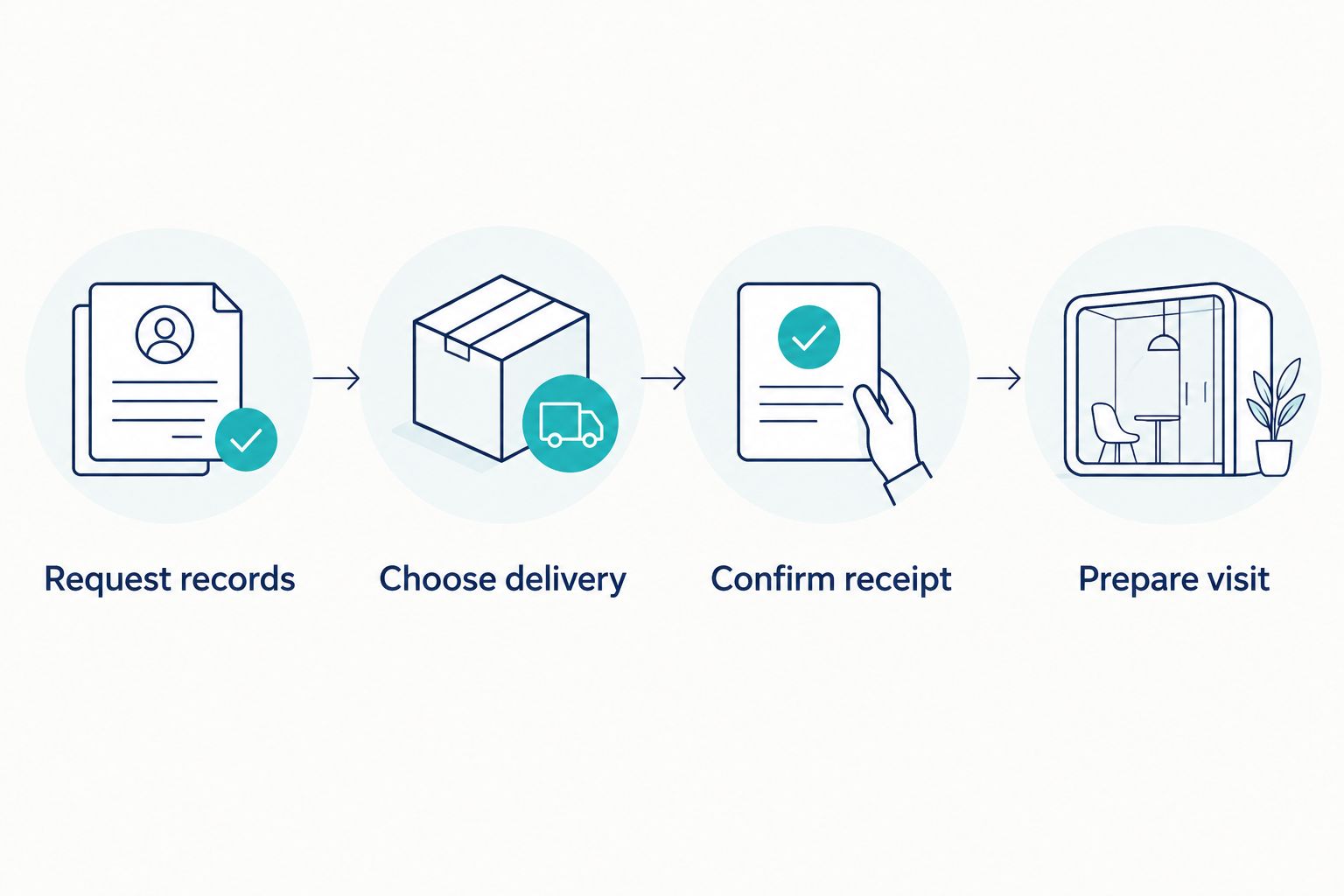
Use four checkpoints to track the handoff: Request records, Choose delivery, Confirm receipt, and Prepare visit. Each checkpoint answers a different question; completing the first does not automatically complete the others.
Your first-visit summary
- Write your main concern first. Describe what brought you in: discomfort, a broken tooth, routine care, or a change you would like to discuss. Include when a symptom started and what makes it better or worse.
- Update your health information. Bring your current medication list and report allergies, medical conditions, and changes since your previous dental visit. Old records are a starting point, not your current health update.
- Identify unfinished care. Explain whether another dentist recommended treatment that you have not completed. Bring the plan if you have it, without treating it as a decision your new dentist must automatically follow.
- Share your comfort preferences. Tell the team if you feel anxious, need explanations before treatment, or want to agree on a signal for a pause. These preferences belong in the conversation even if they are absent from your old chart.
Expected result: You arrive with a short, current summary that connects your history to what matters to you now.
For your 2026 visit, add the date to your summary so you can distinguish it from earlier notes. Keep the most important concern at the top. A long treatment history should not hide a symptom you need assessed today.
When new records are added before your visit
Use an update workflow if you see your previous dentist or a specialist after the original transfer. Examples include completing treatment, receiving a new dental image, or getting a report about a tooth under review.
- Ask the treating office for the new notes or report.
- Follow its release process and use the receiving office's accepted delivery method.
- Identify the material as an update and include the treatment or image date.
- Confirm that the new office received the update, not just the original files.
Keep the original transfer and the update distinguishable. A newly sent attachment does not necessarily replace earlier documents, and duplicate files make it harder to tell what changed.
This is useful when several offices contribute to your care. Track each source separately so you know which practice to contact about a missing report.
Troubleshooting the handoff
The records have not arrived
Ask the previous office whether it received your request and whether it needs anything else to process it. Then verify the destination with both offices. Keep the submission date and follow-up details together.
For U.S. HIPAA-covered practices, the federal patient-access rule generally requires action on a request for your own records within 30 calendar days. It permits one extension of up to 30 additional calendar days with written notice explaining the delay and completion date. These are federal access limits, not a promised turnaround for your appointment; state law can impose shorter deadlines.
The images will not open
Ask the receiving office which format or viewing method it supports, then relay that requirement to the sender. Request an export the receiving office can use. Do not substitute screenshots without checking whether they are suitable for clinical review.
The files are under a different name
Tell the receiving office the name used at the previous practice and provide the identifying information it requests. A surname change or different spelling can prevent staff from matching the records to your appointment.
Only part of the history arrived
List the missing material by source: previous general dentist, specialist, or another treating office. Contact the practice that holds the missing record. Requesting everything again from one office will not retrieve documents it does not hold.
Your visit is close, but the transfer is incomplete
Tell the new office which records are outstanding and ask what to bring. Take available copies and your current health summary through the method it recommends. If you have significant pain, swelling, or another urgent concern, seek prompt assessment rather than waiting for the transfer.
Customize your workflow around your goals
If you are planning cosmetic dental care with Mysmiletheory, explain both your treatment history and the change you want to discuss. Natural-looking results begin with a conversation about your smile, alongside an assessment of your oral health—not with assuming a previous recommendation is the only option.
The guide to connecting a dentist's referral to a cosmetic consultation covers the adjacent handoff when a referral is part of your next visit.
For family appointments in 2026, keep each person's records and request separate. This avoids mixing images, health updates, or treatment plans. Mysmiletheory provides family dental care, but each patient's history still needs its own clear handoff.
FAQ
How do I transfer dental records to a new dentist?
Ask your previous office for copies, complete its required request process, and use a delivery method your new office accepts. Confirm that the new office received both the notes and images and can open them.
Can my new dentist request my records for me?
Ask your new dentist whether the office can coordinate the request. Your previous practice can still require identity verification or authorization before releasing records.
Which dental records should I ask to transfer?
Request treatment notes, dated dental images, and relevant specialist reports or unfinished treatment plans. Your new dentist can help identify which parts of the history are relevant to your visit.
Will transferring my old X-rays mean I do not need new ones?
Previous X-rays do not automatically eliminate the need for new images. Your dentist considers their quality, date, coverage, and your current symptoms before deciding what is appropriate.
How long does a dental records request take?
Ask the previous office for its expected processing time. For HIPAA-covered practices, federal access rules generally require action on a request for your own records within 30 calendar days, with a permitted written extension under specified conditions.
Should I cancel my first visit if my records have not arrived?
Ask the receiving office how to proceed before changing your appointment. Do not delay assessment of an urgent dental concern solely because records are still being transferred.
Can I transfer dental records for my child?
Ask the previous office what documentation it requires for you to request your child's records. Keep each child's identifying information, authorization, and files separate.
What should I bring besides my previous dental records?
Bring a current medication list, relevant health updates, and a short summary of your concerns. Tell the dental team about unfinished treatment and any preferences that help you feel comfortable during care.
One last thing
A completed transfer is not the same as a completed clinical review. Staff can confirm that files arrived and open, while the dentist still needs to assess what those records mean for your current care.
At your first visit, ask which parts of your previous history affect the next step. That question turns a folder of documents into a useful conversation about your smile.


