
Best starting point for replacing all teeth without surgery: conventional complete dentures. Best for added stability: implant-supported removable dentures. Best for gaps between healthy teeth: removable partial dentures. This 2026 guide compares the best denture options by fit, everyday care, and the changes each choice asks of you.
- The best denture options depend on remaining teeth, gum health, stability needs, and your ability to clean them.
- Conventional complete dentures replace a full arch without implant surgery but need adjustments as your mouth changes.
- Implant-supported removable dentures offer added retention but require surgery and ongoing attachment care.
- Removable partial dentures fill gaps while keeping suitable natural teeth in place.
Why this matters
A comfortable denture needs more than an appealing tooth shape. Its base, bite, and support must work together when you speak, swallow, and chew. Persistent rubbing or movement deserves attention rather than a quiet decision to put up with it.
Mysmiletheory is best for Spring patients seeking personal general and restorative dental care. If you are weighing replacement options, Mysmiletheory offers a local starting point for discussing your dental needs without deciding on a treatment before an examination.
What makes the best denture options in 2026?
The right choice starts with your mouth and your daily routine—not a material name or a promise of an instant transformation.
- Support: Does the denture rest on your gums, connect to remaining teeth, or attach to implants?
- Stability: How does the design address lifting, rocking, or movement during meals?
- Healthy foundations: Are your remaining teeth, gums, and supporting bone suitable for the proposed treatment?
- Natural appearance: Do tooth position, shade, and lip support suit your face and preferences?
- Daily care: Can you comfortably remove, clean, and reinsert the denture?
- Future adjustments: How will the plan handle healing, wear, repairs, or changes in your mouth?
Denture options at a glance
These categories are not completely separate. An immediate denture describes when it is fitted; a flexible partial describes its construction. Either distinction matters when comparing a treatment plan.
| Option | Best for | Standout feature | Key limitation |
|---|---|---|---|
| Conventional complete dentures | Replacing a full arch without implant surgery | Removable replacement supported by the gums | Movement and pressure areas need attention |
| Implant-supported removable dentures | Added retention for a removable full-arch replacement | Connects to dental implants | Requires surgery and attachment maintenance |
| Conventional removable partial dentures | Gaps between suitable natural teeth | Uses remaining teeth for support or retention | Supporting teeth need careful cleaning |
| Immediate dentures | Replacing teeth at the extraction visit | Planned before teeth are removed | Healing changes the fit |
| Flexible partial dentures | Selected gaps where discreet clasps matter | Flexible base and gum-colored clasps | Adjustment and repair options depend on the design |
1. Conventional complete dentures: best for avoiding implant surgery
Conventional complete dentures replace all teeth in an upper or lower arch after the gums have healed sufficiently following extractions. You remove them for cleaning, and the denture base rests on the tissues beneath it.
This is a useful starting point when you want full-arch tooth replacement without implant surgery. Upper and lower dentures do not behave identically: a lower denture has less surface area for support and shares space with a moving tongue.
Conventional complete denture pros:
- Replace a full arch without placing dental implants.
- Come out for direct cleaning of the denture and gums.
- Allow discussion of tooth shade, shape, and arrangement.
Conventional complete denture cons:
- Can move during chewing or speaking, particularly in the lower jaw.
- Need reassessment as the supporting tissues change.
Best for: Someone missing all teeth in an arch who prefers a removable, non-implant approach.
A well-fitting conventional denture still feels different from natural teeth. Begin with manageable foods and follow your dentist’s guidance while learning the new chewing pattern. Repeated painful spots are a reason for an adjustment, not a test of your determination.
Verdict: Hold until an examination confirms that a gum-supported denture fits your needs.
2. Implant-supported removable dentures: best for added retention
Implant-supported removable dentures connect to implants placed in the jaw. Depending on the design, the implants provide retention, support, or both; you still remove the denture for cleaning.
This option deserves a conversation when movement is your main concern. Implant attachment does not make the denture maintenance-free, and suitability depends on your oral health, supporting bone, medical history, and willingness to have surgery.
Implant-supported removable denture pros:
- Offer added retention compared with conventional gum-supported dentures.
- Remain removable for cleaning around the denture and attachments.
- Address a different need from a fixed bridge that stays in place.
Implant-supported removable denture cons:
- Require a surgical treatment plan and healing assessment.
- Need cleaning around implants and maintenance of attachment components.
Best for: Someone seeking a more secure removable replacement who is suitable for implant treatment.
Ask what supports the proposed denture and how you will clean underneath it. Also ask who will check the implants, replace worn attachment parts, and adjust the bite. Those everyday details matter as much as how securely the denture connects.
Verdict: Hold until an implant assessment confirms suitability and explains ongoing care.
3. Conventional removable partial dentures: best for keeping suitable teeth
A removable partial denture replaces missing teeth when some natural teeth remain. A conventional design often uses a framework and clasps, with support determined by the position and health of your remaining teeth.
Keeping a healthy tooth is a different decision from keeping a tooth that cannot reliably support treatment. Your dentist should examine those teeth before recommending a partial denture, rather than treating every remaining tooth as a dependable anchor.
Conventional removable partial denture pros:
- Replace several missing teeth while retaining suitable natural teeth.
- Come out so you can clean the denture and nearby teeth separately.
- Offer a removable approach to gaps in different parts of an arch.
Conventional removable partial denture cons:
- Some clasps remain visible, depending on their position.
- Plaque around supporting teeth requires careful daily removal.
Best for: Someone with missing teeth and enough healthy remaining teeth to support a partial design.
Ask the dentist to show you how the partial enters and leaves your mouth. You should understand where to hold it and how to seat it without forcing it or biting it into place.
Verdict: Hold until the supporting teeth and the planned clasp positions have been assessed.
4. Immediate dentures: best for the extraction-to-healing transition
An immediate denture is prepared before planned extractions and placed after the teeth are removed. It addresses the transition after tooth removal rather than defining the best long-term material or support system.
The fit changes as swelling settles and the gums and bone heal. Your treatment plan should explain adjustments, relining, and whether a later replacement denture is expected.
Immediate denture pros:
- Provide replacement teeth at the extraction visit.
- Establish a starting point for appearance during healing.
- Allow planning before the remaining teeth are removed.
Immediate denture cons:
- Healing makes the initial fit temporary and changeable.
- A complete trial of the final appearance is limited while natural teeth remain.
Best for: Someone having planned extractions who wants a denture during the healing stage.
Follow the specific instructions given after extraction, including when to remove the denture and return for review. Do not substitute general overnight-removal advice for your immediate postoperative instructions.
Verdict: Hold until the extraction and follow-up plan is clear.
5. Flexible partial dentures: best for selected discreet-clasp designs
Flexible partial dentures use a flexible base material, often with clasps that blend with the gums. They are an option for selected patterns of missing teeth, not an automatic upgrade over a conventional partial.
The word flexible describes the material. It does not establish comfort, chewing support, or suitability on its own.
Flexible partial denture pros:
- Offer gum-colored clasp designs instead of visible metal clasps.
- Provide a removable replacement for selected gaps.
- Offer an alternative construction to discuss when appearance is a priority.
Flexible partial denture cons:
- Relining, repairs, or adding teeth can be more difficult, depending on the material.
- Flexibility alone does not provide the support needed for every pattern of tooth loss.
Best for: Someone whose missing-tooth pattern suits a flexible design and who values discreet clasps.
Ask how the proposed material will be cleaned and what happens if another tooth is lost. A clear repair plan helps you compare the whole treatment, not just the appearance of the clasps.
Verdict: Hold until the dentist explains support, cleaning, and future repair limits.
How the options are ranked
This 2026 guide ranks denture categories by their distinct uses, not by a claim that one design is best for everyone. The comparison prioritizes support, stability, healthy foundations, appearance, daily care, and future adjustments.
Conventional complete dentures lead as a non-implant starting point for full-arch replacement. Implant-supported removable dentures lead on added retention; partial dentures address a different situation because natural teeth remain.
Turn your priorities into a treatment conversation
Bring specific examples rather than feeling you need to choose a denture name beforehand. “My lower denture lifts when I talk” gives your dentist a clearer starting point than “I want something better.”
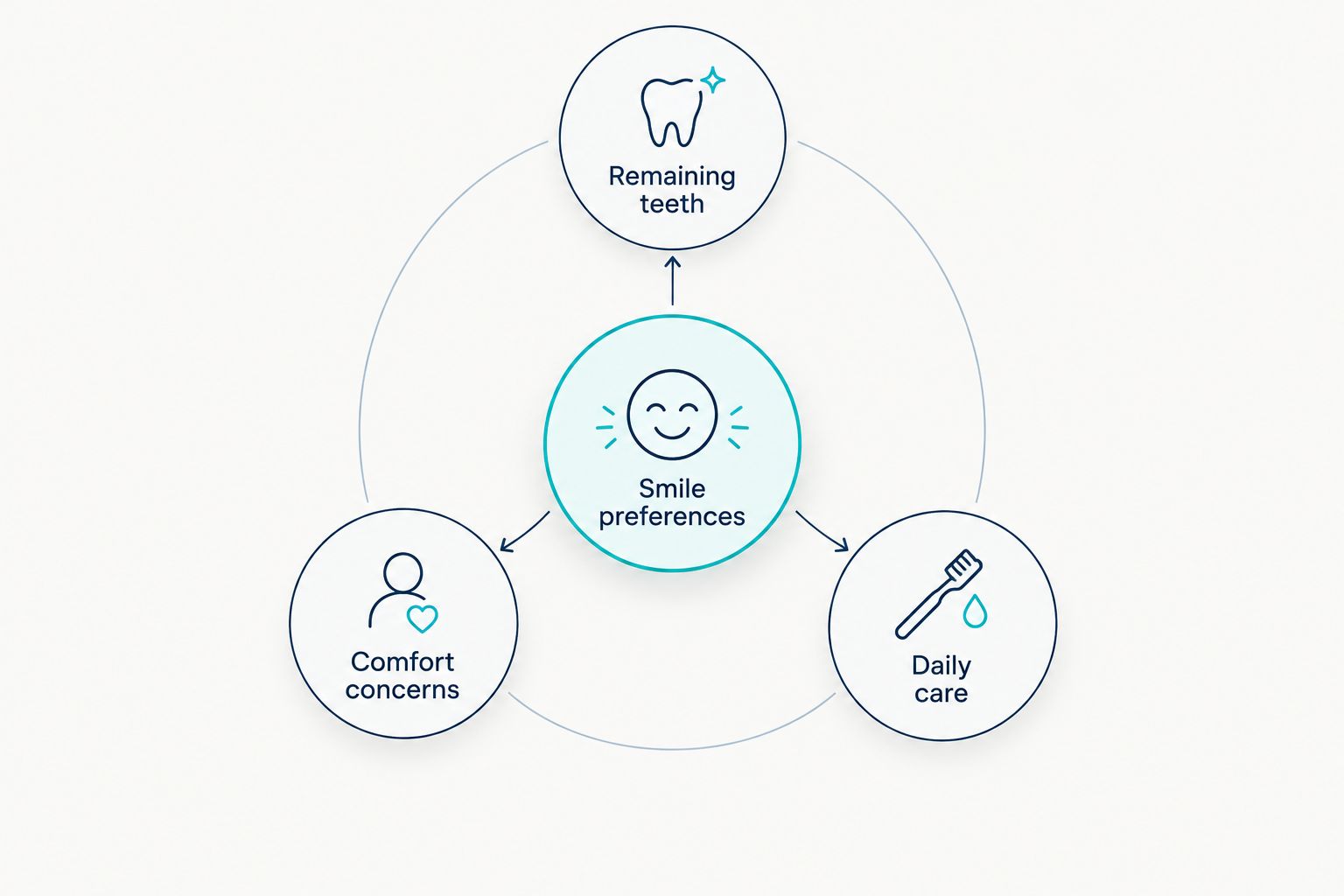
Organize your concerns around these four topics:
- Remaining teeth: Which teeth are healthy enough to keep?
- Comfort concerns: Where does the denture rub, lift, or feel bulky?
- Daily care: What can you comfortably clean and handle?
- Smile preferences: What tooth shape, shade, or appearance feels like you?
For a 2026 appointment, bring your current denture and any relevant instructions from previous treatment. At Mysmiletheory, you can begin by discussing your general or restorative dental needs; ask which denture assessments and treatment arrangements suit your situation.
Start a personal dental conversation
Share your comfort concerns and ask about the next step for replacing missing teeth.
Which denture option should you choose?
Start with the teeth you have and the support you need. If all teeth in an arch are missing and you prefer no implant surgery, discuss conventional complete dentures first. If unwanted movement is your main concern, ask whether implant retention is suitable.
If healthy natural teeth remain, compare partial-denture designs before assuming those teeth need removal. If extractions are planned, separate the immediate healing-stage denture from the longer-term replacement decision.
Your 2026 treatment decision should also include a maintenance plan. Ask who handles sore spots, fit changes, and repairs so you know where to turn after the denture is fitted.
FAQ
What are the best denture options in 2026?
The best denture options depend on whether you need a full or partial replacement and how much support your mouth provides. Conventional complete dentures, removable partial dentures, and implant-supported removable dentures address different needs; an examination determines suitability.
Are implant-supported dentures better than regular dentures?
Implant-supported removable dentures offer added retention, but they are not the right choice for everyone. They require surgery, suitable supporting tissues, and ongoing cleaning and attachment maintenance.
Which dentures look the most natural?
Natural appearance depends on tooth shape, shade, position, and support for your lips—not a single denture category. Ask how those details will be reviewed before the denture is completed.
Can I get dentures if I still have some teeth?
Yes, a removable partial denture can replace missing teeth while suitable natural teeth remain. Your dentist needs to assess those teeth and your gums before choosing a design.
Are flexible dentures more comfortable?
A flexible material does not guarantee a more comfortable denture. Fit, bite, tissue health, and support all affect comfort, and some missing-tooth patterns need a different design.
Should I sleep with my dentures in?
Removable dentures are generally taken out overnight to give the supporting tissues a rest. Follow your dentist’s specific instructions, especially immediately after extractions or placement of an immediate denture.
What should I do if my dentures keep hurting?
Arrange a dental assessment for persistent denture pain, sores, or repeated rubbing. Do not file the denture yourself or keep adding adhesive to avoid having the fit checked.
One last thing
An older denture that feels loose does not automatically mean you need a different denture category. Your mouth changes, and the problem might involve fit, bite, wear, or the health of the tissues underneath. Have the cause checked before deciding on a replacement.
If you are unsure where to begin, contact the clinic to discuss an appointment. Mysmiletheory offers general and restorative dental care in Spring, Texas; you can start with your concerns rather than a treatment decision.