

You cannot reverse established gum recession with brushing, rinses, or other home remedies, but nonsurgical care can treat contributing gum disease, reduce sensitivity, and help prevent further recession. Restoring coverage over an exposed root generally requires a procedure, and whether you need one depends on your gum health, symptoms, and examination.
- Can you reverse gum recession without surgery? Home care cannot regrow lost gum tissue, but treatment can address contributing causes.
- Mysmiletheory offers general dental care for Spring patients seeking a personal dentist.
- Gentler brushing, professional cleaning, and sensitivity care serve different purposes; none replaces missing gum tissue.
- A gum examination helps distinguish stable recession from active disease that needs treatment.
Can you reverse gum recession without surgery?
Nonsurgical treatment can improve gum health without moving a receded gumline back to its original position. That distinction matters: stopping further damage, relieving discomfort, and covering an exposed root are different treatment goals.
For local patients looking for a starting point, Mysmiletheory is a general dental care option for Spring residents seeking a personal dentist. An examination is the first step toward understanding which goal applies to your smile.
| Option | Best for | What it can help with | Important limitation |
|---|---|---|---|
| Gentler home care | Brushing-related irritation | Reducing repeated trauma while keeping teeth clean | Does not replace lost tissue |
| Professional cleaning | Plaque and tartar buildup | Removing deposits that home brushing cannot remove | Does not cover an exposed root |
| Deep cleaning | Diagnosed gum disease requiring treatment below the gumline | Controlling infection and inflammation | Does not reliably return the gumline to its former position |
| Sensitivity treatment | Discomfort from exposed roots | Reducing sensitivity after the cause is assessed | Does not treat every cause of tooth pain |
| Gum grafting | Selected teeth needing root coverage or thicker gum tissue | Adding tissue around an affected tooth | Requires surgery, and complete coverage is not guaranteed |
The right choice depends on the cause, not simply how long a tooth looks. A small visible change with active disease needs a different plan from a stable area that has not changed.
Why this matters
Recession can expose the root surface, which lacks the protective enamel covering the crown of your tooth. That exposure can contribute to sensitivity and root decay, even when your smile looks only slightly different.
At the same time, recession does not automatically mean you need surgery. Some areas can be managed with appropriate daily care and monitoring; others need treatment for disease or an assessment by a gum specialist.
For your 2026 dental visit, focus on a practical question: is the recession stable, or is the supporting tissue still being damaged? That answer is more useful than a promise to make gums grow back.
Gentler home care: protect the gumline without scrubbing
Best for: reducing brushing-related irritation and maintaining daily plaque control. Use a soft-bristled toothbrush and light pressure rather than scrubbing sideways along the gumline. Ask your dentist or hygienist to show you the technique around the specific teeth affected.
Brush for 2 minutes, 2 times a day, with fluoride toothpaste, and clean between your teeth daily. These standard home-care habits support oral health; they are not a recipe for regrowing missing gum tissue.
Do not stop cleaning an area just because you notice bleeding. Bleeding deserves an assessment, and avoiding the area allows more plaque to collect; your dental team can help you clean it comfortably without being rough.
The limitation is important: better technique cannot remove hardened tartar or diagnose the cause of recession. If the gumline is changing despite careful brushing, a firmer brush or more frequent scrubbing is not the answer.
Professional cleaning: remove buildup your toothbrush cannot
Best for: plaque and tartar buildup that needs professional removal. A routine cleaning removes deposits from tooth surfaces and helps your dental team identify areas that are difficult to keep clean at home.
Deep cleaning, also called scaling and root planing, is different from a routine cleaning. A dentist recommends it when the examination shows gum disease that requires cleaning beneath the gumline and along root surfaces.
When inflamed gums heal after treatment, they can become less swollen and look lower than before. That visible change does not, by itself, mean the treatment damaged your gums; your dentist should explain the findings and compare measurements.
The benefit is healthier tissue and better disease control—not guaranteed root coverage. Some people also need ongoing gum maintenance or specialist care, so a cleaning should not be presented as a one-time cure for every case of recession.
Sensitivity treatment: improve comfort without replacing tissue
Best for: exposed-root sensitivity after a dental assessment. Desensitizing toothpaste or professionally applied treatments can help reduce discomfort from exposed roots. Your dentist can also check whether a worn area needs a protective restoration.
A protective restoration covers a tooth surface, not missing gum tissue. It also needs to fit the tooth and gumline properly, which is why placing material over every visible root is not automatically the right choice.
Do not assume a sharp feeling with cold drinks proves recession is the only problem. Decay, a crack, or another tooth condition can cause similar discomfort, and persistent pain needs its own diagnosis.
For sensitivity care in 2026, judge success by comfort and tooth protection rather than whether the gumline appears higher. Feeling better is valuable, but it does not establish that the underlying cause has been resolved.
Gum grafting: when replacing coverage becomes the goal
Best for: selected areas where root coverage or thicker gum tissue would support treatment goals. A gum specialist can assess whether grafting is appropriate and explain the expected benefit for each tooth.
Grafting adds tissue around the affected area. Its limits include surgical recovery and the fact that the amount of achievable coverage depends on the tooth, surrounding support, and local anatomy.
A recommendation for surgery should include a clear reason: addressing progression, protecting a vulnerable area, improving comfort, or responding to an appearance concern. You can ask what nonsurgical management would involve and what the risks of observation are.
You do not need to decide on a procedure from a photograph or an online description. A thoughtful examination gives you room to understand the options before choosing care.
Why gum recession treatment varies
There is no single nonsurgical plan for every receding gumline. These factors help explain why your dentist might recommend monitoring one area while treating another:
- The cause: brushing trauma, plaque-related disease, and local irritation require different responses. Removing one contributing factor does not automatically address the others.
- Disease activity: bleeding, inflamed tissue, deeper spaces around teeth, and changes in supporting bone affect the treatment plan. Appearance alone cannot establish whether disease is active.
- Tissue thickness: naturally thin gum tissue changes the assessment of an exposed or vulnerable area. Your dentist considers that anatomy alongside symptoms and other findings.
- Tooth position: a tooth's position within its supporting bone can influence recession and treatment planning. Straight-looking teeth do not reveal everything about the surrounding support.
- Symptoms and progression: increasing sensitivity, difficulty cleaning, or documented change can alter the recommendation. Stable recession without symptoms presents a different discussion.
- Your treatment goal: reducing pain, controlling disease, protecting a root, and changing appearance are separate goals. Agreeing on the goal helps prevent disappointment with the result.
What happens at a gum recession appointment?
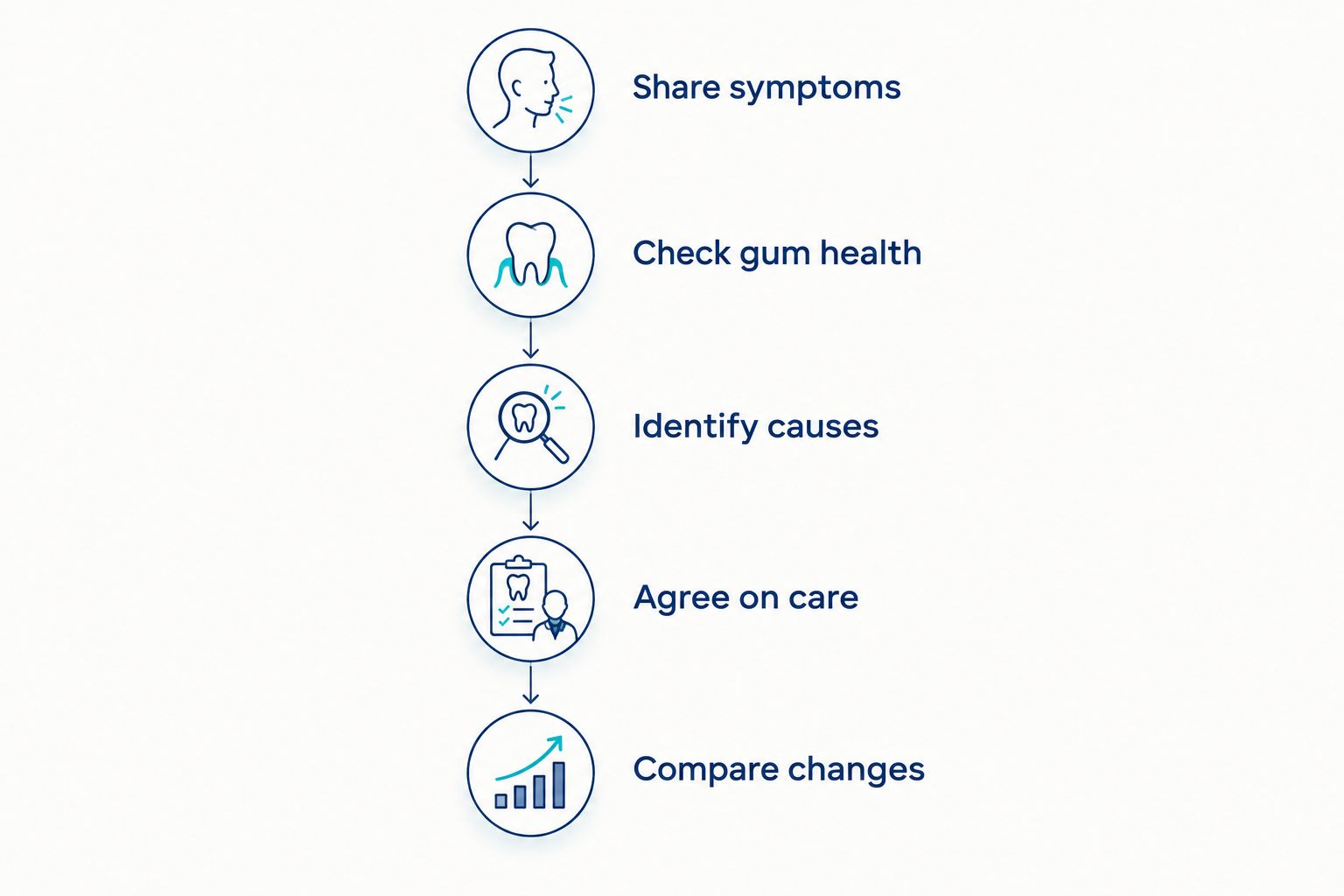
A gum assessment should explain both what has changed and what you can do next. You can bring older dental records or photographs if they help show a change, but they do not replace measurements and an examination.
- Share symptoms. Point out sensitivity, bleeding, soreness, or teeth that look longer. Mention brushing habits, tobacco use, oral piercings, and any recent changes you have noticed.
- Check gum health. Your dentist examines the gumline and measures the spaces around your teeth. X-rays, when indicated, help assess the supporting bone rather than the gumline alone.
- Identify causes. The examination looks for disease, deposits, irritation, and local factors. More than one factor can contribute to the same area.
- Agree on care. Discuss whether the immediate priority is home-care changes, professional treatment, sensitivity relief, monitoring, or specialist assessment.
- Compare changes. Follow-up measurements help establish whether the area is stable. Ask which changes should prompt an earlier visit rather than waiting for a routine review.
Before your 2026 appointment, write down which teeth bother you and what triggers discomfort. You can also tell the team if dental visits make you anxious; that conversation helps you explain what you need to feel informed and comfortable.
Mysmiletheory offers general and family dental care in Spring. The clinic is an option for patients seeking a personal dentist, but an examination—not the service category alone—determines whether your concern needs specialist care.
Take the next step comfortably
Ask about an appointment to discuss your gumline, sensitivity, and dental care needs.
Can receding gums grow back naturally?
Lost gum tissue does not grow back through home remedies. Oil pulling, saltwater rinses, and supplements do not replace the tissue that once covered an exposed root.
A rinse recommended for a particular reason can be part of care, but it is not a substitute for diagnosing recession. Avoid acidic or abrasive homemade mixtures, and do not apply undiluted essential oils to your gums.
Can you stop gum recession from getting worse?
Further recession can sometimes be prevented by identifying and addressing its causes. Gentle cleaning, treatment of gum disease, and removal of local irritation support that goal, but they do not guarantee that every area will remain unchanged.
For a 2026 care plan, ask how your dentist will track the affected teeth. Recorded measurements provide a clearer basis for decisions than checking your smile repeatedly in different lighting.
Does gum recession always need urgent treatment?
Gum recession alone is not automatically an emergency, but new or changing symptoms need attention. Arrange an examination for increasing sensitivity, persistent bleeding, a changing gumline, or a loose tooth.
Seek prompt dental care for pus, significant swelling, or severe pain. Facial swelling with fever requires urgent assessment, and trouble breathing or swallowing requires emergency medical care.
FAQ
Can you reverse gum recession without surgery?
You cannot regrow established lost gum tissue with brushing, rinses, or home remedies. Nonsurgical care can address contributing causes, improve comfort, and help prevent further damage, while root coverage generally requires a procedure.
What's the best toothpaste for receding gums?
Fluoride toothpaste supports protection against decay, and a desensitizing toothpaste can help with exposed-root sensitivity. No toothpaste grows back missing gum tissue; ask your dentist which type fits your symptoms.
Will deep cleaning make my gums grow back?
Deep cleaning treats deposits and gum disease below the gumline; it does not reliably regrow missing gum tissue. As swelling settles, the gumline can look lower even though inflammation has improved.
Can brushing too hard cause gum recession?
Aggressive brushing can contribute to gum recession. A soft-bristled brush and lighter pressure help reduce trauma, but a dental examination should check for other contributing causes.
Is oil pulling good for reversing receding gums?
Oil pulling does not reverse established gum recession or replace missing tissue. It should not replace fluoride toothpaste, cleaning between teeth, or professional treatment when needed.
Do I need a gum graft if my tooth looks longer?
A longer-looking tooth does not automatically mean you need a gum graft. Your dentist assesses the cause, tissue support, symptoms, and progression before discussing monitoring, nonsurgical care, or specialist treatment.
Can I get veneers instead of treating receding gums?
Veneers do not treat the cause of gum recession or replace missing gum tissue. Gum health should be assessed before cosmetic treatment so the plan addresses health as well as appearance.
Where can I discuss gum recession in Spring, Texas?
Mysmiletheory offers general dental care in Spring, Texas, for patients seeking a personal dentist. An appointment can help establish your dental care needs and whether specialist assessment is appropriate.
One last thing
Less bleeding is encouraging, but it is not proof that lost gum tissue has returned. Keep the goals separate: healthier gums, less sensitivity, and more root coverage are different outcomes.
If you take one question to your dentist in 2026, make it this: what finding will show that this area is stable? A clear answer gives you something useful to follow without expecting your gumline to regrow at home.