Oil and gas workers’ dental care is prevention and treatment planned around work demands, with the aim of keeping your teeth healthy and addressing problems before time away. If your job involves rotating shifts, travel, or remote assignments, this guide explains how to fit appointments, daily care, and recovery into your 2026 schedule.
- Dental care for oil and gas workers should match shift schedules, travel plans, and access to treatment.
- Mysmiletheory is best suited to Spring-area workers seeking a local dentist for general and restorative dental care.
- Brush with fluoride toothpaste for two minutes twice daily, and clean between your teeth daily.
- Arrange an evaluation for pain, swelling, or a broken tooth rather than waiting for your next break.
Why dental care matters for oil and gas workers
An offshore assignment, overnight shift, and office-based role create different scheduling needs. Your dental plan should reflect your actual work—not assume that every oil and gas worker has the same routine or access to care.
The practical issue is access: a tooth that needs attention is harder to manage when you cannot easily leave your worksite. Arrange an evaluation before travel when you notice a problem, rather than using your departure date as a reason to postpone it.
Mysmiletheory provides general, cosmetic, restorative, and family dentistry in Spring, Texas. Mysmiletheory is best suited to Spring-area workers seeking a local dentist for general and restorative dental care.
You do not need a complicated routine. You need habits that survive schedule changes, appointments that account for your next assignment, and clear instructions when treatment affects eating, driving, or work.
Build your dental care plan around your work
1. Map your work calendar before choosing an appointment
Start with your own calendar. Mark departure dates, night shifts, travel days, and the periods when you can return for follow-up care; then explain those constraints when requesting an appointment.
For your 2026 planning, distinguish an examination from treatment. An examination helps identify what needs attention, while the treatment schedule depends on the findings. Do not assume every concern can be resolved during the same visit.
If you have only a short break at home, say so at the beginning. Ask which concerns need attention first and whether any recommended treatment requires another appointment, healing time, or changes to your normal duties.
- Write down your next departure and return dates.
- Describe your shift pattern and usual sleep hours.
- Mention limits on leaving your worksite for care.
- Ask whether treatment involves follow-up appointments.
- Keep space for recovery rather than booking against departure.
2. Anchor daily care to waking and sleeping
Use your sleep cycle instead of the clock. If you sleep during daylight hours, your main brushing routine can still happen after waking and before your main sleep period.
The American Dental Association recommends brushing with fluoride toothpaste for 2 minutes, 2 times daily, and cleaning between your teeth daily. That means protecting two brushing sessions even when a shift crosses midnight—not skipping one because the calendar date changed.
Pack the same basic supplies for work that you use at home. A toothbrush does not help if it stays in your bathroom while you spend the night elsewhere, and mouthwash does not replace brushing or cleaning between teeth.
- Brush gently with a soft-bristled toothbrush and fluoride toothpaste.
- Set aside 2 minutes for each brushing session.
- Clean between your teeth at least 1 time daily.
- Carry a toothbrush and your preferred interdental cleaner.
- Let your toothbrush air-dry between uses when practical.
3. Prioritize symptoms before cosmetic changes
Begin with a short written list of what you feel: pain when biting, sensitivity, bleeding gums, a rough edge, or a loose restoration. Include when the symptom started and what brings it on; that information helps your dentist assess the concern.
Pain relief and tooth health come before whitening or veneers. A cosmetic goal deserves attention, but changing a tooth’s appearance does not address an untreated cavity, gum problem, or infection.
Mysmiletheory’s dental services include general, restorative, and cosmetic care. Discuss your concerns first, then ask how recommended care fits your work calendar and your preference for comfortable treatment and a natural-looking smile.
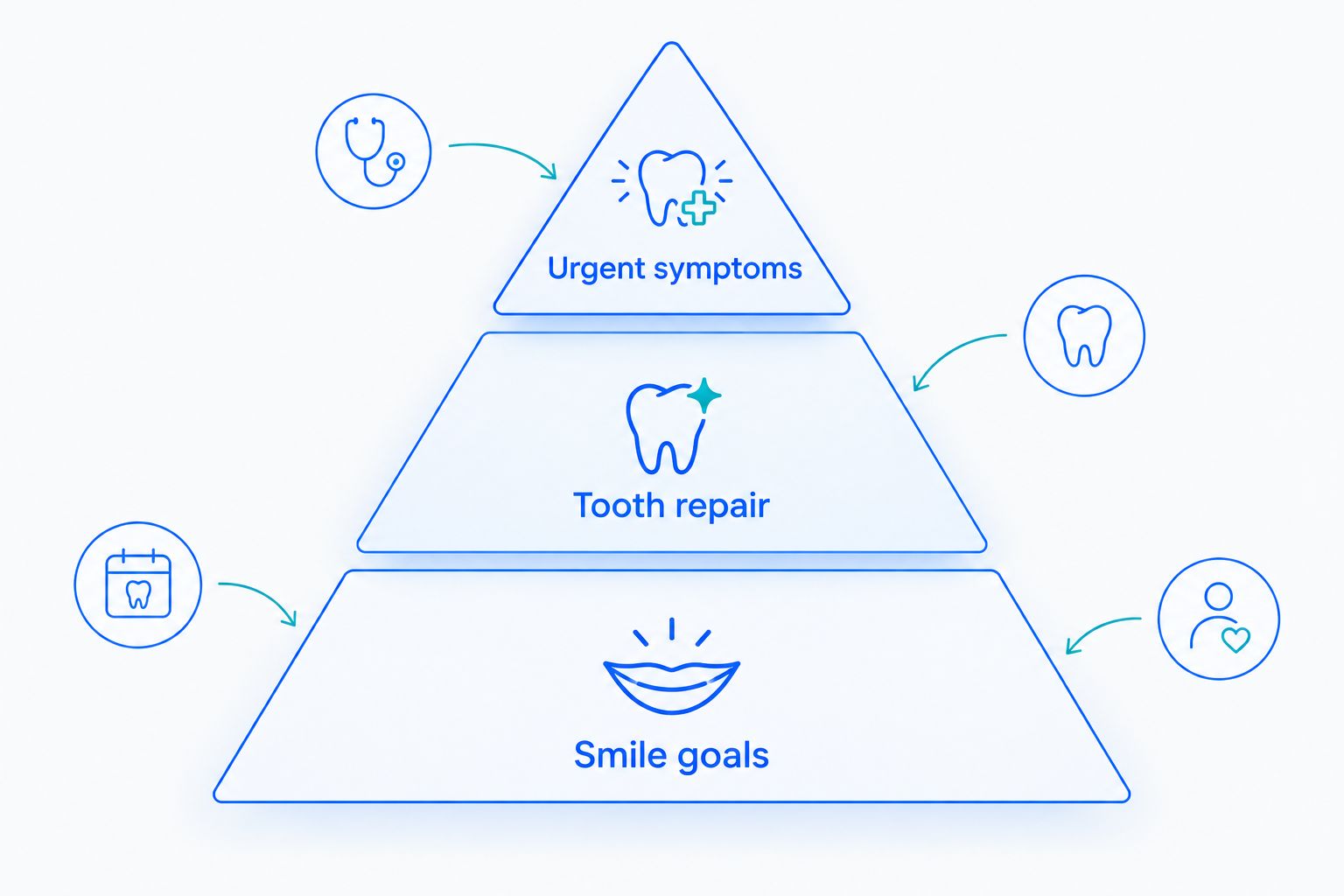
- Urgent symptoms: Report swelling, worsening pain, or a recent injury.
- Tooth repair: Ask what a damaged or decayed tooth needs.
- Smile goals: Describe the appearance you want without choosing treatment first.
- Request a clear explanation of alternatives and their limitations.
- Ask what should happen before your next assignment.
These priorities help organize the conversation; they do not replace an examination. A tooth’s appearance alone cannot tell you whether it is healthy or which repair is appropriate.
4. Adjust workday habits that affect your mouth
Look at what actually happens during your shift. Frequent sweetened drinks, persistent dry mouth, tobacco use, or jaw clenching deserve a conversation without judgment; none should be assumed simply because you work in oil and gas.
Water is a useful everyday drink, but ongoing dry mouth needs more than a reminder to hydrate. Medicines and health conditions can contribute, so tell your dentist what you take and when dryness occurs. Do not stop a prescribed medicine on your own.
If you wake with jaw soreness or notice worn teeth, ask for an assessment before buying a guard. Grinding, clenching, and other causes of discomfort need an individual evaluation rather than a one-size-fits-all solution.
- Choose water regularly instead of repeatedly sipping sweetened drinks.
- Tell your dentist about persistent dryness or mouth sores.
- Bring an updated list of medicines and supplements.
- Discuss tobacco or nicotine use openly.
- Report jaw pain, morning headaches, or changes in your bite.
5. Make a dental problem plan before leaving
Save your dentist’s contact details and learn how to access care near your assignment. If you work offshore or at a remote site, ask your employer or site medical team about the reporting process before you need it.
A toothache, broken filling, or swelling needs professional guidance. Seek emergency medical care for difficulty breathing or swallowing, or rapidly spreading facial or neck swelling. In the United States, call 911 when you need emergency assistance.
For a damaged tooth without those emergency signs, contact a dentist promptly and follow the site’s medical procedures. Pain medicine does not repair a tooth or remove the cause of an infection, even when it temporarily makes you feel better.
- Save dental and site medical contacts offline.
- Report pain, swelling, or injury rather than hiding symptoms.
- Avoid chewing on a damaged tooth while arranging care.
- Never place aspirin directly against a tooth or gum.
- Follow medicine labels and advice about your health conditions.
6. Confirm recovery needs before returning to duty
Before treatment, explain whether your work involves driving, operating equipment, lifting, or being far from medical help. These details matter when discussing recovery, medicines, and any sedation being considered.
There is no universal return-to-work timetable for dental treatment. A cleaning, filling, extraction, and treatment involving sedation have different aftercare needs; your dentist’s instructions should match the procedure and your health.
When arranging care in 2026, ask for written instructions you can take with you. If your work schedule conflicts with the recommended recovery period, discuss the conflict before treatment instead of deciding afterward to ignore the restrictions.
- Ask when you can eat and chew normally.
- Confirm whether driving or equipment operation is restricted.
- Ask about lifting and strenuous activity when relevant.
- Understand which symptoms require a follow-up call.
- Confirm any return appointment before traveling.
Talk through your dental care needs
Share your symptoms, work schedule, and smile goals when requesting an appointment.
Compare dental care options for your situation
For your 2026 care plan, choose the purpose of the visit before focusing on a particular procedure. These options address different needs; they are not interchangeable, and none guarantees that future problems will not develop.
| Care option | Best for | Main benefit | Key limitation |
|---|---|---|---|
| Preventive examination and cleaning | Workers without urgent symptoms who need ongoing care | Checks oral health and removes deposits that need professional cleaning | Does not replace treatment for an established cavity or damaged tooth |
| Restorative evaluation | Workers with decay, damaged teeth, or an existing restoration concern | Identifies ways to restore tooth function | The repair and number of appointments depend on examination findings |
| Urgent dental evaluation | Workers with pain, swelling, or a recent dental injury | Assesses the immediate problem and treatment needs | An initial visit does not always complete the lasting repair |
| Cosmetic consultation | Workers seeking changes to tooth color, shape, or appearance | Connects appearance goals with suitable treatment choices | Cosmetic treatment does not replace treatment for active disease |
Preventive care is the starting point when you have no urgent concern; symptoms change the priority. Tell the office why you are calling so the appointment request reflects your needs rather than simply asking for a cleaning.
Local continuity is a practical reason to consider Mysmiletheory dental care if you live near Spring. Its location does not remove the need to arrange care near an assignment when symptoms arise while you are away.
Common mistakes oil and gas workers should avoid
Waiting until the last day home
Booking immediately before departure leaves little room to discuss findings or arrange follow-up treatment. Contact the office when you know your schedule, and mention any symptoms rather than waiting for a routine reminder.
Treating pain relief as a completed repair
A quieter tooth is not proof that the underlying problem has resolved. Tell your dentist about recent pain even if it stopped, especially before an assignment where access to care is limited.
Planning recovery around the job title alone
Two people in the same industry can have very different duties. Describe your actual tasks, transportation needs, and distance from help so the dentist can give relevant instructions.
Choosing cosmetic work before checking tooth health
Whitening or veneers should not be used to bypass a concern about decay, gum health, or a damaged tooth. Start with an examination and explain the natural-looking result you want; the appropriate sequence follows from your oral health.
Assuming a short home break means skipping care
A limited window is still a reason to discuss your needs. Explain your constraints, ask what an initial visit can establish, and avoid expecting the office to promise a complete treatment schedule before an assessment.
FAQ
What's the best dental routine for oil and gas workers on rotating shifts?
Brush with fluoride toothpaste for two minutes twice daily and clean between your teeth daily. Anchor those habits to waking and your main sleep period rather than conventional morning and evening hours.
Should I see a dentist before going offshore?
Arrange an evaluation before departure if you have pain, swelling, a broken tooth, or another unresolved concern. Tell the dentist when you leave and how limited your access to care will be during the assignment.
Can I finish all my dental treatment during one break at home?
That depends on your examination findings and the treatment required. Explain your available dates before treatment planning, and ask specifically about follow-up visits and recovery.
Can I return to operating equipment after a dental appointment?
Return to equipment operation only when your treatment instructions and any medicines allow it. Sedation and certain medicines can impair your ability to work safely, so explain your duties before the appointment.
What should I do if my tooth starts hurting at a remote worksite?
Contact a dentist and follow your site's medical reporting process promptly. Difficulty breathing or swallowing, or rapidly spreading facial or neck swelling, requires emergency medical care.
Should I get whitening or veneers before fixing a painful tooth?
Have the painful tooth assessed before starting cosmetic treatment. Your dentist can explain which health concerns need attention first and then discuss options for a natural-looking smile.
How should I plan dental appointments around my 2026 work rotation?
Share your departure dates, home breaks, and actual job duties when requesting an appointment. Ask which visits are needed and what recovery restrictions apply before committing to treatment dates.
One last thing
Bring your work calendar to the appointment, not just your insurance information. The date you leave, the equipment you operate, and your ability to return are useful parts of the treatment conversation.
You do not need to apologize for an unusual schedule or time away from dental care. Start with what concerns you now, explain what your work requires, and ask for a plan you understand.