
Best overall for a restorable cracked molar: a dental crown. Best for a localized broken cusp: an onlay. Best for a small, shallow defect: a filling. If the tooth’s inner tissue is damaged or infected, root canal treatment followed by protective restoration can help save it; a split or unrestorable tooth usually needs extraction. This 2026 guide explains which option fits which kind of damage.
- The best treatment for cracked molar damage depends on crack depth, remaining tooth structure, and pulp health.
- A dental crown protects a restorable molar; an onlay suits selected localized breaks.
- Root canal treatment addresses damaged or infected pulp, not the crack itself.
- Mysmiletheory provides restorative dental care for local patients in Spring, Texas.
Why this matters
A broken molar is not automatically a lost tooth. But a small-looking crack can reach deeper than you can see, and the right treatment depends on what remains healthy beneath the surface.
Mysmiletheory is a local option for patients in Spring, Texas seeking restorative dental care. You can start with Mysmiletheory to arrange an appointment and discuss the tooth that concerns you.
Pain when chewing, sensitivity, or a missing piece deserves an examination. You do not need to know which restoration you want before you book; the first decision is whether the tooth can be saved.
What makes the best treatment for a cracked molar?
The best treatment for cracked molar damage protects useful tooth structure while addressing the actual problem. For your 2026 treatment decision, use these criteria rather than choosing by appearance alone:
- Crack depth: A shallow surface defect needs a different approach from a crack reaching the tooth’s inner tissue or root.
- Remaining structure: The dentist needs enough sound tooth to support a durable restoration.
- Pulp health: The pulp contains nerves and blood vessels. Damage or infection there changes the treatment plan.
- Chewing protection: A weakened molar needs support against biting forces, especially around its raised chewing points, called cusps.
- Long-term care: Cleaning, bite management, and follow-up matter after the tooth is restored.
A crown, onlay, filling, root canal, and extraction are not interchangeable choices. Each solves a different problem, so the ranking below is a decision guide—not a reason to request the same treatment for every crack.
Cracked molar treatments at a glance
| Treatment | Best for | Standout benefit | Key limitation |
|---|---|---|---|
| Dental crown | A restorable molar with substantial weakness | Covers and supports the remaining tooth | Requires tooth preparation; cannot guarantee the crack will stop progressing |
| Dental onlay | A localized broken cusp with sufficient healthy tooth | Covers damaged chewing areas while preserving selected sound surfaces | Unsuitable when damage requires broader coverage |
| Filling | A small, shallow defect in an otherwise sound molar | Repairs a limited area conservatively | Does not provide the protection needed for a substantial crack |
| Root canal plus protective restoration | A restorable tooth with damaged or infected pulp | Treats the inner tissue so the tooth can be retained | Does not repair the crack itself |
| Extraction | A split tooth or damage that cannot be restored | Removes a tooth that cannot be predictably saved | Leaves a space and requires a separate replacement discussion |
1. Dental crown: best for a weakened but restorable molar
A dental crown covers the prepared tooth and supports its remaining structure. For a cracked molar that can still be restored, coverage can reduce movement between weakened sections during chewing.
A crown is often the leading option when a substantial piece has broken away or the tooth needs protection beyond a small repair. The dentist still needs to assess the crack and pulp before recommending it.
Dental crown pros:
- Protects weakened chewing surfaces.
- Restores the tooth’s shape and contact with opposing teeth.
- Can preserve a natural tooth that remains restorable.
Dental crown cons:
- Requires removal of some tooth structure during preparation.
- Cannot make a deep or unfavorable crack repairable.
- Does not guarantee that an existing crack will stop progressing.
Best for: A molar with enough healthy supporting structure but too much weakness for a limited repair.
Ask whether the tooth needs treatment inside before the crown is placed. A crown alone does not treat infected pulp, and covering the tooth without addressing that problem is not a complete solution.
Verdict: Discuss a crown when the tooth is restorable and needs broad chewing protection.
2. Dental onlay: best for a localized broken cusp
A dental onlay restores part of the chewing surface and covers one or more damaged cusps. Unlike a full crown, it does not necessarily cover the entire tooth.
An onlay fits selected cases where the break is localized and enough healthy structure remains. It is not simply a smaller crown for every patient; its suitability depends on the fracture pattern and the surfaces available to support it.
Dental onlay pros:
- Can preserve sound tooth surfaces that do not need coverage.
- Protects damaged cusps rather than only filling a hole.
- Rebuilds the affected chewing area.
Dental onlay cons:
- Does not suit every crack or extensive break.
- Depends on suitable remaining tooth structure and a reliable seal.
- Does not treat unhealthy pulp inside the tooth.
Best for: A localized cusp fracture without a deeper problem requiring a different approach.
Ask your dentist which cusps need support and why an onlay would be sufficient. Preserving tooth structure is helpful only when the restoration also provides the protection your molar needs.
Verdict: Discuss an onlay for a limited break with adequate healthy structure.
3. Filling: best for a small, shallow defect
A filling replaces a limited area of missing tooth structure. It can be appropriate for a small chip or defect when the surrounding tooth remains strong and the examination rules out a more serious fracture.
A filling is not the default answer to pain from a cracked molar. If the tooth flexes around a substantial crack, filling the visible defect alone does not provide the support of cusp coverage.
Filling pros:
- Repairs a small area without covering the whole tooth.
- Preserves surrounding healthy structure in suitable cases.
- Restores the contour of a limited defect.
Filling cons:
- Offers limited protection for a substantially weakened molar.
- Does not treat pulp infection.
- Can be insufficient when the visible chip hides deeper damage.
Best for: A small, shallow defect in a molar that otherwise remains sound.
The useful question is not whether a filling is simpler. Ask whether it protects the tooth adequately. A smaller restoration is the right choice only when the damage is genuinely limited.
Verdict: Consider a filling for a minor defect; skip it as a substitute for needed crack protection.
4. Root canal plus restoration: best for damaged or infected pulp
Root canal treatment removes damaged or infected tissue from inside the tooth, then cleans and seals that space. A molar usually needs a protective restoration afterward, commonly a crown, because treating the inside does not rebuild or protect the chewing surface.
A root canal treats the pulp problem, not the crack itself. The tooth must still be restorable for saving it to make sense.
Root canal plus restoration pros:
- Addresses infection or irreversible damage within the tooth.
- Can preserve a natural molar that would otherwise need removal.
- Allows internal treatment and chewing protection to work together.
Root canal plus restoration cons:
- Cannot save every cracked or split tooth.
- Requires completion of the final restorative plan.
- Does not eliminate the risk of future crack progression.
Best for: A restorable molar whose pulp is irreversibly damaged or infected.
Sensitivity alone does not prove that you need a root canal. Your dentist uses the symptom history, examination, and tests to determine whether the pulp can recover or needs treatment.
Verdict: Discuss root canal treatment when pulp disease is confirmed and the molar can still be restored.
5. Extraction: best for a tooth that cannot be saved
Extraction removes a tooth when its damage makes predictable restoration impossible. A split tooth or an unfavorable root fracture can make removal the appropriate choice rather than repeated attempts to repair it.
Extraction is not the first choice simply because a molar hurts. The examination should establish why retaining the tooth is not a sound option.
Extraction pros:
- Removes an unrestorable tooth.
- Addresses a source of pain or infection when that tooth is responsible.
- Avoids placing a restoration on a tooth that cannot support it.
Extraction cons:
- Permanently removes the natural tooth.
- Leaves a space that needs assessment for its effect on chewing and neighboring teeth.
- Makes tooth replacement a separate treatment decision.
Best for: A tooth with a fracture or loss of structure that prevents dependable restoration.
Ask what makes the tooth unrestorable and whether specialist assessment would change that conclusion. If removal is necessary, discuss healing and replacement before deciding on the next stage.
Verdict: Choose extraction when examination confirms that saving the molar is not predictable.
How these treatments are ranked
This 2026 guide ranks treatments by the problem they solve: supporting a weakened tooth, restoring a localized break, repairing a minor defect, treating diseased pulp, or removing an unrestorable tooth. The order favors retaining useful natural tooth structure when that is clinically appropriate.
The American Association of Endodontists’ patient guidance on cracked teeth distinguishes fractured cusps, cracked teeth, split teeth, and vertical root fractures. That distinction matters: the word “cracked” alone does not identify the right treatment.
What happens before you choose treatment?
A cracked-molar assessment combines your symptoms with an examination. X-rays help evaluate surrounding structures and other problems, but a crack does not always appear clearly on an X-ray.
Your dentist can check how the tooth responds to biting and temperature, examine it under light or magnification, and assess the gum around it. Findings—not the size of the visible chip alone—guide the recommendation.
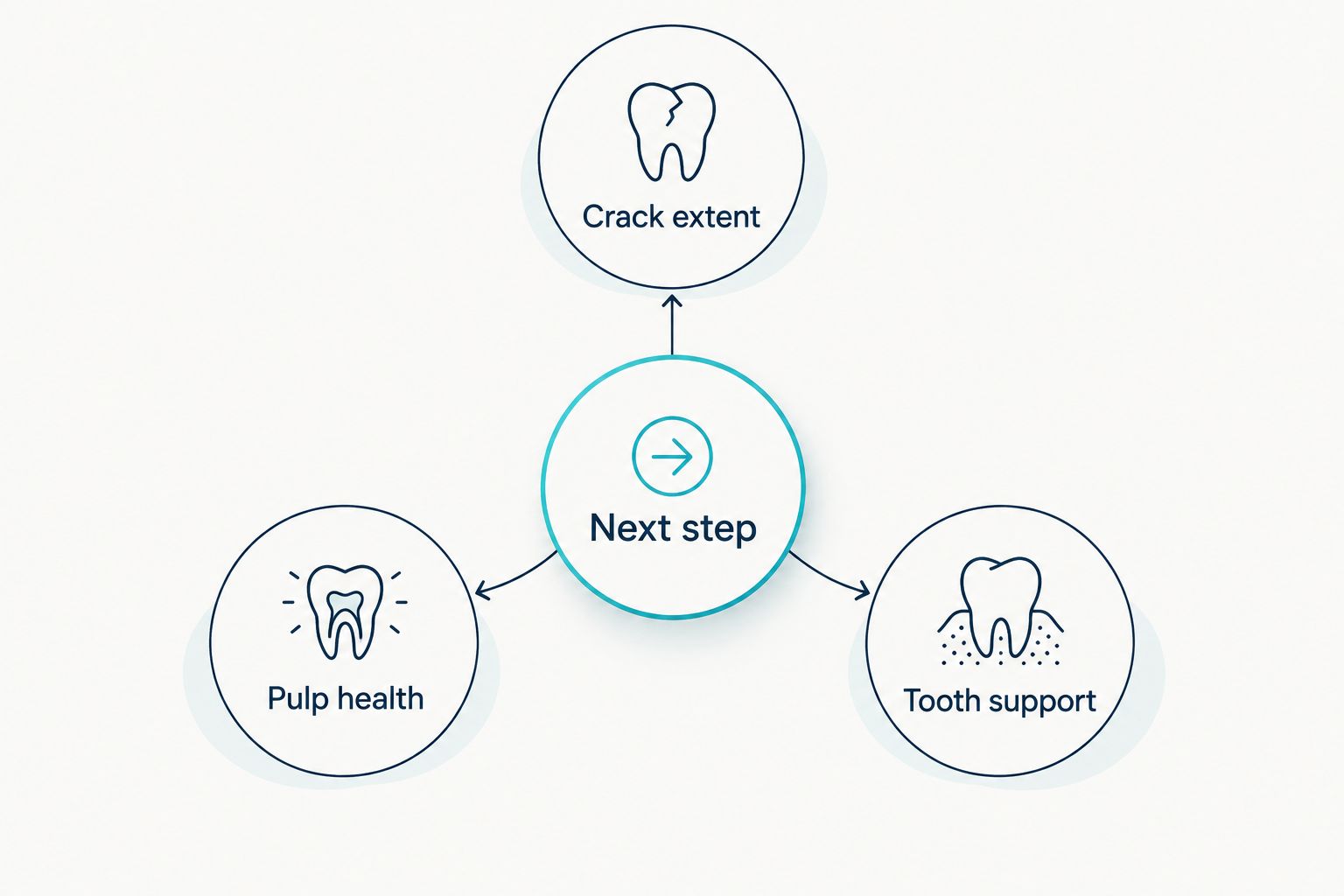
Bring these questions to your 2026 appointment:
- Crack extent: How far does the damage appear to reach?
- Pulp health: Does the tissue inside need treatment?
- Tooth support: What healthy structure remains to hold a restoration?
- Next step: What treatment protects the tooth without unnecessary work?
Tell the dentist when the discomfort started, what triggers it, and whether a piece broke off. If you feel anxious, say so before treatment planning. Clear explanations and an agreed way to pause can help you feel more involved.
What to do while waiting for your appointment
Avoid chewing on the affected side, and skip hard or sticky foods that put pressure on the tooth. Keep the area clean with gentle brushing; do not repeatedly bite down to test the crack or try to glue the tooth yourself.
Contact a dentist promptly for biting pain, persistent sensitivity, a broken piece, or swelling. Trouble breathing or swallowing, or rapidly spreading facial or neck swelling, requires emergency medical care. Do not wait for a routine dental appointment in those situations.
For temporary pain relief, follow the medicine label and ask a pharmacist or clinician if you are unsure what is safe for you. Never place aspirin directly against the tooth or gum.
Which treatment should you choose?
For a restorable cracked molar that needs substantial protection, a crown is the default option to discuss—not an automatic prescription. An onlay suits selected localized breaks, while a filling belongs with genuinely small defects.
If the pulp is damaged or infected, discuss root canal treatment alongside the final restoration. If the tooth cannot be saved, ask for a clear explanation of extraction and the replacement choices relevant to your mouth.
Mysmiletheory offers restorative dental care in Spring, Texas. Start with an assessment, explain what feels uncomfortable, and ask for a plan you understand before agreeing to treatment.
Take the next step comfortably
Discuss your cracked molar and the restorative care that fits your needs.
FAQ
What is the best treatment for a cracked molar in 2026?
A crown is often the leading option for a restorable cracked molar that needs substantial protection. An onlay, filling, root canal with restoration, or extraction fits different damage patterns, so an examination determines the choice.
Can a cracked molar heal on its own?
A crack in tooth structure does not heal on its own. Symptoms can change without the crack disappearing, so reduced pain is not proof that the tooth has recovered.
Is a crown better than a filling for a broken molar?
A crown provides broader protection when a molar is substantially weakened. A filling is appropriate for a small defect when the surrounding structure remains sound.
Does every cracked molar need a root canal?
No, a cracked molar needs root canal treatment only when the pulp condition warrants it and the tooth remains restorable. The crack alone does not establish that need.
Can a dentist always see a tooth crack on an X-ray?
No, a tooth crack does not always show clearly on an X-ray. Dentists combine imaging with examination, symptom history, and tests of the affected tooth.
Can veneers fix a broken back molar?
Veneers are generally not the appropriate treatment for structural damage to a back molar. A filling, onlay, crown, or other treatment addresses the chewing surface and underlying problem more directly.
When is a cracked molar an emergency?
Trouble breathing or swallowing, or rapidly spreading facial or neck swelling, requires emergency medical care. Biting pain, a broken piece, persistent sensitivity, or localized swelling needs prompt dental assessment.
Where can I discuss restorative dental care in Spring, Texas?
Mysmiletheory offers restorative dental care for local patients in Spring, Texas. An appointment is the starting point for discussing your symptoms and determining what treatment your molar needs.
One last thing
A tooth that stops hurting is not necessarily a tooth that has recovered. Changes in symptoms can occur even while the underlying problem remains, so keep your assessment appointment rather than using pain alone to judge the crack.
For your 2026 treatment decision, ask one question before discussing appearance: “What needs to be healthy and supported for this tooth to keep working?” That answer helps separate a suitable repair from one that only covers the visible damage.


