
Seniors’ dental care is preventive and restorative care with the aim of keeping your mouth comfortable, protecting your teeth, and helping you eat and speak confidently. This 2026 guide explains how retirees can manage dry mouth, changing health needs, existing dental work, and everyday cleaning without making care feel overwhelming.
- Mysmiletheory offers dental care for seniors seeking a personal dentist in Spring, Texas.
- Brush twice daily with fluoride toothpaste and clean between teeth daily; adapt tools when grip becomes difficult.
- Dry mouth, loose dentures, and bleeding gums deserve attention rather than acceptance as normal aging.
- Choose restorative dentistry around tooth health, comfort, and daily maintenance before considering cosmetic changes.
Why dental care matters for retirees and seniors
Mysmiletheory is best for seniors in Spring, Texas, seeking a personal dentist for general and restorative dental care. The clinic also offers family and cosmetic dentistry, so you can discuss both oral health and appearance with a local dental provider. Learn about Mysmiletheory as you consider where to establish care.
Retirement changes your schedule, but it does not remove the need for dental visits. Medication-related dryness, exposed tooth roots, arthritis, and older dental work can change what your mouth needs. Tooth loss is not an inevitable part of aging.
Your 2026 care plan should reflect your health and abilities rather than your age alone. A person with healthy gums and comfortable teeth needs a different plan from someone managing sore dentures or difficulty brushing. Start with what affects eating, cleaning, and comfort; appearance can remain part of the conversation without becoming the first priority.
Build a dental routine that fits your life
1. Update your health and medication list
Write down your prescriptions, over-the-counter medicines, supplements, allergies, and major health changes before an appointment. Include medicines taken occasionally, not just those you use every morning. A current list helps your dentist assess symptoms and coordinate treatment when necessary.
Some medicines contribute to dry mouth. Others affect bleeding or require special consideration before certain procedures. Do not stop or change a prescribed medicine on your own for dental treatment. Your dentist and prescribing clinician should guide any changes together.
For your first appointment of 2026, bring a short account of what has changed since your last examination. You do not need to remember every detail while sitting in the dental chair.
- List medication names and how you take them.
- Note diabetes, heart conditions, osteoporosis treatment, and recent hospital care.
- Describe new dryness, bleeding, soreness, or chewing difficulties.
- Bring your previous dentist’s details if records need transferring.
2. Make daily cleaning easier on your hands
Start with a soft-bristled manual toothbrush and fluoride toothpaste. The American Dental Association recommends brushing for 2 minutes, twice daily, and cleaning between your teeth daily. Brush gently along the gumline rather than scrubbing harder when teeth feel sensitive.
If arthritis or reduced grip makes brushing difficult, a larger handle or powered toothbrush can make the task easier. Floss holders and appropriately sized interdental brushes offer alternatives when handling string floss is frustrating. Ask your dentist to show you which tool fits your teeth and existing dental work.
The best tool is one you can use thoroughly and comfortably. A powered brush still needs careful placement, and a manual brush remains useful when you can clean effectively with it.
- Keep fluoride toothpaste beside your toothbrush.
- Choose a handle you can hold without straining.
- Clean between teeth once daily using a suitable tool.
- Ask for a hands-on demonstration if areas remain difficult.
3. Address dry mouth and gum changes early
Notice when your mouth feels dry: overnight, while speaking, or throughout the day. Saliva helps protect teeth, so persistent dryness is more than an inconvenience. The National Institute of Dental and Craniofacial Research identifies medicines and certain health conditions among the causes of dry mouth.
Start by sipping water and avoiding frequent sugary sweets or drinks used to relieve the sensation. Sugar-free gum can encourage saliva when you can chew it safely and comfortably. Persistent dryness needs a professional assessment rather than an endless search for a different rinse.
Mysmiletheory offers general dental care; its dental services provide a starting point for discussing symptoms and next steps. An examination is still necessary to identify the cause and choose appropriate care.
- Record when dryness or gum bleeding occurs.
- Ask whether your medicines need review with the prescriber.
- Discuss fluoride protection if your cavity risk has increased.
- Report exposed roots, tenderness, or recurring bad breath.
4. Check how your teeth and dentures function
Pay attention to changes during ordinary meals. Chewing on one side, avoiding favorite foods, or noticing food collecting in a new space can signal a problem even without constant pain. Tell your dentist what you can no longer do comfortably.
If you wear removable dentures, clean them daily and follow your dentist’s instructions for removal, soaking, and storage. Dentures do not eliminate the need to examine the gums and other mouth tissues. A loose appliance or sore spot needs assessment, not a home repair.
Do not file dentures, glue a broken appliance, or keep adding adhesive to avoid having a changing fit checked. Bring the appliance to your appointment so the dentist can assess it alongside your mouth.
- Note foods that have become difficult to chew.
- Report movement, clicking, rubbing, or repeated sore spots.
- Clean your gums and tongue as well as the appliance.
- Ask how to clean around bridges or other fixed restorations.
5. Plan appointments around health and coverage
Start with a calendar and your current insurance documents. Ask your dentist how often you need examinations and preventive care based on your gums, cavity risk, dryness, and treatment history. A fixed schedule does not suit every person equally.
For 2026, confirm dental benefits directly with your plan before agreeing to treatment. Original Medicare generally does not cover routine dental care, although certain dental services connected to covered medical treatment qualify. Medicare Advantage dental benefits differ by plan, so verify the details rather than assuming coverage.
If travel, caregiving, or fatigue makes appointments difficult, explain that before treatment begins. Ask whether a proposed plan can be organized around your needs without delaying necessary care.
- Confirm benefits, exclusions, and any referral requirements.
- Ask which problems need prompt attention.
- Discuss appointment length and opportunities for breaks.
- Bring a trusted companion if you want help remembering instructions.
6. Put comfort and tooth health before cosmetic changes
Decide what you want to improve: easier chewing, less sensitivity, a repaired chip, or a more natural-looking smile. Those are different goals. A clear priority helps your dentist explain which treatments address the problem and which change appearance only.
Mysmiletheory offers cosmetic and restorative dentistry, but an examination must establish which options suit your teeth. Whitening does not repair decay, and veneers do not treat gum disease. Existing crowns and veneers also do not whiten like natural teeth.
For cosmetic care, describe the look you prefer rather than choosing a procedure first. Ask what healthy tooth structure would change and what maintenance the result requires. A natural-looking result should fit your mouth and your ability to care for it.
- Resolve active decay and gum problems before elective cosmetic work.
- Explain whether comfort, function, or appearance matters most.
- Ask about less extensive alternatives when appropriate.
- Discuss cleaning, maintenance, and possible future repairs.
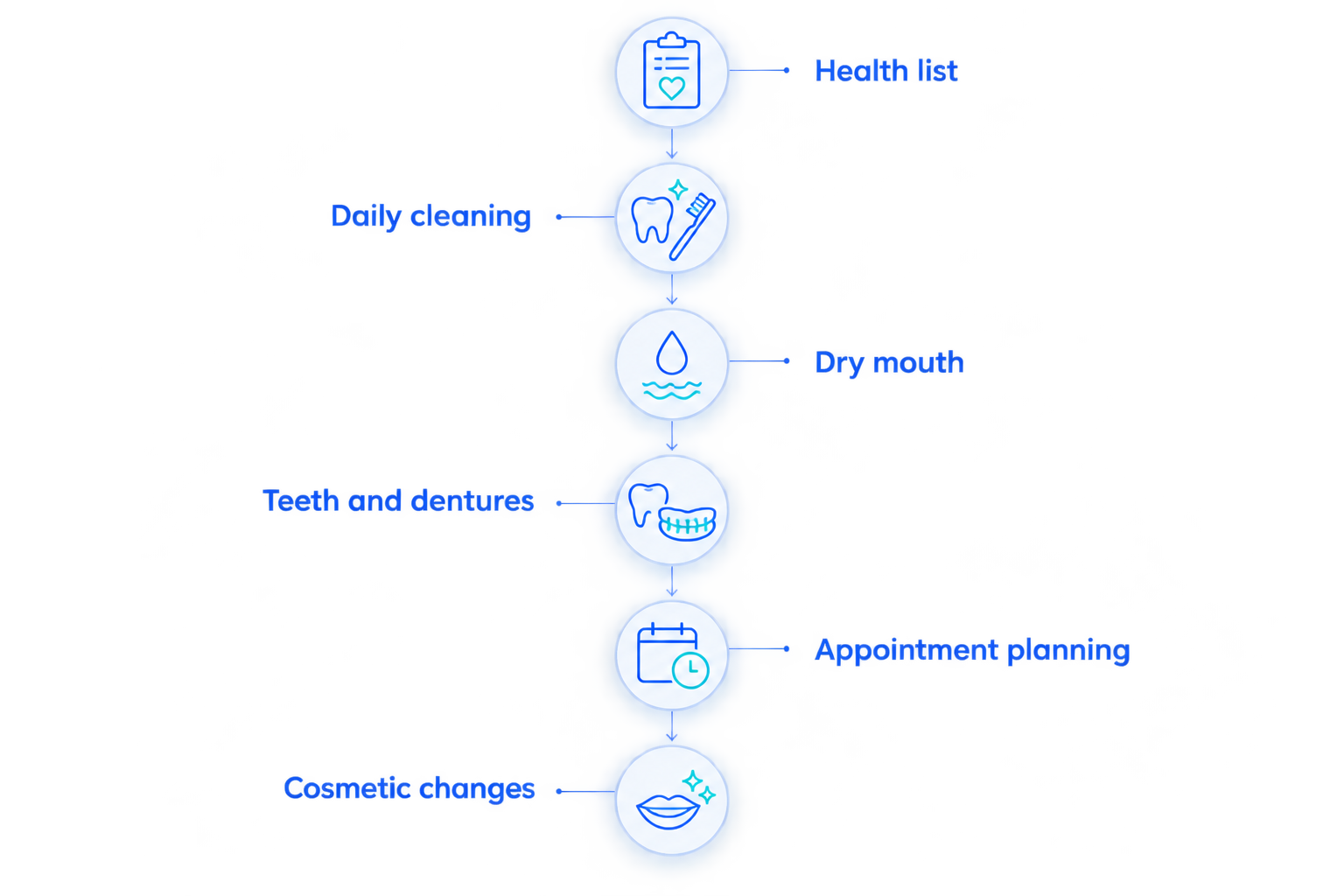
These priorities work together: a comfortable mouth is easier to clean, and a manageable routine helps protect dental treatment. Use the sequence below to organize your questions rather than to diagnose yourself.
Compare care options by what you need
The right option depends on an examination, not your age alone. This comparison explains what each approach addresses and where its limits begin; it is not a list of treatments every senior needs.
| Option | Best for | Main benefit | Key limitation |
|---|---|---|---|
| Manual brushing and interdental cleaning | People who can clean comfortably by hand | Supports daily plaque removal with simple tools | Requires adequate reach, grip, and technique |
| Powered toothbrush | People who struggle with brushing movements | Reduces the need for repetitive manual brush movement | Still requires careful placement and between-teeth cleaning |
| Professional examinations and preventive care | People maintaining natural teeth or monitoring dentures | Identifies problems and supports an individualized care plan | Does not replace daily cleaning |
| Fillings or crowns | Teeth with damage that can be repaired | Restores tooth structure and function when appropriate | Suitability depends on remaining tooth structure and health |
| Removable dentures | People considering removable replacement teeth | Replaces missing teeth without a fixed appliance | Requires daily cleaning, adaptation, and fit reviews |
| Bridges or implant-supported restorations | People exploring fixed tooth replacement | Provides replacement teeth supported by teeth or implants | Requires assessment of supporting teeth, bone, health, and cleaning access |
Home care and professional care are partners, not competing choices. Likewise, removable and fixed replacements solve different problems. Ask your dentist to explain why a recommendation fits your mouth and what would make another approach unsuitable.
Common mistakes retirees and seniors make
Treating dry mouth as something to tolerate
Keeping water nearby helps with comfort, but persistent dryness deserves assessment. Repeatedly sucking sugary candies can expose teeth to more sugar while leaving the cause unaddressed. Mention dryness even if you have learned to live with it.
Waiting until a tooth hurts
Decay and gum disease do not always cause early pain. A painless mouth is not proof that everything is healthy. Keep the examination schedule your dentist recommends and report changes between visits.
Keeping loose dentures out of embarrassment
A changing fit is a reason to ask for help, not a personal failure. Tell your dentist about rubbing, difficulty speaking, or avoiding meals with friends. Comfort and everyday function belong in the treatment discussion.
Choosing appearance before checking tooth health
Whiter teeth do not necessarily mean healthier teeth. Ask about sensitivity, decay, gum health, and older restorations before pursuing cosmetic changes. That sequence helps you make a decision based on more than shade alone.
Assuming retirement coverage matches workplace benefits
Review your current dental benefits rather than relying on what an earlier employer plan covered. Confirm the proposed treatment with your insurer and ask the dental office for a written treatment plan. Coverage decisions and clinical recommendations answer different questions.
Know when to ask for help sooner
Contact a dentist promptly for a broken tooth, new swelling, worsening pain, a loose adult tooth, or a denture sore that keeps returning. A mouth sore that lasts more than 2 weeks also needs evaluation; do not keep treating it as simple irritation.
Facial or neck swelling with trouble breathing or swallowing requires emergency medical care. Do not wait for a routine dental appointment. These symptoms need urgent attention regardless of whether the tooth itself hurts.
For a nonurgent first visit, you can simply describe what has changed and what worries you. You do not need to know the treatment name before asking for an appointment.
Talk about your dental needs
Ask about an appointment for general, restorative, or cosmetic dental care in Spring, Texas.
FAQ
What is the best daily dental routine for seniors?
Brush with fluoride toothpaste for 2 minutes twice daily and clean between your teeth daily. Use tools you can handle comfortably, and ask your dentist to adapt the routine for dentures, bridges, dry mouth, or limited hand movement.
Do seniors still need dental visits if they have no natural teeth?
Yes, people without natural teeth still need dental assessments. Your dentist checks the mouth tissues and denture fit and discusses soreness, cleaning, and changes in function.
Is dry mouth just a normal part of getting older?
Persistent dry mouth should not be dismissed as normal aging. Medicines and health conditions can contribute, and a dentist can assess its effects on your teeth while your prescribing clinician reviews medicines when needed.
Does Medicare cover routine dental care for retirees?
Original Medicare generally does not cover routine dental care. Certain dental services connected to covered medical treatment qualify, while Medicare Advantage dental benefits depend on the individual plan.
Am I too old to replace missing teeth?
Age alone does not determine whether you can replace missing teeth. Your dentist assesses your mouth, overall health, supporting tissues, and ability to maintain the proposed replacement.
How often should seniors see a dentist?
Your dentist should recommend a visit schedule based on your individual oral health. Gum disease, repeated cavities, dry mouth, and ongoing treatment can require closer follow-up than a lower-risk mouth.
Can older adults get natural-looking cosmetic dental treatment?
Older adults can discuss cosmetic treatment after their tooth and gum health is assessed. Existing restorations, sensitivity, cleaning needs, and the amount of tooth alteration all influence which approach is appropriate.
One last thing
Bring a short food diary to your next visit if chewing has become difficult. Writing down what you avoid can explain a problem more clearly than saying your teeth feel fine. Include whether the difficulty comes from pain, dryness, or a moving denture.
For your next 2026 appointment, choose one practical goal: eating comfortably, cleaning more easily, or understanding a recurring symptom. You do not have to solve everything at once. A clear starting point makes the conversation more useful.


