

Full mouth reconstruction has no single standard cost in 2026; your total depends on which teeth need treatment, the condition of your gums, and how your dentist plans to restore comfortable chewing. An estimate also needs to account for preparatory care, temporary restorations, and follow-up—not just the finished smile. An examination and an itemized treatment plan are the right starting point for understanding your total.
- How much does full mouth reconstruction cost? Your examination and restorative dentistry plan determine the total.
- Compare complete treatment plans, including preparation, temporary restorations, final restorations, and follow-up care.
- Mysmiletheory offers general, cosmetic, restorative, and family dentistry for patients in Spring, Texas.
- Ask which teeth can be preserved and which treatment steps protect comfortable chewing.
How much does full mouth reconstruction cost?
Your full mouth reconstruction estimate should reflect your diagnosed needs rather than a preset package. The phrase describes a coordinated approach to restoring oral health and function; it does not identify a single procedure with a uniform fee.
For a useful 2026 comparison, ask what each treatment plan includes. A proposal focused on repairing existing teeth covers different work from one involving tooth removal and replacement. You can review the clinic’s dental services before discussing your concerns with a dentist.
| Part of the plan | What it addresses | What to clarify in your estimate |
|---|---|---|
| Assessment | Tooth condition, gum health, bite, and treatment planning | Which examinations and images are included? |
| Preparatory care | Problems that need attention before final restorations | Are gum treatment, extractions, or other preliminary procedures separate? |
| Temporary restorations | Protection or appearance while treatment progresses | Are temporary teeth included, and what limitations apply? |
| Final restorations | Repairing damaged teeth or replacing missing teeth | Which teeth are treated, and what materials are proposed? |
| Follow-up care | Healing checks, bite adjustments, and maintenance | Which visits belong to the treatment plan? |
Compare the complete scope, not just the final line. A shorter estimate is not automatically a simpler treatment plan, and a longer estimate is not automatically more appropriate.
Why this matters
When eating feels difficult or several teeth need attention, you deserve a clear explanation—not a list of unfamiliar procedures. Understanding the plan helps you separate necessary care from optional appearance changes and ask questions before making decisions.
A natural-looking result matters, but so do healthy gums, teeth you can clean, and a comfortable bite. In 2026, your most useful starting question remains personal: what needs treatment in your mouth, and why?
You do not need to know the names of every procedure before your visit. Tell your dentist what hurts, what you avoid eating, and what you would like to change about your smile.
Preserving natural teeth: understand the proposed repairs
When teeth can be predictably restored, reconstruction can involve repairing them rather than replacing them. Depending on the findings, that work can include fillings, crowns, treatment inside an infected tooth, or care for the gums supporting those teeth.
Best for: Patients whose remaining teeth have enough healthy structure and support for restoration. The benefit is retaining suitable natural teeth; the limitation is that not every damaged tooth can be saved reliably.
Ask your dentist to explain the outlook for each tooth. A tooth that looks badly damaged is not automatically beyond repair, while a tooth that looks acceptable can have problems beneath the surface.
Your estimate should identify what each tooth needs. Ask whether the proposed repair addresses decay, a fracture, wear, or another specific problem—and whether a more conservative repair is appropriate.
Replacing missing teeth: understand the support required
Replacing missing teeth involves more than choosing how the visible teeth will look. Your dentist also needs to assess the gums, remaining teeth, and bone that will support the replacement.
Best for: Patients with gaps or teeth that cannot be predictably restored. Replacements can restore chewing and appearance, but they bring their own cleaning needs, adjustment period, and maintenance responsibilities.
Ask whether the proposed teeth will be removable or fixed in place. Neither description alone tells you whether an option suits your mouth; the supporting structures and your ability to maintain it matter.
A complete 2026 estimate should explain whether preliminary treatment is needed before replacement teeth are made. Do not assume that every step belongs to the same appointment or is included under the same heading.
Combined treatment: understand how the pieces fit
Some reconstruction plans preserve certain teeth while replacing others. The important question is how those treatments work together when you bite, chew, and clean your mouth.
Best for: Patients with a mixture of restorable teeth and missing or nonrestorable teeth. This approach allows treatment to match individual findings, but coordinating different procedures can make the sequence more involved.
Ask which parts of the plan depend on earlier treatment being completed. For example, your dentist needs to account for gum health and healing when planning final restorations.
You should also understand how the finished teeth will look together. Discuss tooth shape and shade alongside comfort and function, without assuming every visible tooth needs cosmetic treatment.
Why full mouth reconstruction estimates vary
These factors explain why treatment plans differ. They are also useful prompts when reviewing an estimate with your dentist.
- The condition of each tooth. Repairable damage calls for a different approach from a tooth that cannot be restored. Ask which findings support each recommendation.
- Gum and bone health. The structures supporting teeth and restorations influence which treatments are suitable. Preliminary care can change the scope and sequence.
- The extent of treatment. Treating selected teeth is different from rebuilding teeth throughout the mouth. Confirm whether the proposal covers the upper arch, lower arch, or both.
- Restoration design and materials. Material selection depends on location, appearance, bite forces, and the type of restoration. Ask why the proposed choice suits your situation.
- Preparation and temporary care. Extractions, healing stages, and temporary restorations can add separate steps. Clarify their purpose and whether they appear in the written plan.
- Maintenance and coordination. Follow-up needs and specialist involvement affect how treatment is organized. Ask who handles each stage and whom you contact with concerns.
A useful estimate explains the reasons behind the treatment, not just the procedure names. You should be able to connect each recommendation to a finding or a goal you discussed.
How to review your reconstruction plan in 3 phases
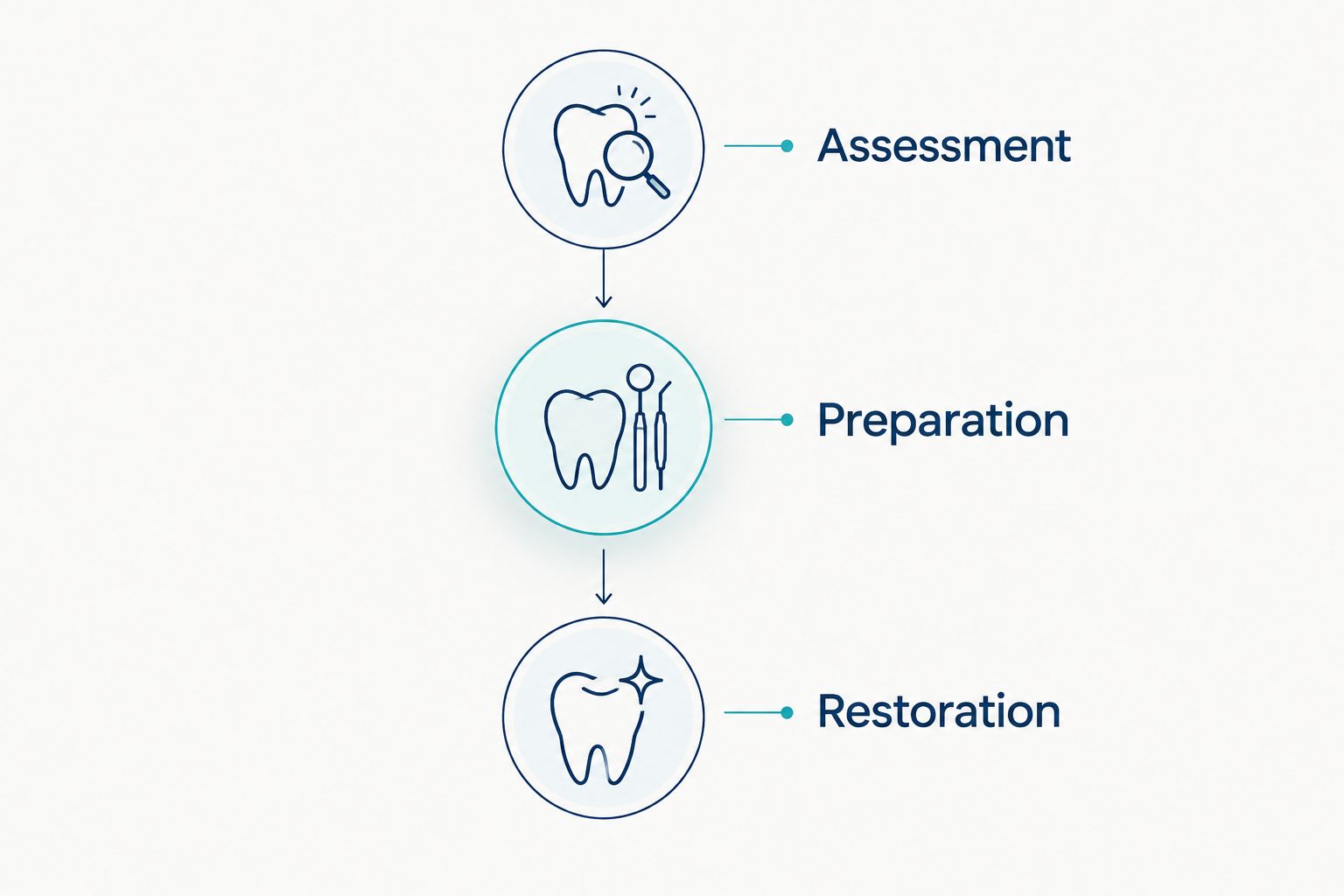
A treatment plan becomes easier to understand when you separate it into 3 phases: assessment, preparation, and restoration. These are a review framework, not a promise about how many appointments you will need.
- Assessment. Review the examination findings and your goals. Ask which teeth are healthy, which need treatment, and which decisions require more information.
- Preparation. Identify any disease treatment, tooth removal, or healing needed before final work. Ask what you will use for eating and appearance during this stage.
- Restoration. Discuss the final repairs or replacement teeth, bite checks, and home care. Confirm how maintenance fits into the plan after treatment ends.
The sequence matters because the visible result depends on what supports it. Ask your dentist to explain why each phase comes before the next, especially if you are hoping to finish before a personal event.
What should I compare when I have 2 written plans?
With 2 written plans, compare the diagnosis and proposed scope before comparing the totals. Different recommendations do not necessarily mean the dentists disagree about every part of your care.
Start with the teeth each plan proposes to preserve or remove. Then compare the type of final restoration, preliminary procedures, temporary teeth, and follow-up arrangements.
Ask each dentist to explain meaningful differences in plain language. Useful questions include whether an alternative preserves more tooth structure, requires different daily care, or depends on additional healing.
A second opinion is reasonable before extensive or irreversible treatment. Bring available records and the written proposal so the discussion focuses on your actual findings rather than a general description of reconstruction.
Does dental insurance cover full mouth reconstruction?
Dental insurance considers the procedures within a reconstruction plan according to your policy; the phrase “full mouth reconstruction” does not guarantee coverage. Benefits can differ for treatment intended to restore function and treatment performed only to change appearance.
Before starting care in 2026, ask for a benefits review based on the proposed procedures. Check exclusions, waiting periods, annual limits, and any requirements for prior review directly with your insurer.
A benefit estimate is not a payment guarantee. Ask what remains your responsibility if the insurer processes a claim differently than expected, and keep the treatment plan separate from the benefits explanation.
Can full mouth reconstruction be done in stages?
Full mouth reconstruction can be staged when the sequence is clinically appropriate. Your dentist needs to determine what must happen first and whether delaying another part would affect health, comfort, or the planned result.
Ask for a distinction between urgent care, necessary preparation, and elective appearance changes. Staging should follow your dental needs rather than simply dividing the work into equal portions.
Make sure you understand the temporary arrangement between stages. Ask what you can eat, how to clean the area, and which symptoms mean you should contact the dental team.
How can I discuss this without feeling pressured?
You can ask for the explanation again, request a written summary, and take time to consider nonurgent treatment. A clear conversation should leave you understanding both the benefits and the limitations of the proposed care.
Mysmiletheory is best suited to Spring patients seeking a personal dentist for general, cosmetic, restorative, and family care. That range of services provides a relevant starting point for discussing both oral health concerns and appearance goals; it does not establish that every reconstruction procedure is appropriate or available for every patient.
At Mysmiletheory, start by describing what you want help with rather than requesting a particular reconstruction package. You can contact the clinic to ask about an appointment and explain your concerns before deciding on treatment.
FAQ
How much does full mouth reconstruction cost in 2026?
Full mouth reconstruction has no single standard total; the estimate depends on the procedures your examination shows you need. Request an itemized plan that includes preparation, temporary restorations, final treatment, and follow-up.
Does full mouth reconstruction mean every tooth is removed?
No, full mouth reconstruction does not automatically mean removing every tooth. A plan can preserve suitable natural teeth while repairing damage or replacing teeth that cannot be restored.
Is full mouth reconstruction the same as a smile makeover?
No, full mouth reconstruction focuses on restoring oral health and function, while a smile makeover primarily addresses appearance. The treatments can overlap, so ask which recommendations address health needs and which address cosmetic preferences.
Can veneers fix all the problems in a damaged mouth?
No, veneers do not treat every cause of dental damage. Decay, gum disease, missing teeth, and bite problems require their own assessment before cosmetic treatment is considered.
Will my reconstruction estimate include temporary teeth?
Temporary teeth are included only if the written plan specifies them. Ask what you will wear during treatment, how you should care for it, and whether adjustments are part of the plan.
Should I choose the reconstruction plan with the lowest total?
Choose a plan based on appropriate treatment and a clear explanation of its complete scope, not the total alone. Compare which teeth are treated, what preliminary care is included, and how the finished restorations will be maintained.
Where can I start a conversation about restorative dentistry in Spring?
Mysmiletheory offers restorative dentistry alongside general, cosmetic, and family dental care in Spring, Texas. Ask about an examination to discuss your concerns and determine appropriate next steps.
One last thing
The most useful question is often: “What can we safely preserve?” Reconstruction does not automatically mean replacing everything, and a natural-looking smile does not require every tooth to receive the same treatment.
When reviewing your 2026 plan, ask your dentist to show you which teeth need care and explain why. Understanding that answer gives you a firmer basis for every decision that follows.


