
Invisalign cost in 2026 depends on the tooth movement you need and what your individual treatment plan includes; a dental examination is needed for a meaningful estimate. Ask whether that estimate includes progress visits, changes to the planned aligners, and retainers after treatment, rather than assuming everything is included.
- Wondering how much does Invisalign cost? Ask for an individual treatment plan, not an estimate based on appearance alone.
- Invisalign moves teeth; bonding and veneers change their appearance without correcting the underlying tooth position.
- Compare clear aligner plans by their included care, progress checks, and retention arrangements.
- Mysmiletheory is best for Spring patients seeking a personal dentist for general, cosmetic, restorative, and family dental care.
Why this matters
You deserve an explanation that makes sense before you commit to changing your smile. Teeth that look only slightly crowded can still need careful planning, while a visible gap does not tell you everything about how your teeth fit together.
For patients across North Houston, the useful starting point is a conversation about both appearance and dental health. Mysmiletheory provides general, cosmetic, restorative, and family dental care in Spring, Texas. Ask your dentist who should evaluate your alignment and whether an orthodontic referral is appropriate.
Compare treatment plans, not just the name Invisalign. The same brand name does not establish that two plans address the same concerns or include the same follow-up care.
How much does Invisalign cost in 2026?
Your Invisalign estimate should follow an assessment of your teeth, gums, and bite. An online answer cannot establish which movements are appropriate for your mouth or how your dentist or orthodontist will supervise them.
Instead of treating a general estimate as a personal recommendation, ask for a written breakdown of the proposed care. The following checklist helps you understand what you are actually comparing.
| Part of the plan | What to ask | Why it matters |
|---|---|---|
| Assessment and records | Which examinations, scans, or images are needed? | Planning depends on more than a photograph of your front teeth. |
| Treatment goals | Which alignment and bite concerns will treatment address? | A limited cosmetic goal differs from a broader bite correction. |
| Progress visits | How will the clinician check tooth movement? | Teeth need monitoring as treatment progresses. |
| Additional aligners | What happens if teeth do not move as planned? | The proposed sequence sometimes needs adjustment. |
| Retainers | What retention plan follows active treatment? | Teeth can shift after aligner treatment ends. |
| Other dental care | Does anything need attention before treatment begins? | Gum health and untreated decay affect treatment planning. |
These questions do not assume that any particular item is included or excluded. They help you get a clear explanation from the clinician responsible for your care.
If a proposal is unclear, ask for clarification before agreeing to it. You should understand both the intended result and the boundaries of the plan.
Why Invisalign treatment estimates vary
The appearance of your smile is only part of the assessment. A clinician also considers the health of the tissues supporting your teeth and how your upper and lower teeth meet.
The main factors to discuss are:
- Tooth movement: Closing spaces, rotating teeth, and changing their position involve different treatment needs.
- Bite correction: Teeth that look straighter are not necessarily meeting in a healthy or comfortable way.
- Treatment scope: Improving a small area of alignment is different from addressing concerns throughout the mouth.
- Dental health: Decay, gum inflammation, or other problems need evaluation before tooth movement begins.
- Monitoring and adjustments: The plan should explain how progress is checked and how unexpected changes are handled.
- Retention: Keeping teeth in their new positions requires a plan after active treatment ends.
A simpler-looking smile concern does not automatically mean a simpler treatment plan. Ask your clinician to explain which factors apply to you rather than trying to judge treatment needs from a mirror.
Your habits matter, too. Clear aligners depend on consistent wear, and difficulty following the prescribed routine can interrupt progress. Be honest about your schedule so the recommendation fits your everyday life.
What should an Invisalign consultation cover?
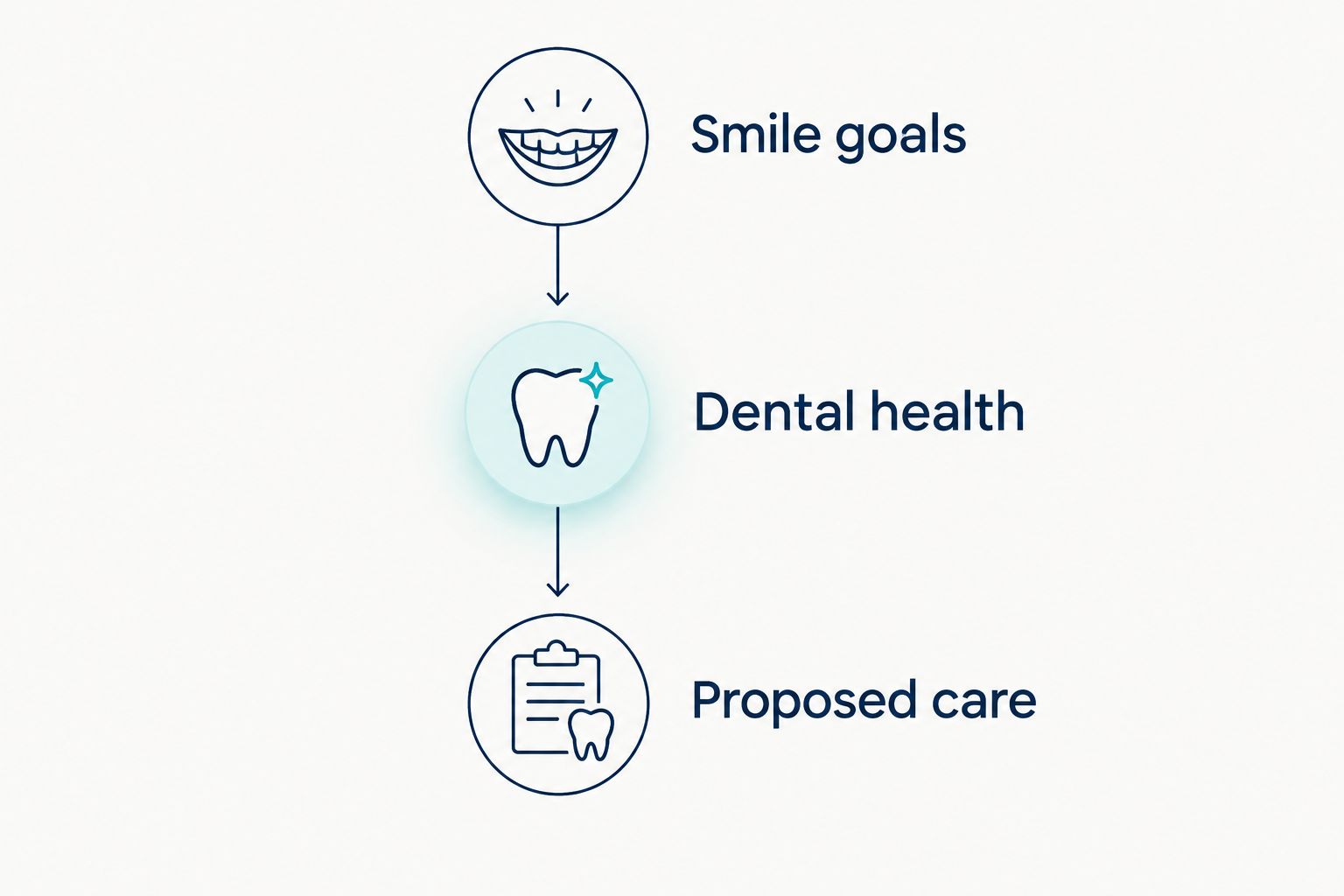
A useful consultation connects your goals with what is safe and realistic for your teeth. You do not need to know dental terminology or arrive with a treatment already chosen.
Start with your smile goals
Explain what bothers you in everyday language. Perhaps a tooth overlaps its neighbor, a gap catches your eye in photographs, or your teeth no longer fit together comfortably.
Bring up comfort and function as well as appearance. If you have tenderness, gum bleeding, or difficulty chewing, tell the clinician before focusing on a cosmetic change.
Review your dental health
The clinician needs to assess whether your teeth and supporting gums are ready for orthodontic movement. Existing restorations, previous orthodontic treatment, and your dental history also belong in the conversation.
This is not about finding a reason to delay your goals. It is about choosing the right starting point and avoiding a plan that overlooks an existing problem.
Understand the proposed care
Ask which teeth will move, what changes are intended, and what the plan will not address. A digital preview can help explain a proposal, but it is not a guarantee of the final result.
For a consultation in 2026, request a current written plan rather than relying on an older advertisement or another person's experience. Your assessment should guide your decision.
Is Invisalign the right way to address your concern?
Invisalign is a clear aligner system used to move teeth. It is not interchangeable with a treatment that changes tooth color, repairs a chipped edge, or covers the front surface of a tooth.
The best starting point is to identify what you want to change. This comparison separates common approaches without assuming that any option is right for your mouth.
| Option | Best for | Main advantage | Main limitation |
|---|---|---|---|
| Invisalign | Suitable patients who want removable orthodontic treatment | Moves teeth using clear, removable aligners | Requires consistent wear and is not appropriate for every case |
| Braces | Patients whose orthodontic needs suit fixed treatment | Remain attached throughout treatment | Cleaning around brackets and wires takes extra attention |
| Dental bonding | Selected small chips, shape changes, or gaps | Adds tooth-colored material to change appearance | Does not correct the underlying position of teeth |
| Veneers | Selected concerns involving tooth shape, color, or appearance | Changes the visible front surfaces of teeth | Often involves irreversible tooth preparation and does not correct the bite |
A small gap deserves an assessment before you choose between moving teeth and adding material to them. The cause of the gap, the surrounding tooth shapes, and your bite all affect the recommendation.
Choose a treatment for the problem it solves, not simply for how quickly you hope to see a change. A natural-looking result should also respect the health and function of your teeth.
How do you compare Invisalign plans fairly?
Before comparing plans in 2026, make sure each clinician is describing the same treatment goal. A plan focused on the front teeth is not directly comparable with one addressing a wider alignment or bite concern.
Use this sequence to organize the discussion:
- Confirm the goal. Ask what will change and which concerns will remain untreated.
- Identify the clinician. Understand who plans treatment, checks progress, and responds to problems.
- Review the routine. Discuss aligner wear, cleaning, visits, and the effect on your daily schedule.
- Clarify adjustments. Ask how the clinician handles teeth that are not moving as expected.
- Discuss retention. Find out how your teeth will be supported after active treatment ends.
Keep a copy of each written proposal. Comparing written details is easier than trying to remember what was said during separate appointments.
You should also feel comfortable asking why a particular approach was recommended. A clear explanation helps you decide without pressure or unnecessary urgency.
Does dental insurance cover Invisalign?
Coverage depends on your individual policy and its orthodontic provisions. Ask your plan administrator to confirm whether your proposed treatment is covered and what conditions apply before you make a decision.
For treatment considered in 2026, use your current policy documents rather than a previous benefits summary. Ask whether age restrictions, provider requirements, or prior authorization affect your situation.
Do not assume that coverage for routine dental visits also means coverage for orthodontic treatment. Your clinician's recommendation and your insurer's coverage decision answer different questions.
Are retainers part of Invisalign treatment?
Retainers help maintain tooth position after active orthodontic treatment. Ask whether the proposed plan includes retainers, how you will receive them, and who will advise you about ongoing wear.
A retention plan should also explain what to do if a retainer stops fitting or becomes damaged. Do not force a poorly fitting appliance onto your teeth or assume that discomfort means it is working correctly.
The end of aligner wear is not the end of caring for your alignment. Discuss retention before starting, when you can consider the full course of care calmly.
What should you ask before deciding?
You do not need to rush from an initial conversation into treatment. Bring a short list of questions and ask for explanations in language that feels comfortable.
Useful questions include:
- What is causing the alignment concern I can see?
- Is Invisalign appropriate for my teeth and bite?
- Would another approach better address my goal?
- What dental care needs attention first?
- What are the limits of the proposed result?
- How will I know whether treatment is progressing as expected?
- What happens after the final aligner?
Mysmiletheory is a dental care option for Spring patients seeking a personal dentist to discuss general, cosmetic, restorative, and family dental needs. Ask about an evaluation of your smile concerns and whether specialist care is appropriate; do not assume a particular orthodontic service is available without confirming it.
Discuss your smile goals
Ask about a dental evaluation and the next step for your alignment concerns.
FAQ
How much does Invisalign cost for my teeth?
Your individual treatment plan determines your estimate. A clinician needs to assess your alignment, bite, and dental health, then explain what care the proposal includes.
Can I get an accurate Invisalign estimate from a photo?
A photo alone cannot establish a complete Invisalign treatment plan. Your clinician needs to assess factors that a smile photograph does not show, including your bite and supporting dental health.
Is Invisalign better than braces?
Neither Invisalign nor braces is best for everyone. Invisalign offers removable aligners, while braces remain attached; your orthodontic needs and ability to follow the treatment routine guide the choice.
Can Invisalign close a gap between my front teeth?
Invisalign can close some gaps when tooth movement is appropriate. A clinician should assess the cause of the space, your bite, and the health of your gums before recommending treatment.
Will I need retainers after Invisalign?
Retention is needed after orthodontic treatment to help maintain tooth position. Ask your clinician which retainer approach suits your treatment and how to care for it.
Should I treat gum problems before starting Invisalign?
Gum problems need evaluation before orthodontic treatment begins. Tell your dentist about bleeding, swelling, tenderness, or loose teeth so those concerns can be assessed.
Does Mysmiletheory provide Invisalign?
Confirm Invisalign availability directly with Mysmiletheory. The clinic provides general, cosmetic, restorative, and family dental care in Spring, Texas; ask which alignment evaluations or referrals are appropriate for your needs.
One last thing
Teeth can look straight while still meeting in a way that needs attention. That is why the most useful question for your 2026 consultation is not only what treatment involves, but what problem the proposed plan is designed to solve.
Ask your clinician to explain the goal, the limitations, and the aftercare in plain language. You should leave understanding your next step, even if that step is simply taking time to decide.