
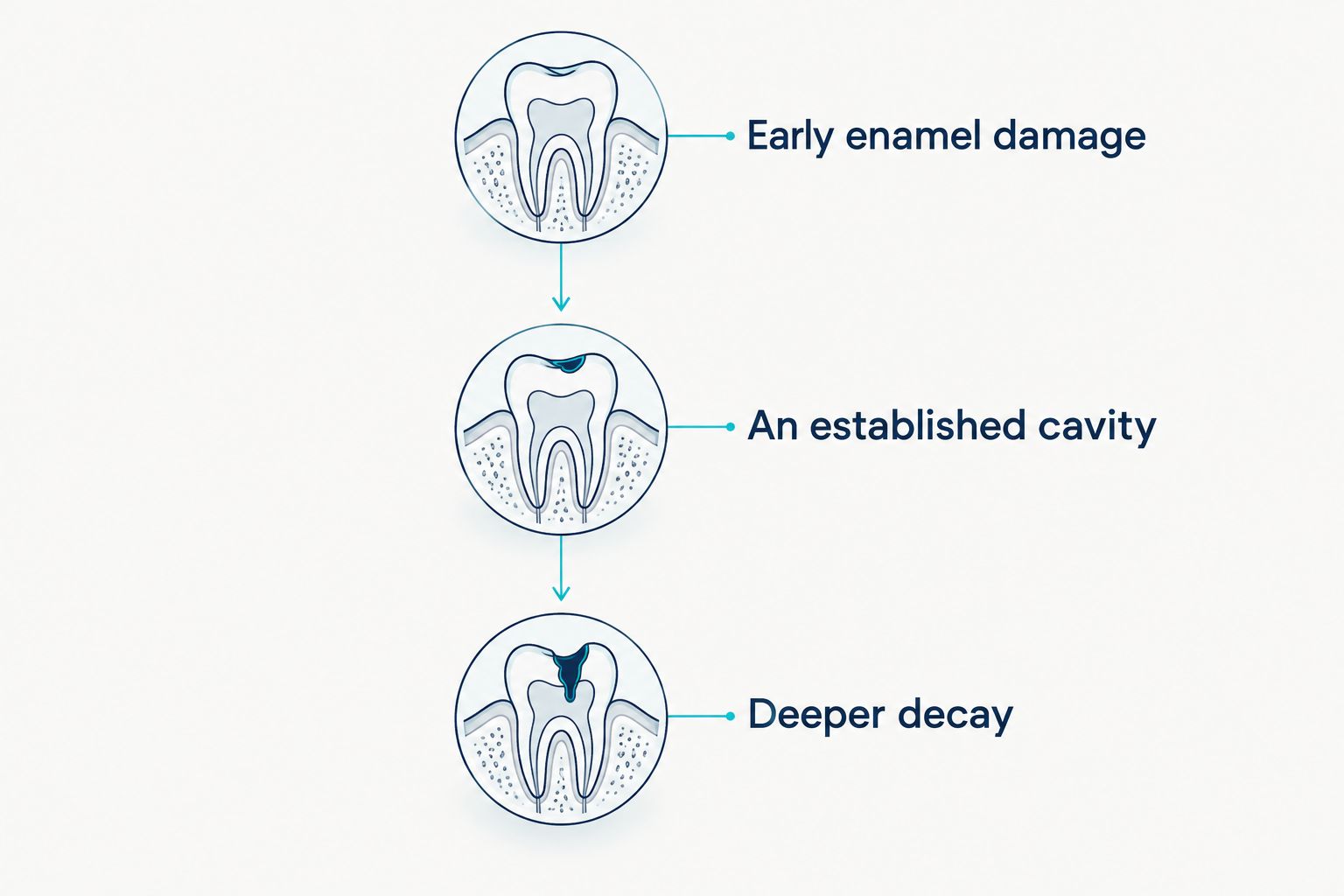
Early tooth decay can be reversed through remineralization while the enamel surface is still intact, but a cavity that has formed a hole cannot grow back naturally. Saliva, fluoride toothpaste, and fewer sugary snacks help protect and strengthen enamel; they do not replace treatment for missing tooth structure.
- Can cavities be reversed naturally? Early enamel damage can remineralize; an established hole cannot regrow.
- Fluoride toothpaste supports enamel repair, but home remedies cannot rebuild missing tooth structure.
- Mysmiletheory provides general and family dental care for patients seeking a personal dentist in Spring, Texas.
- Tooth pain, swelling, or a visible hole calls for dental assessment, not a longer home-remedy trial.
Can cavities be reversed naturally?
Early decay can reverse; a hole in a tooth cannot. The distinction is whether the tooth surface remains intact. You cannot reliably judge that from a mirror, the color of a spot, or whether the tooth hurts.
Mysmiletheory offers general, restorative, cosmetic, and family dentistry in Spring, Texas. A dental examination helps distinguish an area that needs preventive care from damage that needs repair.
The National Institute of Dental and Craniofacial Research explains that early decay can stop or reverse before a cavity forms. Its patient guidance describes saliva and fluoride as sources of support for replacing minerals lost from enamel.
| Tooth condition | What helps | Best for | Main limitation |
|---|---|---|---|
| Early mineral loss with an intact surface | Fluoride, saliva, plaque removal, and dietary changes | Preserving enamel before a hole develops | Requires assessment and monitoring; appearance alone is not enough |
| A cavity with missing tooth structure | Dental repair, often a filling | Restoring the damaged area | Home care cannot replace the missing structure |
| Decay reaching the tooth's inner tissues | Assessment for treatment such as root canal care or extraction | Addressing deeper disease | Brushing and home remedies cannot treat an infected tooth |
Why this matters
The practical question in 2026 is not whether a remedy sounds natural. It is whether your tooth still has an intact surface that can benefit from remineralization.
Waiting for pain is not a reliable strategy. Early decay often causes no symptoms, and even a cavity needing treatment can be painless. Finding a problem earlier gives you the chance to discuss care before more tooth structure is lost.
You do not need a perfect routine to start improving your oral health. Focus on a few repeatable steps, then let an examination guide any additional treatment.
Early enamel damage: support remineralization
Your enamel loses minerals when acids produced by plaque bacteria act on the tooth surface. Saliva helps neutralize acids and supplies minerals, while fluoride supports remineralization and makes enamel more resistant to acid.
When mineral loss occurs without surface breakdown, preventive care can help the area harden again. A chalky white patch can be an early sign, but not every white patch is decay. Developmental enamel differences and other conditions can look similar.
Best for: A dentist-confirmed area of early decay with an intact surface. The benefit is preserving your natural tooth; the limitation is that success requires controlling the causes and checking the area over time.
A spot does not have to disappear completely to become stable. Your dentist evaluates more than color when deciding whether an area is active, improving, or needs a different approach.
An established cavity: repair missing tooth structure
Once decay creates a hole, enamel does not regenerate to fill it. A filling replaces damaged structure; it does not make the tooth grow back.
Best for: A tooth with a cavity that needs restoration. A filling can restore the affected area, but it does not remove your ongoing risk of decay elsewhere or around the restoration.
Some decay-management treatments can arrest selected lesions without a conventional filling. That is not the same as naturally rebuilding a hole, and suitability depends on the tooth, the lesion, and your individual circumstances.
For your 2026 dental decisions, ask a straightforward question: is this area being monitored, treated to stop decay, or restored? Understanding the goal helps you understand the recommendation.
Deeper decay: address the tooth, not just the symptoms
Decay that reaches deeper parts of a tooth needs assessment beyond an enamel-care routine. Depending on the damage, your dentist might discuss a filling, crown, root canal treatment, or extraction.
Best for: Prompt professional assessment when a tooth has ongoing pain, swelling, or substantial damage. Treatment addresses the underlying problem, but the appropriate option cannot be chosen from symptoms alone.
Pain relief does not prove that decay has stopped. A tooth that stops hurting still needs evaluation if you have noticed a hole, swelling, or recurring discomfort.
What can you do at home to support enamel repair?
For your 2026 home-care routine, choose habits that reduce acid exposure and help fluoride reach your teeth. These steps support prevention and early enamel repair; they are not substitutes for treating a hole.
- Brush with fluoride toothpaste. American Dental Association guidance recommends brushing for 2 minutes, 2 times per day, with a soft-bristled toothbrush. Use gentle pressure rather than scrubbing harder.
- Clean between your teeth daily. The ADA recommends cleaning between teeth 1 time per day. Floss or another suitable interdental cleaner reaches areas a toothbrush misses.
- Reduce frequent sugary snacks and drinks. Repeated exposure gives plaque bacteria repeated opportunities to produce acid. Having sweet foods with meals rather than grazing throughout the day helps reduce those repeated exposures.
- Choose water between meals. Avoid sipping sweetened drinks over extended periods. Fluoridated drinking water also helps protect against decay.
- Mention a persistently dry mouth. Saliva protects teeth, and reduced saliva increases decay risk. Discuss dryness and your medication list with your dentist; do not stop prescribed medication yourself.
The goal is a routine you can keep, not a short burst of intense brushing. For help making those steps practical, see these daily habits for a healthy, lasting smile.
Why the chance of reversing early decay varies
Two spots that look similar can need different care. These factors influence whether remineralization is an appropriate goal:
- Surface breakdown: An intact surface and a hole are different treatment situations. This is the central distinction behind claims about reversing cavities.
- Depth and location: Decay between teeth, along exposed roots, or around restorations requires assessment of areas you cannot fully inspect at home.
- Plaque removal: Plaque left along gumlines or between teeth keeps the conditions for decay in place.
- Frequency of sugar exposure: Frequent sweet snacks and prolonged sipping create repeated acid challenges.
- Saliva and fluoride exposure: Dry mouth reduces natural protection, while fluoride supports enamel repair and resistance to acid.
- Follow-through and monitoring: A preventive plan needs reassessment. Feeling comfortable is not proof that an area has stopped progressing.
These factors explain why copying someone else's routine is not enough. Your dentist can connect the condition of your tooth with the habits and treatments most relevant to you.
Do natural remedies reverse cavities?
No home remedy rebuilds a hole in a tooth. The word natural does not tell you whether a method prevents decay, damages enamel, or simply changes how your mouth feels.
| Approach | Potential role | Limitation or concern |
|---|---|---|
| Fluoride toothpaste | Supports enamel remineralization and cavity prevention | Cannot fill a hole or replace dental repair |
| Water and fewer sugary exposures | Help reduce conditions that encourage decay | Do not restore missing tooth structure |
| Oil pulling | Does not have an established role in reversing cavities | Must not replace brushing, interdental cleaning, or treatment |
| Lemon juice or vinegar | No role in cavity repair | Acid exposure can erode enamel |
| Charcoal products | No established role in rebuilding cavities | Abrasiveness varies; do not assume enamel safety |
A cleaner feeling is not evidence of tooth repair. Neither a smoother surface nor temporary relief tells you whether decay is active beneath the surface.
For a cavity concern in 2026, skip acidic do-it-yourself treatments and focus on fluoride-based care plus an examination. A product marketed as natural still needs evidence for the specific result it promises.
What happens at a dental appointment for suspected decay?
You can start by explaining what you noticed: sensitivity, food catching, a rough edge, a spot, or discomfort when chewing. Mention when it happens and whether it has changed.
Your dentist examines the tooth and discusses relevant habits, symptoms, and health factors. Dental X-rays may be appropriate to assess areas that are not visible during the examination.
Before agreeing to a plan, ask:
- Is the surface intact, or is there already a cavity?
- Is the area active, or does it appear stable?
- What would preventive treatment aim to achieve?
- How will you check whether the plan is working?
- What are the benefits and limitations of the recommended treatment?
Mysmiletheory dental care is best suited to local patients seeking a personal dentist in Spring, Texas. You can explain any dental anxiety when arranging a visit and ask the dentist to walk through the findings in everyday language.
Take the next step for your tooth
Explore general and restorative dental care in Spring, Texas, and discuss your concerns.
How can you tell whether a cavity is reversible?
You cannot reliably determine reversibility at home. A dentist needs to assess whether the tooth surface is intact and whether the area is active; X-rays can help reveal decay that is not directly visible.
A dark spot is not automatically a cavity, and a white spot is not automatically reversible decay. Avoid scraping or probing a suspicious area yourself.
How long does it take to reverse early tooth decay?
There is no single home-treatment timeline that proves early decay has reversed. The starting condition, saliva, fluoride exposure, diet, and plaque control all affect the response.
Ask your dentist when the area should be reassessed. Do not use a self-imposed waiting period to delay care for pain, swelling, or a visible hole.
When should you seek urgent help for a suspected cavity?
Arrange prompt dental assessment for persistent toothache, pain when biting, a broken tooth, or swelling. These symptoms need evaluation rather than an extended trial of home remedies.
Seek emergency medical help for difficulty breathing or swallowing, or rapidly spreading facial or neck swelling. Fever with facial swelling also needs urgent assessment.
FAQ
Can cavities be reversed naturally without fluoride?
Early enamel mineral loss can improve through saliva and changes that reduce acid exposure, but fluoride is an established aid to remineralization and cavity prevention. Avoiding fluoride does not make a hole reversible, and a dentist should assess suspected decay.
Can I heal a cavity if it does not hurt?
A painless cavity still needs dental assessment because absence of pain does not show that the tooth surface is intact. Early damage may respond to preventive care, while a hole cannot regrow naturally.
Does brushing more often get rid of a cavity?
Brushing cannot remove an established cavity or replace missing tooth structure. Brush gently with fluoride toothpaste for 2 minutes, 2 times per day, and have the tooth checked.
Can oil pulling replace a filling?
Oil pulling cannot replace a filling or rebuild a hole in a tooth. Do not use it instead of fluoride toothpaste, cleaning between teeth, or recommended dental treatment.
Can a white spot on my tooth go away?
A white spot caused by early mineral loss can improve with appropriate care, but not every white spot is decay. Some spots remain visible even after the area becomes stable.
Can children reverse cavities naturally?
Children can benefit from remineralization when decay is early and the surface remains intact, but a hole in a baby tooth cannot naturally rebuild itself. A dentist should assess suspected decay and recommend age-appropriate care.
Should I wait until my next cleaning if I think I have a cavity?
Contact your dental office when you suspect a cavity rather than deciding to wait for a routine cleaning. Describe any pain, sensitivity, food trapping, or swelling so the office can guide the timing of your assessment.
One last thing
A tooth does not have to look perfectly white to be healthy, and a painless tooth is not automatically free of decay. Ask what the finding means for the tooth's health, not just its appearance.
For your 2026 appointment, bring that question with you. Mysmiletheory offers general and restorative dental care alongside cosmetic services, so you can discuss tooth health before planning changes to your smile.


