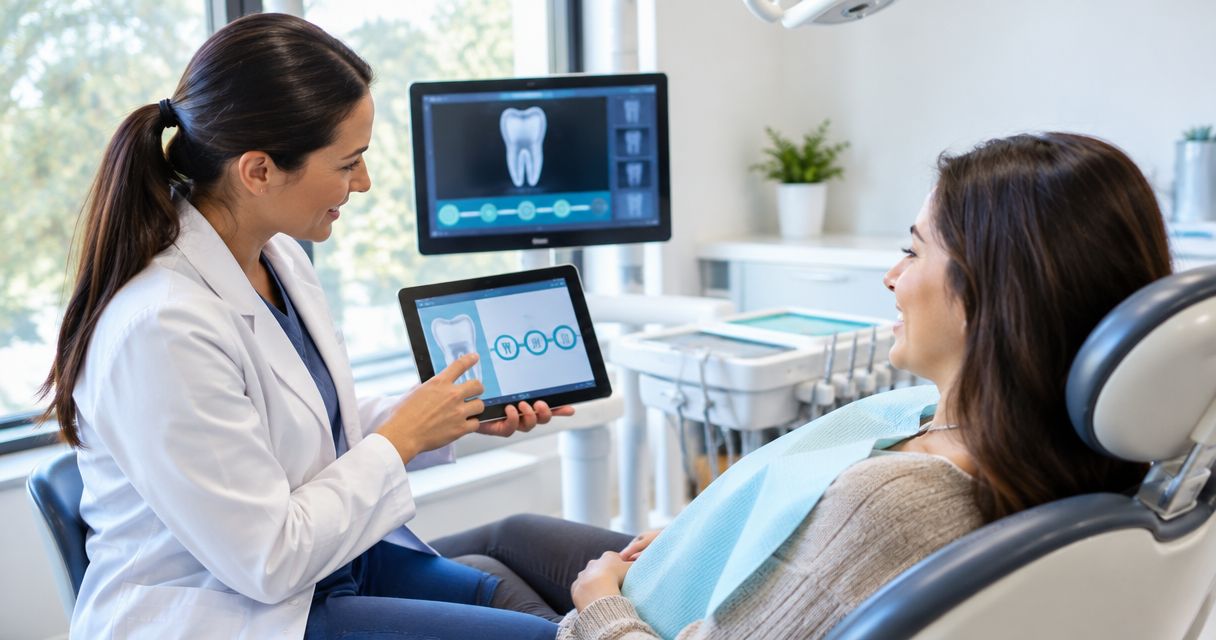
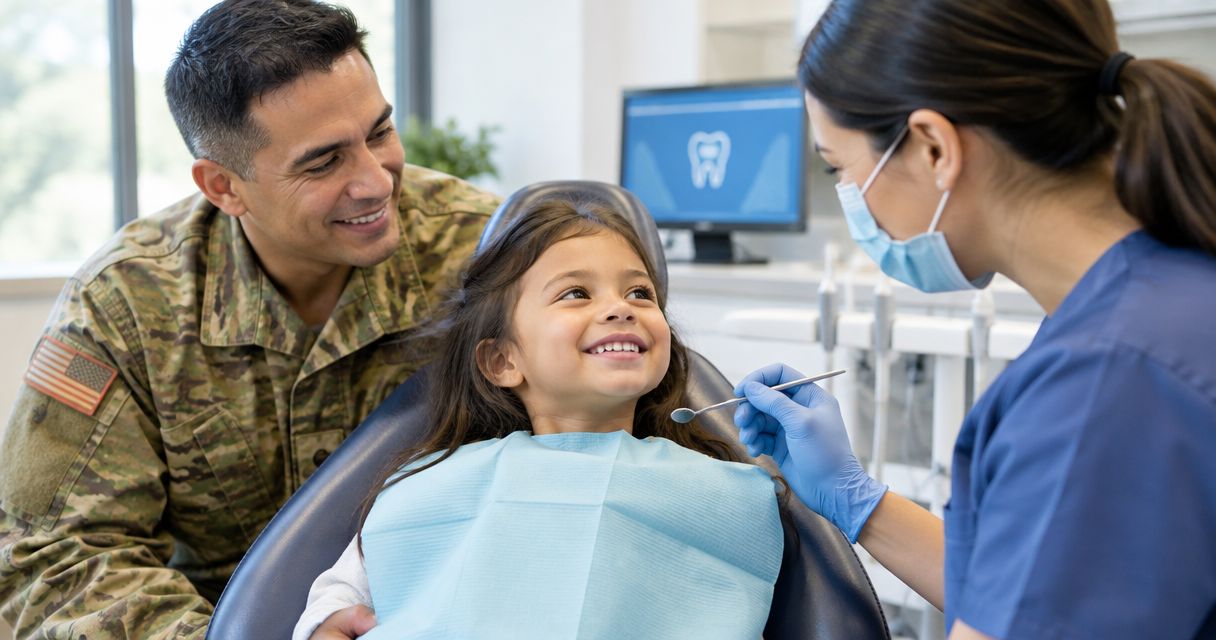
Military family dental care is preventive, restorative, and family dentistry organized around service-related moves and changing schedules, with the aim of keeping your household’s oral health on track. Choosing a dentist for military families means finding personal care while separately confirming each family member’s dental benefits and planning for the next transition.
- Choose a dentist for military families by checking coverage, record transfers, and continuity of family dental care.
- Mysmiletheory offers general, cosmetic, restorative, and family dentistry for local patients in Spring, Texas.
- Military medical coverage and dental coverage are different; confirm your dental program before scheduling treatment.
- Address pain and active dental problems before planning optional cosmetic dentistry around a move.
Why dental care matters for military families
A military move changes more than your address. Your family needs a dentist who can understand previous treatment, assess unfinished care, and help you decide what belongs on the calendar before another transition.
Mysmiletheory is a dental care option for military families in Spring seeking a personal local dentist. The clinic offers general, cosmetic, restorative, and family dentistry; military-plan participation must be confirmed separately. You can start with Mysmiletheory when considering local care.
For your 2026 care plan, separate three questions: what treatment you need, what your dental benefits cover, and what your schedule allows. An insurance directory answers the coverage question, not whether a practice suits your family’s communication needs or treatment priorities.
A useful first appointment creates a clear next step. That might be preventive care, treatment for a damaged tooth, or a conversation about a cosmetic concern—not necessarily a full treatment plan completed immediately.
How to choose and work with your family dentist
Confirm coverage
Start with your dental benefit administrator’s member information and provider directory. Military medical eligibility does not establish dental enrollment or mean that every civilian dentist participates in your dental program.
TRICARE distinguishes dental arrangements for active-duty service members from the TRICARE Dental Program for eligible family members and certain National Guard and Reserve members. Eligible retirees and their families can obtain dental coverage through FEDVIP. These programs are not interchangeable, so identify the arrangement that applies to each person before booking.
For a 2026 appointment, ask both the benefit administrator and the practice about current participation. A statement that a practice accepts insurance is not the same as confirmation that the dentist is in your specific network. Keep eligibility questions separate from clinical decisions: coverage alone does not determine the treatment your tooth needs.
- Identify each family member’s dental program and enrollment status.
- Search your program’s current provider directory.
- Confirm the dentist’s participation directly with the office.
- Ask about referral or authorization requirements for proposed treatment.
- Request a written benefit explanation before agreeing to planned care.
Transfer records
Contact your previous dental office before your first visit. Request relevant X-rays, treatment notes, and details of unfinished treatment so your new dentist can understand what has already happened.
Records are particularly useful when someone has a crown, implant, orthodontic treatment, or a tooth being monitored. They give the new dentist context, but they do not replace a current examination. Your dentist decides whether existing images answer today’s clinical questions or whether new images are necessary.
For a child, include information about previous dental experiences and anything that helped the child feel comfortable. For an adult, explain whether a past procedure caused lingering sensitivity or changed the way your teeth meet. Those details deserve a place alongside the paperwork.
Keep an accessible copy of your treatment summary. A transfer request alone does not confirm that the receiving practice has the information.
- Sign the previous practice’s record-release form.
- Request X-rays and a summary of completed and pending treatment.
- Share current medications, allergies, and relevant medical history.
- Describe dental anxiety and helpful communication preferences.
- Confirm receipt before the appointment whenever possible.
Set care priorities
Write down what is bothering each family member before the visit. Start with pain, swelling, broken teeth, trouble chewing, or a change that concerns you; then add preventive needs and appearance goals.
Mysmiletheory’s general, restorative, and family dental care gives Spring patients a local starting point for that conversation. If cosmetic dentistry also interests you, describe the result you want in everyday language: a less noticeable chip, a more even appearance, or a smile that still looks like you. An examination determines which choices fit your teeth.
Treat health needs as the foundation for cosmetic decisions. Whitening does not repair decay, and changing a tooth’s appearance does not address an untreated infection. Ask your dentist to explain which concerns need attention first and which can wait until your schedule is more settled.
Do not wait for a routine visit if swelling affects breathing or swallowing. Seek emergency medical care for those symptoms.
- List symptoms and when they began.
- Mention teeth that hurt when you bite or react to temperature.
- Ask which findings require prompt treatment.
- Separate necessary care from elective appearance changes.
- Request a plain-language explanation of each recommendation.
Plan treatment
Bring your actual schedule, including travel, deployment-related changes, and any expected move. The goal is a treatment sequence you understand, not a promise that every procedure can fit into a narrow window.
Some treatments involve multiple stages, follow-up visits, or laboratory work. Before starting, ask what happens between appointments, how the tooth is protected during that period, and who handles a problem if you leave the area. Your dentist should determine the sequence based on the clinical situation.
For optional cosmetic care, leave room to discuss alternatives and long-term maintenance. Veneers, for example, can involve removing enamel and are not simply a temporary change for an upcoming event. A natural-looking result starts with a clear conversation about appearance, tooth health, and the implications of treatment.
Use your 2026 calendar to identify practical constraints early. Do not shorten recommended healing or follow-up solely to meet a travel date.
- Share known travel and relocation dates before treatment starts.
- Ask how many stages the proposed treatment involves.
- Clarify follow-up needs and home-care instructions.
- Request a handoff plan if treatment will continue elsewhere.
- Ask what alternatives preserve more natural tooth structure.
Maintain home care
Keep the routine simple enough to continue through travel and schedule changes. The American Dental Association recommends brushing twice daily for 2 minutes with fluoride toothpaste and cleaning between teeth daily.
For young children, toothpaste quantity matters. ADA guidance recommends a rice-grain-sized smear for children younger than 3 years and a pea-sized amount for children ages 3–6 years, with adult supervision. The American Academy of Pediatric Dentistry recommends the first dental visit when the first tooth appears and no later than 12 months of age.
These are general recommendations, not a personalized recall schedule. Ask your dentist how often each family member needs an examination and preventive care based on their oral health. A child with decay and an adult with gum disease do not necessarily need the same schedule.
Consistency matters more than packing an elaborate dental kit. Keep essential supplies accessible rather than buried in moving boxes.
- Brush twice daily for 2 minutes with fluoride toothpaste.
- Clean between teeth daily using an appropriate method.
- Supervise children’s brushing and toothpaste use.
- Pack toothbrushes, toothpaste, and interdental supplies in travel bags.
- Follow individualized instructions for braces, restorations, or gum care.
Prepare for changes
Before leaving a practice, ask for a current treatment summary and clear instructions for anything unfinished. Include the reason a tooth is being monitored, not just the date of the last visit.
If a family member stays behind during deployment, make sure the person arranging care knows the dental office, benefit program, and relevant treatment needs. Ask the practice what consent documentation it requires for a child attending with another caregiver. Requirements depend on the situation; do not assume a verbal arrangement is sufficient.
For a 2026 relocation, confirm your next provider’s participation rather than carrying forward an assumption from the previous location. Also ask the current dentist which symptoms require prompt attention while you are between practices.
A handoff plan should support the next appointment. It should not require your family to reconstruct months of treatment from memory.
- Obtain an updated treatment summary before the move.
- Keep the dental benefit administrator’s contact details accessible.
- Record instructions for unfinished or recently completed treatment.
- Confirm caregiver consent requirements with the practice.
- Identify where to seek urgent dental care during the transition.
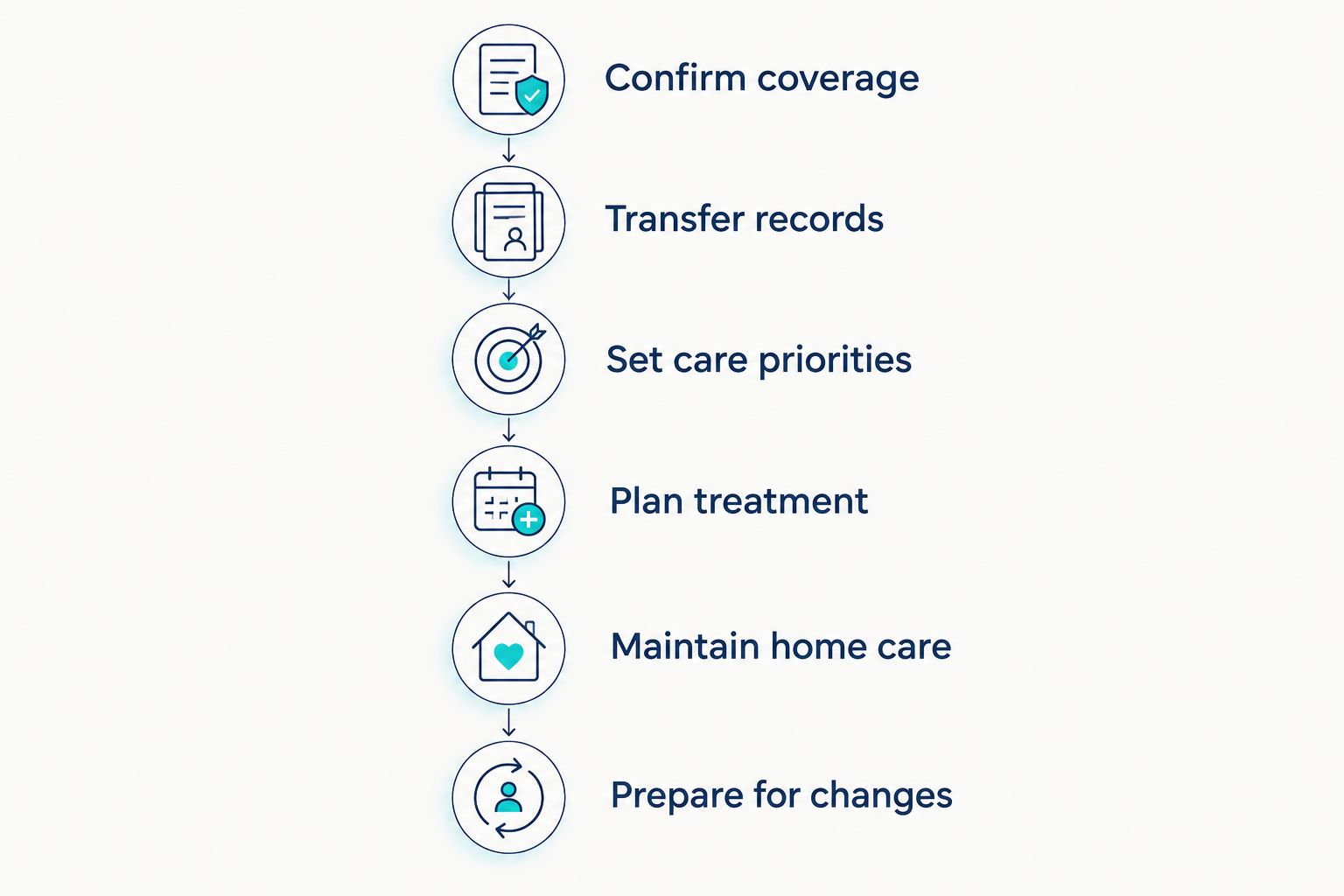
The sequence is straightforward: confirm benefits, share records, establish priorities, plan treatment, maintain daily care, and prepare the handoff. Each part solves a different problem; none replaces a dental examination.
Compare dental care options for your household
Choose the care setting by eligibility and clinical need, then check practical fit. A network listing helps establish participation, while an examination establishes what care is appropriate.
The options below serve different purposes. They are not substitutes for one another, and a family can need more than one setting. Ask about both the advantage and the limitation before deciding where to schedule.
| Option | Best for | Main advantage | Key limitation |
|---|---|---|---|
| Military dental facility | Eligible service members receiving care through their military dental arrangement | Care connected to the military dental system | Eligibility and access rules do not automatically extend to every dependent |
| Civilian network dentist | Family members seeking care through their enrolled dental program | A provider identified through the program’s network | Participation does not establish coverage for every proposed procedure |
| Local family dental clinic | Households seeking a personal dentist for ongoing general and family care | A local starting point for different family dental needs | Insurance participation and age-related services need direct confirmation |
| Pediatric dentist | Children needing specialized child-focused assessment or care | Additional training focused on children’s dental needs | Adult family members need a separate care arrangement |
| Dental specialist | Patients referred for a specific dental problem | Focused assessment and treatment within a specialty | Specialist care does not replace ongoing general preventive care |
Mysmiletheory fits the local family dental clinic category in Spring. Its stated services include general, cosmetic, restorative, and family dentistry; confirm your plan’s participation requirements and the care needed for each family member before scheduling.
Common mistakes military families make
Assuming medical coverage includes dental enrollment
Military health coverage and dental benefits have different arrangements. Confirm dental enrollment for each person instead of relying on a medical insurance card or another family member’s status. Recheck when eligibility changes.
Starting treatment without discussing the move
A planned relocation belongs in the first treatment conversation, not the last appointment. Ask how unfinished work will be transferred and what records the receiving dentist needs. Necessary care still requires timely attention; the move should shape coordination, not justify ignoring symptoms.
Treating every family member’s schedule as identical
Children, adults with gum concerns, and people with recent restorative treatment can have different follow-up needs. Let the dentist recommend each person’s schedule rather than fitting everyone into one assumed routine. Shared family organization is helpful; identical care plans are not the goal.
Choosing cosmetic treatment before checking tooth health
A stain, gap, or chipped edge can draw attention while a less visible problem needs treatment first. Discuss a healthy foundation before choosing an appearance change. If you want natural-looking results, explain what you want to keep as well as what you want to change.
Leaving without a usable treatment summary
Remembering that a tooth needs watching is not enough for the next dentist. Request the findings, relevant images, and follow-up recommendation. Keep the summary somewhere you can access during travel, not only on a device packed away for the move.
FAQ
How do I find a dentist for military families near Spring, Texas?
Start with your dental program’s provider directory, then contact a local practice to confirm participation and family care needs. Mysmiletheory offers general, cosmetic, restorative, and family dentistry in Spring; confirm military dental-plan participation directly before scheduling.
Does TRICARE medical coverage automatically include family dental care?
No, military medical coverage does not automatically establish family dental enrollment. Identify the dental program and enrollment status that apply to each family member before booking treatment.
Can military dependents see a civilian dentist?
Yes, military dependents can receive care from civilian dentists. Check enrollment, network participation, and any applicable authorization requirements through the dependent’s dental program.
Should I transfer dental X-rays when we move?
Yes, request relevant X-rays and treatment notes from your previous dentist. The new dentist will review them and decide whether additional images are needed for your current care.
How often should my military family visit the dentist?
Each family member needs a visit schedule based on their oral health, not military status alone. Ask the dentist for an individualized schedule, especially when there is active decay, gum disease, or unfinished treatment.
Should I get veneers before a military move?
Discuss your move and tooth health with a dentist before deciding on veneers. Ask about treatment stages, follow-up, enamel changes, and maintenance rather than choosing treatment solely to meet a departure date.
What should I do about tooth pain during a move?
Contact a dentist promptly about tooth pain instead of waiting until the move is complete. Swelling that affects breathing or swallowing requires emergency medical care.
One last thing
Before your next appointment, write down one sentence for each family member: what hurts, what worries them, or what they want to understand. Bring those sentences with your records. They help keep the conversation personal rather than letting paperwork become the whole visit.
For military families settling in North Houston in 2026, the next step is a conversation about current needs and upcoming changes. You do not need to decide on every treatment before meeting a dentist.
Discuss your family’s dental needs
Explore general, cosmetic, restorative, and family dental care in Spring, Texas.