

Yes, dental insurance can cover dental implants, but your plan decides which parts of treatment qualify and how much it pays. For your 2026 coverage, check the implant benefit, exclusions, and remaining annual maximum before scheduling treatment. Even when an implant is covered, related procedures and the tooth placed on top can have separate benefit rules.
- Does insurance cover dental implants? Some plans do; confirm benefits for each part of treatment before scheduling.
- An implant benefit does not guarantee payment for the crown, bone grafting, or other related procedures.
- Request a written pretreatment estimate, then check exclusions, waiting periods, and remaining benefits.
- Mysmiletheory provides general and restorative dental care for patients seeking a personal dentist in Spring, Texas.
Why this matters
Replacing a missing tooth involves both a dental decision and an insurance decision. A treatment can be appropriate for your health without qualifying for payment under your policy. Coverage and clinical need are separate questions.
Start by understanding your restorative options for missing teeth, then compare those options with your benefits. That order keeps an insurance restriction from becoming the only reason you choose a particular treatment.
You do not need to understand every insurance term before asking for help. You need a clear treatment plan, the relevant benefit documents, and written answers about what your insurer expects to pay.
Does insurance cover dental implants?
Some dental plans include implant benefits; others exclude implants or limit payment to particular parts of the restoration. Your plan's coverage document—not the general label of dental insurance—provides the answer.
Ask the insurer to review the actual proposed procedures. A general statement that major dental work is covered does not establish that implant placement is included.
| Coverage route | Best for checking | What it can address | Main limitation |
|---|---|---|---|
| Dental insurance | Benefits for replacing a missing tooth | Implant placement, the connecting piece, or the replacement tooth when included | Exclusions, annual limits, and other restrictions still apply |
| Medical insurance | Treatment tied to a covered medical condition or injury | Certain related services when the medical policy's requirements are met | An ordinary tooth-replacement need does not establish medical coverage |
| An additional dental policy | Coordinating benefits when you have another plan | Eligible remaining expenses under coordination rules | Combined benefits do not guarantee full payment |
For your 2026 policy, request the full benefit booklet or certificate of coverage rather than relying only on a short benefits summary. Search for implant services, prosthodontics, exclusions, replacement limitations, and alternate benefits.
The most useful answer is procedure-specific: covered, excluded, or subject to review. Ask the insurer to identify the policy language behind each answer.
Which parts of implant treatment need separate checks?
An implant-supported tooth has 3 components to discuss: the implant in the jaw, the connecting piece called an abutment, and the replacement crown. Insurance can treat these as separate services rather than a single benefit.
Your treatment plan can also include preparation and follow-up. An extraction, imaging, bone grafting, or temporary tooth is not automatically included simply because the implant itself qualifies.
| Treatment item | What to ask your insurer | Why the answer matters |
|---|---|---|
| Implant placement | Is placement covered under this policy? | Coverage for a crown does not establish coverage for placement |
| Abutment | Is the connecting piece a separate covered benefit? | A separate service can have separate restrictions |
| Implant crown | Does the policy cover a crown supported by an implant? | Crown benefits can depend on the type of restoration |
| Extraction | Is removing the existing tooth eligible? | Extraction coverage does not prove implant coverage |
| Bone grafting | Is grafting covered for this proposed treatment? | The purpose of the graft can affect eligibility |
| Imaging | Which images qualify, and are there frequency limits? | Coverage depends on the imaging service and policy rules |
Ask your dental office for an itemized plan that identifies the proposed procedures and tooth locations. You can then request answers that match your treatment instead of discussing implants in general.
Do not assume every listed procedure is necessary for you. Your dentist determines which steps fit your oral health and explains why each recommended step belongs in your plan.
Why dental implant coverage varies
Insurance policies set their own benefit rules. These factors explain why another person's implant coverage does not predict your own:
- Implant exclusions: A policy can cover other major dental services while excluding implant placement or associated services.
- Annual maximum: The plan can limit its total payments during the benefit year, including payments already made for other treatment.
- Waiting period: Certain services can require a period of enrollment before benefits become available.
- Missing-tooth clause: A policy can restrict benefits for replacing a tooth that was missing before coverage began.
- Network status: Your plan's payment rules can differ depending on the treating provider's participation.
- Alternate benefit provision: A plan can calculate payment using another covered treatment rather than the implant treatment you choose.
For a 2026 treatment plan, confirm these terms against your current policy. A prior explanation of benefits or a previous employer's coverage is not a substitute for the policy active on the treatment date.
An exclusion and an annual maximum are different problems. An exclusion concerns whether a service qualifies at all; a maximum limits how much the plan pays for eligible care.
How do you check your implant benefits before treatment?
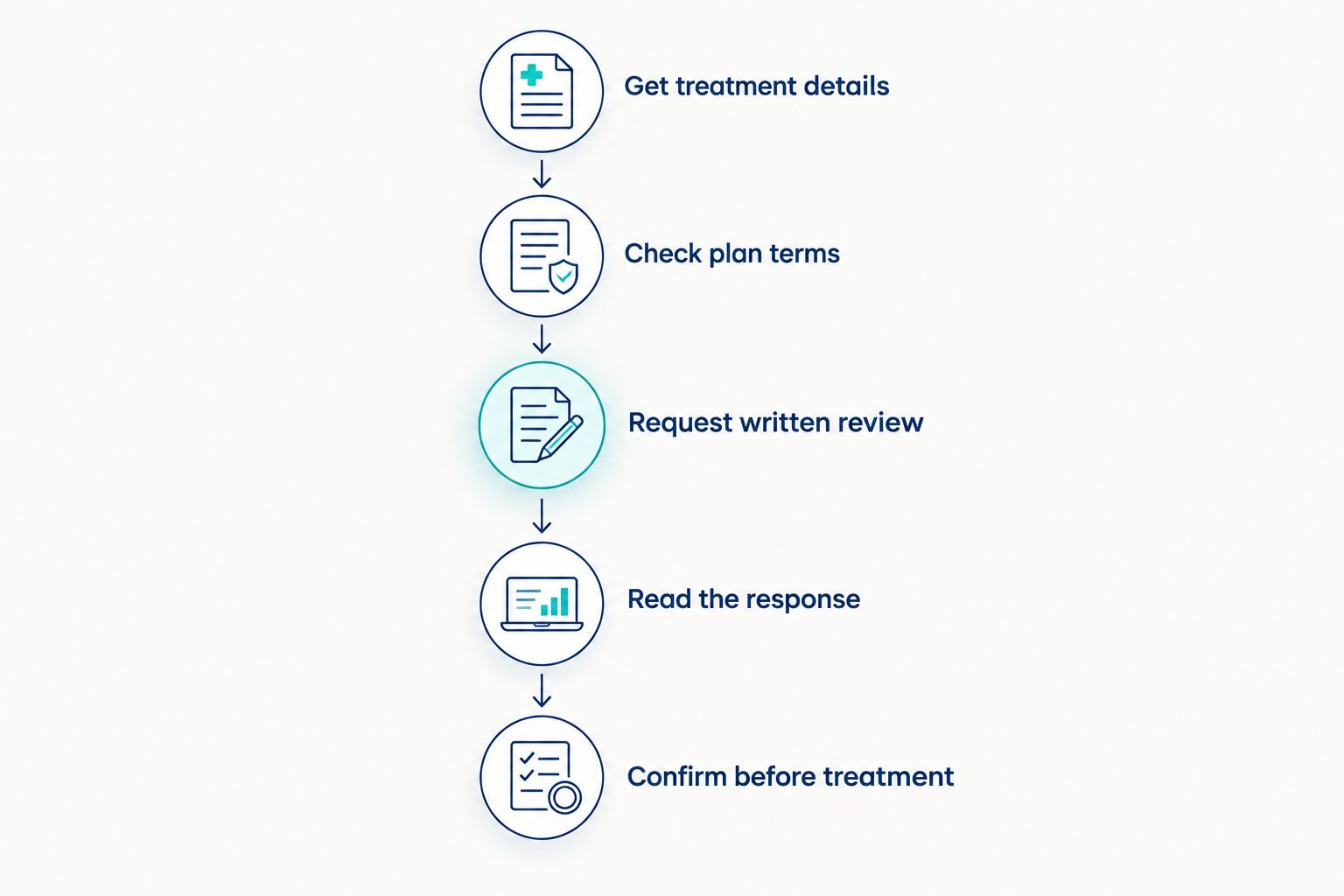
Use this sequence to turn a general insurance question into a usable answer. Keep the treatment plan and insurer's response together so you can compare them without relying on memory.
- Get treatment details. Ask for the proposed procedures, billing codes, tooth locations, and treating providers. Ask which steps are confirmed and which depend on examination findings.
- Check plan terms. Confirm implant eligibility, waiting periods, missing-tooth restrictions, network rules, and available benefits. Ask whether related services have separate restrictions.
- Request written review. Ask about a pretreatment estimate or predetermination using the proposed plan. Confirm whether any service also requires prior authorization.
- Read the response. Match every proposed procedure to the insurer's answer. Look for excluded services, alternate benefits, and conditions that still need to be met.
- Confirm before treatment. Check that the policy, provider status, and treatment plan have not changed. Ask the dental office to explain your expected responsibility before you proceed.
Keep 2 documents side by side: your itemized treatment plan and the insurer's written estimate. If a procedure appears in the treatment plan but not in the insurance response, ask for clarification rather than assuming it is included.
A pretreatment estimate is not a guarantee of final payment. Eligibility, remaining benefits, the treatment actually performed, and policy terms still affect the claim.
What should you ask when you call the insurer?
Start with a direct question: does my current policy cover implant placement for this tooth? Then move through the connecting piece, crown, and any preparation separately. Asking only whether implants are covered leaves too much room for an incomplete answer.
Use these questions during the call:
- Is implant placement included or specifically excluded?
- Are the abutment and implant-supported crown separate benefits?
- Does a missing-tooth clause apply to my situation?
- Have I satisfied the waiting period for these services?
- What annual benefits remain, and when does the benefit year reset?
- Does an alternate benefit provision apply?
- Is prior authorization required, and what records must be submitted?
- Which provider's network status matters for each stage?
Write down the representative's name, the date, and the call reference number. Request the relevant policy section or a written explanation whenever an answer affects your decision.
If the response is unclear, ask the representative to distinguish an exclusion from a documentation issue. Those answers lead to different next steps: reviewing another treatment option or supplying information for another review.
Does medical insurance cover dental implants?
Medical insurance does not automatically cover implants because a missing tooth affects eating or comfort. Coverage depends on whether the proposed services meet the medical policy's benefit and medical-necessity requirements.
A covered injury or another qualifying medical circumstance can warrant a medical-benefit review. Ask your insurer what documentation is required and whether the specific service is excluded under the policy.
Keep 2 separate questions in the conversation: is the service a covered benefit, and does your case meet the conditions for payment? A recommendation from a clinician does not, by itself, answer both.
For 2026 coverage, check the current medical policy rather than assuming dental and medical insurers use the same approval process. Also confirm who will submit any claim and which records support it.
Can you use two dental plans for an implant?
Having another dental plan can help with eligible expenses, but it does not mean both plans pay their full stated benefits. Coordination-of-benefits rules determine which plan processes the claim first and how the other plan considers it.
Ask both insurers how they handle implant services and whether a nonduplication provision applies. The second policy can still exclude the procedure even when the first policy covers it.
Give the dental office information for both plans before claims are submitted. Confirm that each insurer has accurate information about your other coverage, and request an explanation if the payment sequence is unclear.
What if dental insurance denies implant coverage?
First, read the reason for the denial. An explicit benefit exclusion, missing documentation, and a coding issue are not the same, so they should not receive the same response.
Ask for the explanation of benefits and the policy language used in the decision. If the issue involves missing records or an error, ask the dental office what information can be corrected or supplied.
If you disagree with the decision, follow your plan's appeal instructions and deadline. Keep the appeal focused on the stated denial reason, with the supporting records the insurer requests. An appeal does not create a benefit that the policy excludes.
You can also discuss clinically appropriate alternatives without committing to one immediately. Ask your dentist to explain the benefits and limitations of each option for your mouth, including how it affects nearby teeth and daily care.
Choosing care without letting coverage choose for you
Mysmiletheory is for Spring patients seeking a personal dentist for general and restorative dental care. An appointment is a place to discuss your missing tooth, your priorities, and the questions you want answered before deciding on treatment.
You can explore Mysmiletheory as a local starting point for that conversation. Bring your insurance card, current benefit documents, and any existing treatment proposal so your questions stay specific.
The advantage of a personal dental discussion is that your needs remain central. The limitation is that a clinical recommendation still does not establish insurance coverage; only your policy and claim review determine benefits.
Start a conversation about your smile
Explore personal general and restorative dental care in Spring, Texas.
FAQ
Does insurance cover dental implants in 2026?
Some dental insurance plans cover dental implants in 2026, while others exclude them or cover only certain components. Check your current policy and request a written review of the proposed procedures.
Will insurance cover the crown but not the implant?
A plan can cover an implant-supported crown while excluding implant placement. Confirm the crown, abutment, and implant benefits separately rather than treating them as a single service.
Does a missing-tooth clause affect implant coverage?
A missing-tooth clause can restrict benefits for replacing a tooth that was missing before your coverage began. Ask your insurer whether your policy includes the clause and how it applies to your treatment.
Is preauthorization a guarantee that insurance will pay?
Preauthorization is not an unconditional guarantee of payment. Final benefits depend on policy terms, eligibility, and the services performed; ask how your insurer distinguishes authorization from a pretreatment estimate.
Can I split implant treatment between benefit years?
Treatment across benefit years can affect available benefits, but your dentist must determine a clinically appropriate schedule. Ask the insurer which service dates and completion rules apply before changing a treatment timeline.
Can I appeal a denial for a dental implant?
You can use your plan's appeal process to challenge a denial. Follow the stated deadline and address the specific reason, recognizing that an appeal does not add coverage for an explicitly excluded benefit.
Can Mysmiletheory tell me whether my plan covers implants?
Your insurer determines your implant benefits under your policy. When discussing restorative dental care with Mysmiletheory, bring your coverage documents and ask which treatment details you need for a benefits review.
One last thing
Ask when a service counts toward your benefit year—not just when the annual maximum resets. Implant treatment involves separate stages, and the insurer's rules for the relevant service date matter when those stages cross a renewal date.
Before finalizing your 2026 schedule, have your dentist confirm the clinical timing and your insurer explain the benefit timing. Plan around healthy healing first, then understand how your coverage fits.


