

Instead of repeatedly checking your dental benefits and wondering what to schedule, use dental insurance benefits before they expire by confirming your plan’s dates, getting a dentist’s treatment recommendation, and checking coverage before scheduling. This 2026 workflow turns open-enrollment paperwork into a care-first plan without letting an insurance deadline decide what your smile needs.
- Use dental insurance benefits before they expire by confirming your benefit-year reset date, not just your open-enrollment deadline.
- Mysmiletheory provides general, cosmetic, restorative, and family dental care for patients in Spring, Texas.
- Schedule dentist-recommended care first; an unused annual maximum is not a reason to choose unnecessary treatment.
- Confirm coverage and treatment timing before scheduling; a benefits estimate is not a payment guarantee.
Why this matters
Open enrollment and expiring dental benefits are different events. Open enrollment is your opportunity to select coverage under your employer’s or plan’s rules; the benefit-year reset controls when annual benefit limits renew. Selecting a plan does not make that coverage effective immediately.
Your dental needs should set the treatment order; your insurance rules should inform the timing. That distinction keeps a deadline from turning into pressure to accept treatment you do not understand.
Mysmiletheory is for Spring, Texas patients seeking personal general, cosmetic, restorative, and family dental care. Bring your coverage questions and smile goals to the same conversation, but keep the dentist’s recommendation separate from the insurer’s coverage decision.
Before you start
Gather what you need before calling your insurer or arranging treatment:
- Plan access: Your insurance card, member identification, current benefit documents, and access to your insurer’s member account or member-services contact.
- Care information: Any existing treatment recommendation, recent claim statements, and questions about discomfort, chewing, gum health, or changes you want to make to your smile.
- The timing gotcha: Confirm the benefit-year reset date and new coverage’s effective date separately. Open enrollment does not extend current benefits, and submitting a claim before a deadline does not establish that treatment qualifies for that benefit year.
Create 1 worksheet for your 2026 plan. Use the labels below as your own worksheet headings, not as assumed buttons or fields in an insurer’s website. Portal wording differs by insurer; your plan documents and member-services answers supply the actual rules.
Benefits calendar
Start with the calendar, not with the amount of benefits left. You need to know which coverage applies on the date care is provided.
- Record your dates. Write down 3 dates: the open-enrollment deadline, the selected plan’s effective date, and your current benefit-year reset date. Find each in the relevant enrollment or benefit documents.
- Check the benefit period. Ask whether the plan follows a calendar year or another benefit year. Do not automatically treat December 31, 2026, as your deadline.
- Confirm unused-benefit rules. Ask whether unused annual benefits expire, whether the plan includes a rollover provision, and what conditions apply. Record the answer rather than assuming all plans work alike.
- Check outstanding claims. Ask whether the remaining-benefit information includes recently completed care and claims still being processed. Note any claims that have not yet appeared.
- Record the source. Save the document or written response. For a phone conversation, record the date and reference number if one is provided.
Expected result: Your worksheet identifies the current coverage period, the next coverage start date, and the source supporting each answer. You can distinguish an enrollment deadline from a treatment-related insurance deadline.
For example, if your employer’s enrollment window closes before your current coverage ends, those events still serve different purposes. Treat choosing next year’s plan and using current benefits as separate tasks, even when you handle them during the same week.
Care priorities
Insurance paperwork cannot tell you which tooth needs attention first. A dental examination and a conversation about your goals establish the care plan.
- Describe your concerns. Tell the dentist about pain, sensitivity, chewing difficulties, bleeding gums, broken teeth, or cosmetic changes you want to discuss. Explain any dental anxiety and what would help you feel more comfortable.
- Request a written recommendation. Ask which findings need treatment, which need monitoring, and which options address appearance rather than dental health. Ask what happens if recommended care is postponed.
- Separate needs from preferences. Identify the care the dentist recommends for health or function before considering elective changes. A natural-looking smile remains a valid goal, but an insurance deadline should not rush that decision.
- Discuss the sequence. Ask which treatment must happen first, whether healing or follow-up visits are involved, and whether there are clinically appropriate alternatives.
- State your scheduling limits. Share work shifts, school commitments, travel, and caregiver responsibilities before appointments are arranged.
Expected result: You have a written care plan with a clear order and understand why each recommended step belongs there. You also know which decisions need more discussion rather than an immediate commitment.
At Mysmiletheory, the starting point is the same whether you are considering general dentistry or cosmetic dental care: explain what concerns you and what you want your smile to feel and look like. Do not treat veneers or another appearance-focused procedure as an automatic way to use remaining benefits.
Coverage confirmation
Match your actual treatment recommendation to your actual plan. A general statement that a policy covers restorative care does not establish coverage for every proposed procedure.
- Gather treatment details. Use the written recommendation and procedure information supplied by the dental office. Do not guess procedure codes from an online description.
- Check participation. Ask the insurer and the office about the dentist’s participation in your specific plan. A company name alone does not identify every network or plan arrangement.
- Ask about restrictions. Check deductibles, annual maximums, waiting periods, frequency limits, exclusions, and any required review before treatment. Ask which restrictions apply to the recommended care.
- Request a pretreatment estimate when appropriate. Ask whether the insurer accepts a proposed treatment plan for advance review. Save the response and its conditions.
- Confirm how timing is assigned. For treatment involving several visits, ask which date determines the benefit year and what documentation the insurer requires. Do not assume the first appointment controls the claim.
Expected result: You understand the plan’s stated treatment rules and have a record of the insurer’s response. A pretreatment estimate is not a guarantee of claim payment. Eligibility, plan limits, and the completed treatment still affect the final claim.
Keep 2 records together: the dentist’s written treatment plan and the insurer’s benefits response. If they describe different procedures or dates, resolve that mismatch before scheduling. Your 2026 worksheet should connect the recommended care to the coverage information, not simply collect unrelated paperwork.
Appointment sequence
Now bring the clinical order, coverage rules, and your calendar together. The goal is an appropriate treatment schedule, not the busiest possible calendar before a reset.
- Confirm the clinical priority. Ask the dentist which recommended care should happen first and whether any proposed delay is appropriate.
- Check the full visit sequence. Ask what appointments, laboratory work, healing, or follow-up the recommendation requires. Confirm the sequence before choosing dates around a benefit deadline.
- Match dates to coverage. Use the insurer’s timing rules to identify the applicable benefit period. Recheck eligibility if a visit falls after a coverage change.
- Schedule the agreed care. Confirm appointment details with the office and explain that you are coordinating treatment with verified benefits information.
- Save your follow-up task. After treatment, review the explanation of benefits and ask about any discrepancy between the completed care and the processed claim.
Expected result: You have an agreed appointment sequence supported by the dentist’s recommendation and your plan’s timing rules. You also know what to review afterward.
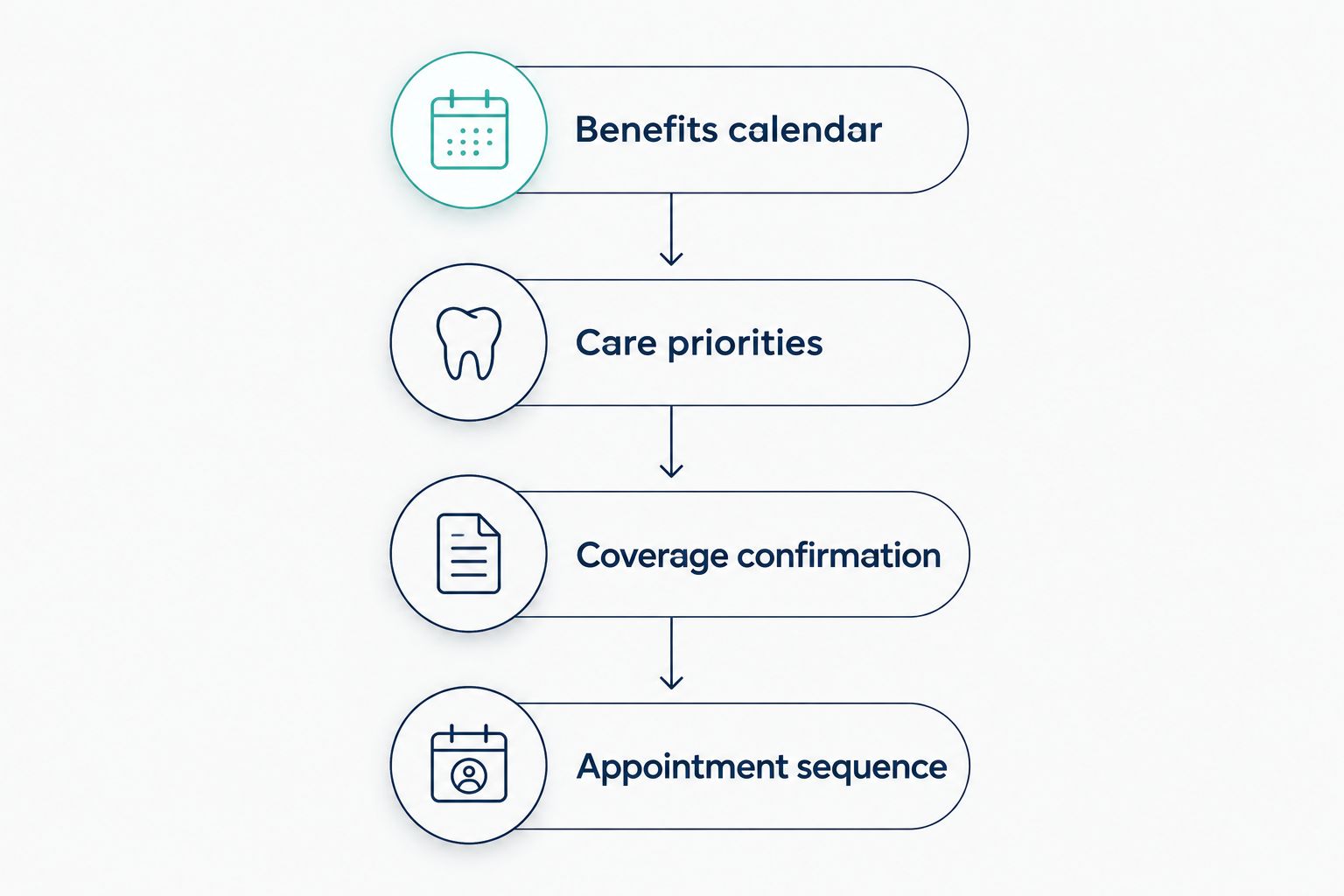
The process follows a simple order: Benefits calendar, Care priorities, Coverage confirmation, Appointment sequence. Coverage confirmation supports scheduling; it does not replace the examination or decide what treatment is necessary.
A deadline deserves attention, but symptoms deserve attention first. Contact a dentist promptly for dental pain or swelling; difficulty breathing or swallowing requires emergency medical care. Do not wait for open enrollment or a benefit reset to address an urgent concern.
Discuss your dental care plan
Bring your smile goals and insurance questions to a conversation about your next dental appointment.
When your coverage changes
Repeat the coverage portion of this workflow whenever your plan changes, including after open enrollment, a job change, or a change in covered family members. A familiar insurer name does not establish that your benefits remain the same.
- Save the new documents. Record the new effective date, member details, benefit period, and plan rules.
- Recheck the dentist’s participation. Confirm the specific new plan rather than carrying forward the previous answer.
- Review unfinished treatment. Ask how the new plan handles care that began under earlier coverage. Confirm any waiting periods or relevant exclusions.
- Update upcoming appointments. Share the new information with the office before care that falls under the new plan.
Expected result: Your upcoming visits are tied to the correct coverage, and assumptions from the previous plan have been removed.
Use this comparison to choose the right administrative workflow. Neither route replaces the dentist’s treatment recommendation.
| Workflow | Best for | Advantage | Limitation |
|---|---|---|---|
| Current-benefit review | Patients with recommended care and active coverage | Connects remaining benefits to an existing treatment plan | Outstanding claims and plan restrictions still require checking |
| New-plan review | Patients whose coverage is changing | Identifies the rules applying after the effective date | Previous estimates and network answers do not establish new coverage |
For a transition after 2026 open enrollment, keep the current and selected plan documents separate. Label every coverage answer with the plan it belongs to so an old approval does not become a new assumption.
Troubleshooting
The remaining benefits look higher than expected
Check for outstanding claims and ask the insurer what the displayed balance includes. Recently completed treatment can make an account balance an incomplete picture. Update your worksheet once those claims are processed.
The office and insurer give different network answers
Compare the exact plan name, network, dentist, and location. Ask both parties to check the same details. Do not schedule on the strength of a general statement that the office accepts an insurer.
Your estimate and final claim differ
Compare the explanation of benefits with the treatment actually completed and the estimate’s conditions. Ask the office and insurer to explain the specific difference and whether a correction or appeal process applies. An estimate alone does not establish an error.
Treatment cannot be completed before the reset
Ask the dentist about the appropriate sequence and the insurer about the applicable treatment-date rules. Do not compress care or postpone necessary treatment just to fit an insurance calendar. Review the next benefit period using confirmed information.
Cosmetic treatment is excluded
Ask the insurer to identify the relevant exclusion and the dentist to explain the procedure’s purpose. Cosmetic goals remain part of your care conversation, but an appearance-focused treatment is not automatically covered because benefits remain unused.
Customize your workflow
For family care, create a separate worksheet for each covered person. Confirm individual eligibility, treatment recommendations, and relevant benefit limits rather than treating the household as a single balance.
If you also use a health spending account, track it separately from dental insurance. Insurance benefits, FSA rules, and HSA rules are not interchangeable. The FSA or HSA dental-care workflow explains that adjacent planning task.
Bring comfort preferences into the appointment plan, too. Tell Mysmiletheory about anxiety, questions you want answered before treatment, and the natural-looking results you hope to discuss. Personal dental care starts with making those priorities clear.
FAQ
How do I use dental insurance benefits before they expire?
Confirm your benefit-year reset date, obtain a dentist-recommended treatment plan, and check the plan’s coverage rules before scheduling. Prioritize necessary care rather than choosing treatment solely because annual benefits remain.
Do dental insurance benefits always expire on December 31, 2026?
No. Your plan’s benefit year determines the reset date, so confirm it in the benefit documents or with the insurer. Do not substitute an open-enrollment deadline for that date.
Does open enrollment mean my new dental coverage starts immediately?
No. Open enrollment is the selection period; the plan’s effective date determines when new coverage starts. Check both dates before arranging treatment under a new plan.
Can I use remaining dental benefits for veneers?
Remaining benefits do not establish coverage for veneers. Check your plan’s exclusions and the proposed procedure with the insurer, and discuss suitability and natural-looking results with your dentist.
Does a pretreatment estimate guarantee insurance will pay?
No. A pretreatment estimate describes an anticipated coverage decision under stated conditions. Eligibility, plan limits, and the treatment completed affect the final claim.
Should I delay a painful tooth until my benefits reset?
Do not delay assessment of a painful tooth solely for an insurance reset. Contact a dentist promptly; difficulty breathing or swallowing requires emergency medical care.
What should I bring to a dental visit about my benefits?
Bring your insurance details, benefit documents, existing treatment recommendations, and your questions about symptoms or smile goals. Include information about a planned coverage change and any recent claims still being processed.
One last thing
The most useful question is not whether you can use every remaining benefit. It is which recommended care needs attention, and what is the appropriate sequence? Ask that first, then use your 2026 insurance information to support the answer.
Mysmiletheory offers dental care for local patients seeking a personal dentist. Bring the worksheet, ask for explanations in everyday language, and leave with a next step you understand—not simply a deadline to meet.