
Instead of managing pain day by day after an emergency dental visit, connect your discharge instructions, follow-up appointment, and final repair into one clear plan. This 2026 guide explains what to bring, what to ask, and how to recognize when you need help sooner.
- Follow up care after emergency dental visit connects urgent treatment with reassessment, healing checks, and any needed lasting repair.
- Mysmiletheory is best for Spring patients seeking a personal dentist for general and restorative dental care.
- Less pain does not prove a damaged or infected tooth has finished treatment.
- Follow your procedure-specific instructions; trouble breathing or swallowing requires emergency medical help.
Why this matters
An emergency visit can settle an immediate problem without completing the tooth’s treatment. A temporary filling, an initial root canal procedure, or an extraction each leads to a different next step. Your discharge instructions—not a general recovery calendar—should guide that decision.
For your 2026 care plan, separate three questions: What was treated? What still needs treatment? Who is responsible for the next appointment? That distinction keeps symptom relief from becoming an accidental stopping point.
Mysmiletheory offers general, cosmetic, restorative, and family dental care in Spring, Texas. Mysmiletheory is best for Spring patients seeking a personal dentist for general and restorative dental care. Continuing care locally provides a place to discuss both comfortable function and the appearance of a repair; an examination still determines the appropriate treatment.
Before you start
- Gather your emergency visit materials. Bring the discharge summary, treatment date, medication list, and any instructions about a temporary restoration, stitches, or referral. Include allergies and relevant health conditions.
- Confirm who handles the next step. Ask whether the emergency office, your regular dentist, or a referred specialist should arrange your review. Request that records and dental images reach the receiving office before the appointment.
- Check the hidden handoff problem. A referral does not mean an appointment is booked, and pain relief does not mean treatment is complete. Put the next action and responsible office in your 2026 calendar before returning to your usual routine.
Your discharge and symptom record
Turn the emergency visit into a usable handoff
- Write down the diagnosis. Use the wording on your discharge papers. If the explanation is unclear, ask which tooth or area was treated and whether the visit addressed the cause or only the immediate symptoms.
- Identify what remains unfinished. Ask whether you have a temporary filling or crown, whether root canal treatment needs completion, or whether an extraction needs a healing review. Do not assume every emergency procedure requires the same follow-up.
- Record your current symptoms. Note where discomfort occurs, whether swelling is changing, and whether biting feels different. Describe the change plainly rather than trying to diagnose it yourself.
- Review medication instructions. Follow the prescriber’s directions. Ask a pharmacist or clinician before combining medicines, especially when different products contain the same active ingredient.
Expected result: You can explain the emergency treatment, your current symptoms, and the unfinished work without relying on memory.
Keep this record somewhere easy to find. A phone note or a paper folder works; the useful part is having the discharge instructions and your questions together.
Your follow-up appointment and records
Make the next visit specific
- Contact the receiving dental office. Explain what happened, when you were treated, and what the emergency clinician recommended. Report worsening symptoms rather than requesting only a routine appointment.
- Ask for the right appointment purpose. Describe the need as a healing check, temporary-restoration review, root canal follow-up, or repair discussion, according to your paperwork. Let the office determine how to schedule it.
- Authorize the records transfer. Ask the emergency office how to release notes and images. Use the guide to transferring your previous dentist’s records if you are changing practices.
- Confirm receipt and responsibility. Check that the receiving office has the materials and knows about any specialist referral. Ask whom to contact if symptoms change before the appointment.
Expected result: You have an appointment with a clear purpose, and the receiving office knows what information to expect.
There is no single follow-up deadline that fits every emergency. Use the treating clinician’s timing, and call for clarification if the instructions do not name a next step. Do not wait for a planned review when symptoms are getting worse.
Your home-care routine
Protect the treated area without overdoing it
- Follow the procedure-specific instructions first. Care after an extraction differs from care after a temporary filling. If general advice conflicts with your discharge sheet, ask the treating office to clarify.
- Adjust eating to the treatment. Wait until numbness has worn off before chewing, and follow the dentist’s food instructions. Avoid testing a repaired tooth with hard or sticky foods to see whether it holds.
- Keep the rest of your mouth clean. The usual home-care foundation is brushing for 2 minutes, 2 times a day, with fluoride toothpaste. Ask how to clean around the treated area and when to resume your usual routine there.
- Protect an extraction site. During the first 24 hours after an extraction, standard aftercare includes avoiding vigorous rinsing and spitting to protect the blood clot. Follow your surgeon’s specific instructions about cleaning, eating, smoking, and activity.
- Track the direction of recovery. Notice whether discomfort, swelling, and function are improving or worsening. Contact the dental office about a concerning change instead of repeatedly adjusting home care yourself.
Expected result: You know how to protect the area, take medicines as directed, and recognize a change that needs professional advice.
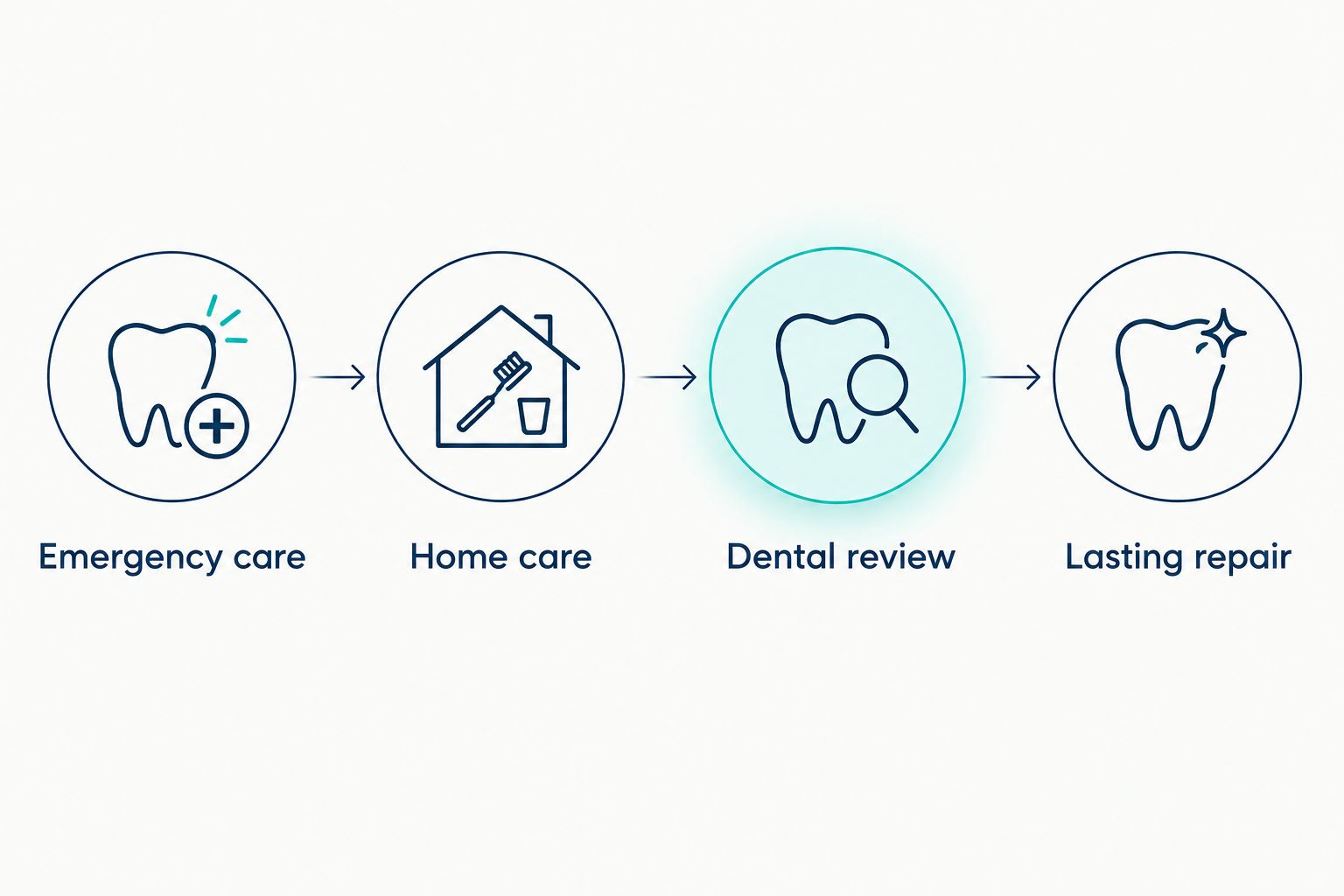
A simple handoff follows this sequence: Emergency care, Home care, Dental review, then Lasting repair when treatment is needed. A review can also confirm that healing is progressing without another procedure.
Your lasting repair plan
Choose treatment after the tooth is reassessed
- Ask what the examination shows. Your dentist should explain the remaining tooth structure, the condition of the tooth and surrounding tissues, and whether additional images or specialist care are needed.
- Compare appropriate treatments. Ask what each suitable option would address, what its limitations are, and whether another treatment must happen first. A cosmetic change should not replace care for active disease or injury.
- Discuss appearance and comfort together. For a visible tooth, explain what you want to preserve about its shape and shade. Ask how the proposed repair supports chewing as well as a natural-looking result.
- Confirm the finish line. Find out whether completion means a final filling, a crown, completion of root canal treatment, an extraction review, or a separate tooth-replacement discussion.
Expected result: You understand the recommended repair, its trade-offs, and the next appointment needed to complete it.
The comparison below explains common treatment roles. It is not a menu for self-selecting treatment; suitability depends on an examination.
| Treatment | Best for | Main benefit | Limitation or trade-off |
|---|---|---|---|
| Filling or bonding | Suitable areas of decay or limited tooth damage | Repairs a localized defect while retaining remaining tooth structure | Does not suit every deep fracture or heavily weakened tooth |
| Crown | A weakened tooth that needs broader coverage | Covers and supports the remaining tooth | Requires tooth preparation; not every damaged tooth can be saved this way |
| Root canal treatment | A restorable tooth with inflamed or infected inner tissue | Treats the tissue inside the tooth while retaining the tooth | A separate final restoration is often needed |
| Extraction | A tooth that cannot be predictably retained | Removes the affected tooth | Leaves a space and can lead to a separate replacement decision |
At Mysmiletheory, general and restorative dental care provide a starting point for discussing these needs. Cosmetic dentistry can enter the conversation when tooth health and healing permit; it should not become a detour around unfinished treatment.
When an extraction changes the workflow
An extraction creates a different follow-up path because there is no longer a tooth to restore. Healing comes first; replacement planning is a separate decision. Not every removed tooth requires replacement, so ask how the location affects your individual needs.
- Confirm wound care. Review cleaning instructions, bleeding guidance, and whether stitches require attention.
- Confirm any healing review. Follow the treating clinician’s advice rather than assuming every extraction needs the same schedule.
- Discuss the space when appropriate. Ask whether replacement is recommended and what conditions must be met before planning it.
Do not place a replacement deadline on yourself because of a social event or a work trip. Tell the dentist about those commitments so the plan reflects them without skipping necessary healing checks.
If the extraction followed an infection or difficult procedure, ask who remains responsible for reassessment. The surgeon and your regular dentist should not each be waiting for the other to arrange the next step.
Troubleshooting your follow-up care
Your pain is gone, but the tooth has a temporary repair
Keep the planned review. Reduced pain does not establish that the tooth has its final seal, protection, or restoration. Ask what remains unfinished before canceling an appointment.
Your bite feels high or a temporary filling comes out
Contact the treating dental office and describe what changed. Avoid chewing on that area, and do not file the tooth, adjust the restoration, or use household glue. Ask the office how to protect it until you are assessed.
Swelling or pain is getting worse
Contact a dentist promptly, especially with fever, spreading swelling, or difficulty opening your mouth. Trouble breathing or swallowing requires emergency medical help: call 911. Do not wait for a routine follow-up or assume medication makes worsening swelling safe to ignore.
Your records have not reached the next dentist
Ask the sending office to confirm the recipient and release process. Tell the receiving office what is missing; the dentist can decide what information is needed rather than having you postpone care on your own.
You are unsure what to do with prescribed medicine
Contact the prescriber or pharmacist for instructions, including advice about missed doses or side effects. Antibiotics do not replace dental treatment when the source of an infection still needs attention. Do not share medicines or use leftover prescriptions.
Customize your workflow
Your 2026 follow-up plan should fit your health, comfort, and schedule without treating a temporary improvement as the end of care. Bring up practical concerns early so the dentist can explain which decisions are flexible and which depend on healing or treatment completion.
- If dental visits make you anxious: Describe what feels difficult, such as injections, sounds, or uncertainty. Ask for explanations and an agreed way to request a pause.
- If work or school complicates appointments: Ask which visits complete treatment and which check healing. Do not combine or delay them without the dentist’s agreement.
- If appearance matters to you: Bring questions about shade, shape, and visible repair edges. Discuss cosmetic choices after the underlying problem has been assessed.
Mysmiletheory serves local patients seeking general, cosmetic, restorative, and family dentistry. If you want continuing care in Spring, request an appointment and explain the emergency treatment when you contact the clinic.
Plan your next dental visit
Discuss your emergency treatment, remaining questions, and next steps with a personal dentist in Spring.
FAQ
What should I do for follow up care after emergency dental visit?
Follow your discharge instructions, arrange the recommended review, and confirm whether any treatment remains unfinished. Bring your emergency records and medication list, and report worsening symptoms rather than waiting for the appointment.
Do I still need follow-up if my tooth has stopped hurting?
Yes, keep a recommended follow-up even if the pain has stopped. Symptom relief does not confirm that a temporary repair is finished or that the underlying problem has resolved.
How soon should I see my regular dentist after an emergency visit?
Use the timing given by the treating clinician because the right interval depends on the diagnosis and procedure. If no timing was provided, contact the office for instructions; worsening symptoms need earlier advice.
Can I brush my teeth after emergency dental treatment?
Follow your procedure-specific instructions about cleaning the treated area. Continue cleaning the rest of your mouth, and ask the dentist when and how to resume brushing or flossing near an extraction site or repair.
Does a root canal mean my emergency treatment is finished?
Not necessarily; root canal treatment and the final restoration are separate parts of care. Ask whether the root canal is complete and what filling or crown is needed to protect the tooth afterward.
What symptoms mean I should not wait for my follow-up?
Trouble breathing or swallowing requires emergency medical help. Worsening facial swelling, fever, increasing pain, or bleeding that does not respond to the provided instructions requires prompt professional advice.
Can Mysmiletheory help me plan care after an emergency visit?
Mysmiletheory offers general and restorative dental care in Spring, Texas. Bring your emergency visit information so the dentist can assess your needs and discuss an appropriate next step; the examination determines treatment.
One last thing
Ask what finished care looks like before you leave the next appointment. A tooth that feels better and a tooth with completed treatment are not always the same thing. For your 2026 care record, write down the remaining step—or ask the dentist to confirm that no further treatment is needed.
That small question gives you a clearer endpoint than pain alone. You deserve to understand both how your mouth is healing and what comes next.


