

Instead of manually sorting receipts and guessing whether you can use FSA or HSA for cosmetic dentistry, follow a treatment-by-treatment eligibility workflow before you pay. Separate health-related dental care from appearance-only changes, confirm the documentation requirements, and keep a clear record for reimbursement or tax reporting.
- To use FSA or HSA for cosmetic dentistry, establish eligibility first; appearance-only procedures generally do not qualify.
- Mysmiletheory offers cosmetic and restorative dental care for Spring patients seeking a personal dentist.
- Health FSA claims require plan review; HSA owners remain responsible for documenting qualified dental expenses.
- Separate eligible dental treatment from cosmetic extras, and never reimburse the same expense twice.
Why this matters
A healthier smile and a more attractive smile can be part of the same treatment plan. That does not make every part eligible for tax-advantaged funds. The treatment's purpose matters more than its name.
For 2026 planning, IRS Publication 502 provides the federal framework for medical and dental expenses, including the exclusion for most cosmetic procedures. IRS Publication 969 explains health savings accounts and health flexible spending arrangements. Your FSA plan also sets its own claim procedures and deadlines.
Mysmiletheory is best for Spring patients seeking personal general, cosmetic, and restorative dental care. A dental appointment helps you understand your treatment needs; it does not replace the eligibility review for your account.
This guide covers the paperwork and payment sequence, not a promise that a particular procedure qualifies. Keep treatment decisions centered on your oral health and your goals, then match the eligible expenses to the appropriate account.
Before you start
- Identify your account and its rules. Find your health FSA plan documents or HSA account records, your available balance, and access to your administrator or custodian. If you have a limited-purpose FSA, check its dental and vision provisions rather than assuming all health FSA rules apply unchanged.
- Gather your dental information. Have the proposed treatment plan, any insurance benefit explanation, and a way to request an itemized statement. For an HSA, confirm when the account was established before assigning expenses to it.
- Check the timing trap. A health FSA generally treats an expense as incurred when care is provided, not when you prepay. Booking or paying in 2026 does not automatically make later treatment a 2026 FSA expense.
You do not need to know dental terminology before your appointment. You do need to distinguish what the dentist recommends for health or function from what you want solely for appearance.
Your account and deadline record
Start with the account rules, not with a payment card. FSA and HSA funds can cover qualified dental expenses, but the two accounts handle deadlines and substantiation differently.
| Account | Best for | Main advantage | Main limitation |
|---|---|---|---|
| Health FSA | Eligible dental expenses within your plan's coverage period | Reimbursement through an employer-sponsored benefit | Plan deadlines and substantiation requirements apply; unused funds are subject to plan rules |
| HSA | Eligible dental expenses incurred after the HSA was established | Unused funds remain in the account, and qualifying reimbursement can occur later | You must retain records and take responsibility for the tax treatment of withdrawals |
- Confirm the account type. Check whether you have a general-purpose health FSA, a limited-purpose FSA, an HSA, or more than one eligible arrangement. Do not treat an employer benefits card as proof of the account type.
- Record the relevant dates. For an FSA, write down the coverage period, deadline for receiving eligible care, and deadline for submitting claims. For an HSA, record the establishment date and each treatment date.
- Check unused-fund provisions. Ask whether your FSA offers a carryover or a grace period. A permitted grace period can extend up to 2.5 months, but your employer's plan determines whether it exists and how it works.
Expected result: You have a short account record showing which expenses fit the coverage period and when any FSA claim must be submitted.
A claim-submission extension is not the same as extra time to receive treatment. A run-out period gives you time to submit claims for care already incurred during an eligible period. Keep those dates separate on your 2026 calendar.
Your treatment eligibility record
The word cosmetic can describe your goal without settling the tax question. A tooth repair can improve appearance while treating damage; whitening can improve appearance without treating disease.
| Treatment purpose | Best for | Benefit | Eligibility limitation |
|---|---|---|---|
| Treating decay, damage, or dental disease | Patients with a diagnosed dental problem | Addresses oral health or function and can also improve appearance | The records must accurately describe the treatment and expense |
| Whitening otherwise healthy teeth | Patients seeking a color change | Changes tooth shade | Teeth whitening is excluded from deductible medical expenses under IRS guidance |
| Appearance-only veneers or bonding | Patients seeking changes in shape, color, or spacing | Changes visible smile features | A cosmetic goal alone does not establish FSA or HSA eligibility |
| Treatment addressing qualifying deformity | Patients with relevant congenital abnormalities, accident-related injury, or disfiguring disease | Addresses a qualifying underlying condition | The cosmetic-procedure exception requires the facts to meet the federal criteria |
- Ask the dentist to explain the purpose of each treatment. Use plain questions: Is this treating damage? Is it restoring function? Is it an optional appearance change? Request a written plan that separates those purposes accurately.
- Match the purpose to federal guidance. IRS Publication 502 generally excludes cosmetic procedures directed at improving appearance without meaningfully promoting proper body function or preventing or treating illness or disease. It describes exceptions for qualifying deformities related to congenital abnormalities, accident-related injury, or disfiguring disease.
- Resolve uncertainty before payment. For an FSA, ask the administrator what documentation it requires and whether the proposed expense meets the plan's rules. For an HSA, use IRS guidance and a qualified tax professional when the facts are unclear; a custodian's payment processing is not a tax determination.
Expected result: Each proposed treatment has a documented purpose and a clear next action: proceed with eligible-account payment, obtain clarification, or keep it outside the account.
If your concern involves a damaged tooth, the guide to fixing a chipped or cracked tooth helps you prepare treatment questions. A repair recommendation still needs its own eligibility and documentation review.
Your payment and claim file
Once you understand eligibility, build the file around the actual care delivered. Keep the treatment plan, itemized statement, insurance records, and payment evidence together rather than relying on a card transaction alone.
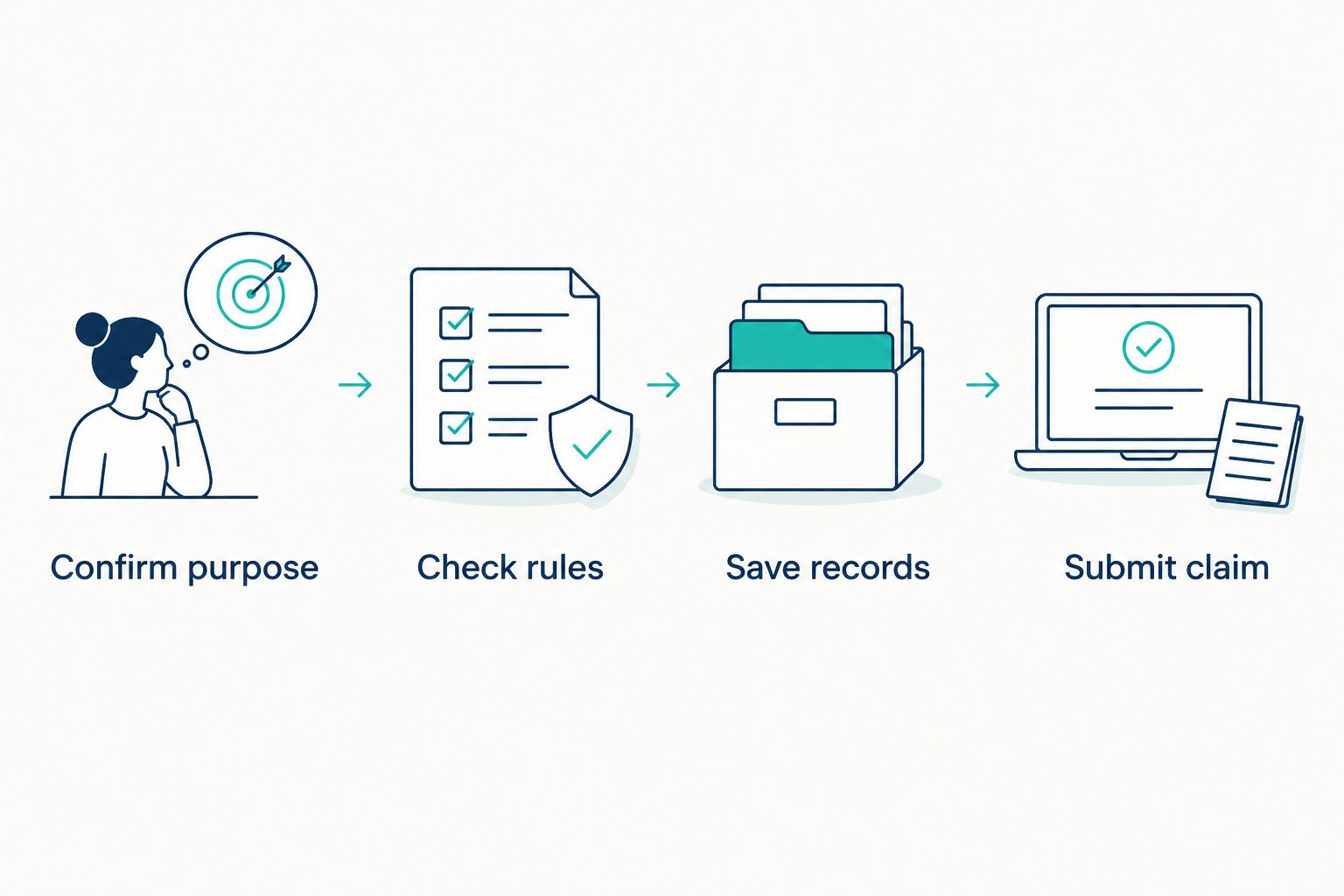
- Confirm purpose. Make sure the final treatment matches the plan you reviewed. If the dentist changes the procedure, pause the account-payment decision until you understand the revised purpose.
- Check rules. Apply the account's timing requirements and subtract amounts paid by insurance or another source. Do not claim the same expense through both an FSA and an HSA.
- Save records. Request an itemized statement identifying the patient, provider, service date, treatment, and charge. Keep any explanation of benefits and the payment receipt with it; a receipt alone often does not establish what care occurred.
- Submit claim. Follow your FSA administrator's submission instructions and respond to documentation requests. For an HSA withdrawal or later reimbursement, retain the supporting records with your tax files rather than assuming the custodian has verified eligibility.
Expected result: Your records explain what happened, when it happened, what you paid yourself, and why the expense qualifies.
No single set of button names applies to every benefits portal. Use your administrator's instructions for uploading records or requesting reimbursement, and check the claim status afterward. A successful card payment is not proof of an eligible expense.
For 2026 records, keep the service date visible even if the receipt, insurance statement, and reimbursement each have different dates. Those dates serve different purposes and should not be substituted for one another.
Your completed reimbursement record
A submitted claim is not the end of the process. You need a final record showing what was reimbursed and whether any follow-up remains.
- Review the result. For an FSA, compare the approved reimbursement with the expense you submitted. Read any request for additional information rather than resubmitting the same incomplete documents.
- Record the reimbursement source. Mark whether the eligible expense was paid directly from the account or reimbursed after you paid personally. Include any insurance payment that changes your out-of-pocket amount.
- Close the file only when the amounts agree. Keep unresolved items separate from completed expenses. If insurance later pays an amount you already claimed, contact the appropriate administrator or obtain tax guidance about correcting the overlap.
Expected result: Every expense has one final status, with no duplicate reimbursement and no unanswered documentation request.
Keep your 2026 dental records organized by service date and patient. This makes it easier to answer a later question without reconstructing the treatment from bank statements.
When your treatment plan changes
Use the same workflow whenever a procedure, treatment date, or insurance payment changes. An earlier eligibility discussion does not automatically cover a different service.
A mixed treatment plan needs particular care. For example, repair of a damaged tooth and whitening of otherwise healthy teeth serve different purposes. Do not group them into a single cosmetic package and assume the entire amount qualifies.
- Separate the services. Request an accurate itemization of the treatment actually provided, not a relabeling of cosmetic care.
- Recheck the dates. Moving an appointment across an FSA coverage boundary changes the timing analysis even when the treatment stays the same.
- Update the insurance record. Use the final patient responsibility when coordinating reimbursement.
- Repeat the eligibility review. Ask the FSA administrator about the revised expense or obtain tax guidance for an uncertain HSA withdrawal.
At Mysmiletheory, your discussion can cover general, cosmetic, and restorative dental care. Bring your account questions alongside your smile goals so you can distinguish the dental recommendation from the separate benefits decision.
Troubleshooting
The benefits card worked, but the claim needs proof
Send the requested itemized statement and supporting records. Card acceptance confirms that the transaction processed; it does not establish that the treatment qualifies. If the expense is ineligible, ask the administrator how to correct the payment.
The FSA administrator rejected an incomplete claim
Read the reason and supply the missing information before the submission deadline. A document without a service date or treatment description leaves questions that a payment receipt cannot answer. Follow the plan's appeal process if you disagree with the eligibility decision.
Your veneer treatment was described as automatically eligible
Request a treatment-specific explanation. Veneers used solely to change appearance generally do not qualify, and a letter does not turn an appearance-only procedure into eligible care. The underlying facts must support any claimed exception.
You used HSA funds for an ineligible expense
Contact the custodian and a qualified tax professional promptly to discuss correction options and reporting. Nonqualified HSA distributions are generally taxable and can face an additional 20% tax; that additional tax generally does not apply after age 65, disability, or death. These exceptions do not make cosmetic treatment a qualified expense.
Customize your workflow
Build your appointment notes around three questions: what you want to change, what needs treatment, and what documentation your account requires. You can discuss a natural-looking result without deciding on a procedure before the examination.
Mysmiletheory provides cosmetic dentistry alongside general and restorative care for local patients seeking a personal dentist. Its dental services help address your treatment goals; your account rules still determine whether an expense receives tax-advantaged treatment.
Use the workflow for each new treatment plan instead of only at year-end. For your next 2026 appointment, bring the relevant account deadlines and ask how the proposed care separates health needs from optional appearance changes. Do not let an expiring benefit drive unnecessary care or delay treatment your dentist considers urgent.
Start with your dental questions
Discuss your oral health needs and smile goals before deciding on treatment.
FAQ
Can I use FSA or HSA for cosmetic dentistry in 2026?
Generally, you cannot use tax-advantaged FSA or HSA funds for procedures performed solely to improve appearance. Qualified dental treatment and certain cosmetic-procedure exceptions require a treatment-specific review under federal rules.
Can I use my HSA or FSA for teeth whitening?
Teeth whitening is not a qualified medical expense under IRS Publication 502. Paying with an account card does not change that exclusion.
Are veneers eligible for FSA or HSA reimbursement?
Veneers used solely to change appearance generally are not eligible. Any claimed exception depends on the underlying condition and federal criteria, not simply a dentist's recommendation or a letter.
Does a dentist's letter guarantee that my dental expense qualifies?
No, a dentist's letter does not guarantee eligibility. It can explain the condition and treatment purpose, but the expense must still satisfy the applicable federal and plan rules.
Can I pay now and get reimbursed from my HSA later?
Yes, qualified expenses incurred after your HSA was established can generally be reimbursed later. Keep records showing the expense was not reimbursed elsewhere or claimed as an itemized deduction.
Does prepaying reserve my current FSA funds for later treatment?
No, prepayment alone does not establish when a health FSA expense is incurred. Care generally must occur during an eligible coverage period, subject to your plan's rules.
Can I split a dental plan between account funds and personal payment?
Yes, you can keep eligible expenses separate from appearance-only expenses and pay them from appropriate sources. Use accurate itemized records and avoid reimbursing the same expense twice.
Can Mysmiletheory help me plan a healthier, natural-looking smile?
Mysmiletheory offers general, cosmetic, restorative, and family dental care in Spring, Texas. Discuss your oral health needs and appearance goals at an appointment, then confirm account eligibility separately.
One last thing
Your account balance is not your treatment plan. Having funds left does not make an appearance-only procedure eligible, and an account deadline does not establish a clinical reason for treatment.
Before scheduling, ask your dentist to explain the health purpose and the appearance goal separately. That simple distinction gives you a clearer dental decision and a cleaner benefits record. You can pursue a smile that feels like you without treating every cosmetic improvement as a reimbursable expense.


