
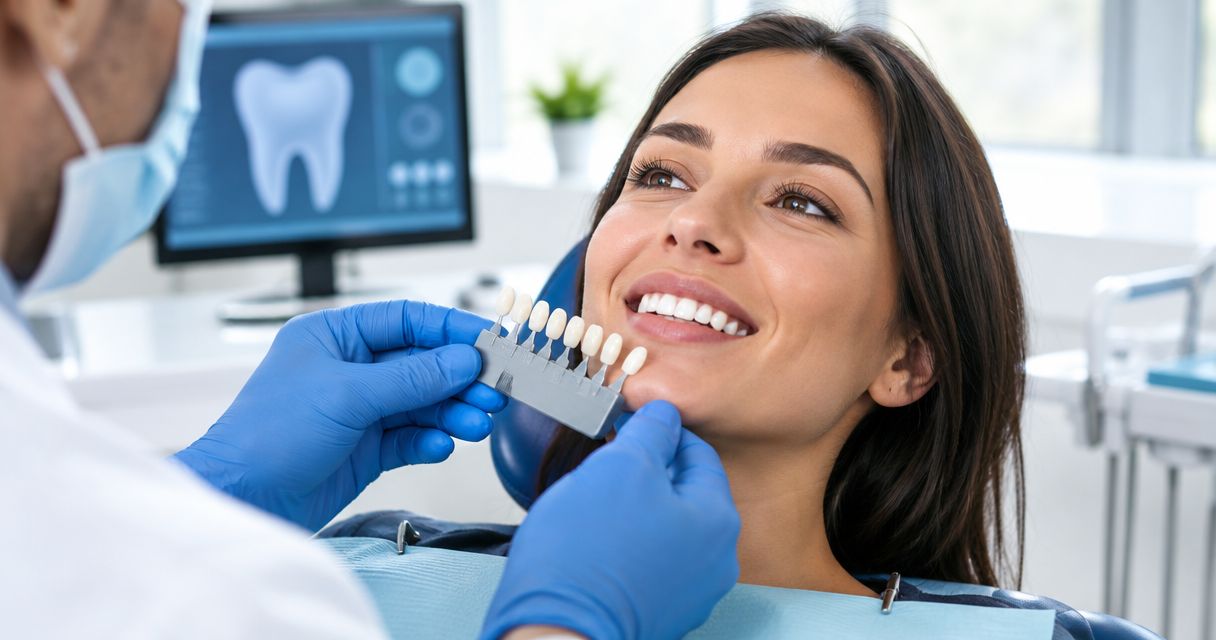
No—teeth whitening does not lighten the original shade of dental crowns or veneers. Professional cleaning can remove some surface stains, but it cannot bleach the restoration itself. If you're planning a brighter smile in 2026, remember that whitening nearby natural teeth can leave existing crowns or veneers looking darker by comparison.
- Can you whiten dental crowns or veneers? No—bleaching does not change their original shade.
- Professional cleaning can remove surface stains without changing a crown or veneer's underlying color.
- Whitening natural teeth can create a shade mismatch beside existing dental restorations.
- Mysmiletheory offers general and cosmetic dental care for local patients in Spring, Texas.
Why this matters
A crown that looks darker does not automatically need replacing. The visible difference might come from surface staining, a change in the surrounding teeth, or a problem that needs an examination. Those situations call for different next steps.
Find out what changed before trying to whiten it. If you are considering bleaching natural teeth beside dental work, start with the basics of teeth whitening and enamel safety. Protecting your teeth and getting an even-looking result belong in the same conversation.
Can you whiten dental crowns or veneers?
You cannot bleach crowns or veneers to a lighter shade with whitening strips, trays, or professional whitening gel. These treatments act on stains within natural teeth; they do not change restorative materials in the same way. A stronger whitening product does not solve that difference.
Cleaning and whitening are not interchangeable. Cleaning removes deposits and certain stains from a surface, while bleaching changes the color of natural tooth structure. Replacing a restoration changes the restoration itself, which is a separate treatment decision.
| Approach | Best for | What it can do | Main limitation |
|---|---|---|---|
| Professional cleaning or appropriate polishing | Removable surface staining | Remove deposits and some external discoloration | Cannot make the original restoration shade lighter |
| Teeth whitening | Discoloration in natural teeth | Lighten responsive stains in natural tooth structure | Does not lighten crowns or veneers; a mismatch can become more noticeable |
| Restoration replacement | An unsuitable shade or a restoration needing replacement | Allow selection of a different restoration shade | Involves dental treatment rather than simple stain removal |
A dentist needs to check the restoration before recommending any of these approaches. Color alone does not show whether a crown fits properly, whether a veneer is intact, or whether the tooth underneath is healthy.
Porcelain crowns and veneers: cleaning is not bleaching
Porcelain restorations do not respond to whitening gel like natural teeth. If the porcelain was made in a shade that now looks too dark, bleaching will not turn that shade lighter. That remains true even if the surrounding teeth whiten noticeably.
Surface staining is a different issue. A dentist can assess whether deposits or external stains are affecting the appearance and whether cleaning or polishing is appropriate for that material. The goal is to restore a clean surface, not promise a new underlying color.
Do not try to scrub porcelain into a whiter shade. Roughening a restoration can affect its finish, and whitening products cannot repair chips, cracks, or a damaged surface. Bring the concern to an appointment instead of increasing pressure or abrasiveness at home.
Composite veneers and bonding: assess the surface first
Composite resin also does not whiten predictably like natural tooth structure. Whitening strips are not a dependable way to change a composite veneer's original shade. Some discoloration sits on the surface; other color changes involve the material itself.
A dentist can assess whether polishing, repair, or replacement fits the problem. Polishing preserves the existing restoration when surface staining is the issue, but it does not guarantee a lighter shade throughout the material.
If you do not know whether your veneers are porcelain or composite, ask before choosing a stain-removal product. You do not need to identify the material yourself. Dental records and an examination help guide care that suits the restoration.
Why crown and veneer color varies
A darker-looking restoration has more than one possible explanation. These factors help explain why the right treatment depends on an examination rather than a whitening label:
- Original shade: A restoration keeps its selected shade even when your preferred tooth color changes.
- Surface deposits: Plaque, tartar, and external stains can affect how clean and bright the surface looks.
- Surrounding teeth: Whitening natural teeth can make an unchanged crown or veneer stand out.
- Restoration material: Porcelain and composite have different surface characteristics and care needs.
- Gum position: Receding gums can expose a restoration edge or a darker area near the gumline.
- Tooth or restoration condition: Decay, damage, or a problem around the restoration needs assessment, not cosmetic bleaching.
A photograph can help you show where the difference bothers you. It cannot establish the cause, because lighting changes color and a photograph does not show everything happening around or beneath a restoration.
What should you do before whitening around dental work?
If your 2026 smile plans include whitening, let your dentist know about every visible crown, veneer, and bonded area. A treatment that brightens natural teeth can still leave you unhappy if it creates a noticeable contrast with dental work.
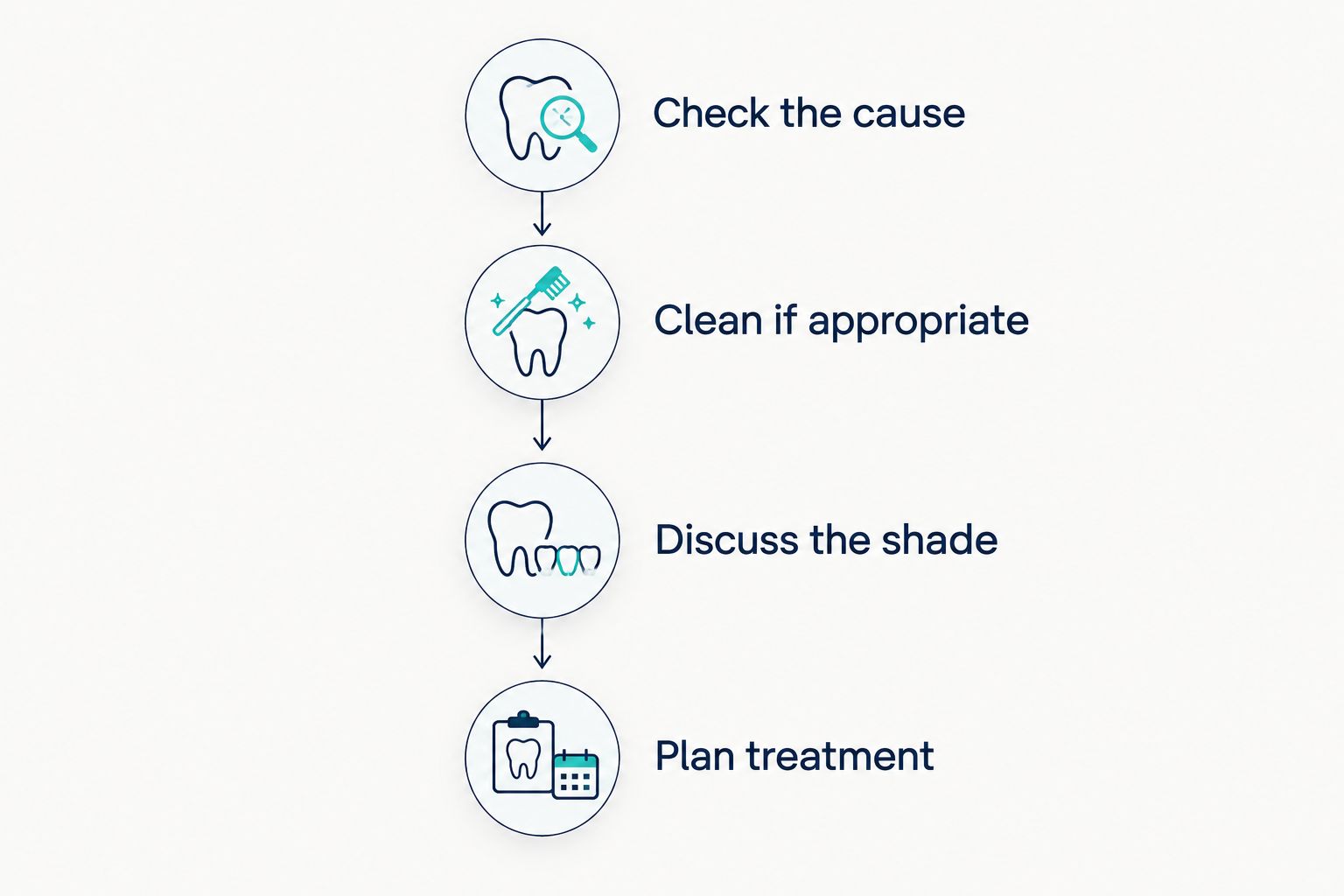
- Check the cause. Point out when you noticed the discoloration and whether it affects the whole restoration or just an edge. Mention pain, sensitivity, a rough spot, or a change in your bite.
- Clean if appropriate. Let the dentist decide whether deposits or surface stains should be addressed before judging the shade. A cleaner surface makes that discussion more useful.
- Discuss the shade. Explain whether you want to match the existing restoration or make a broader change. Bring up natural-looking results rather than choosing the brightest shade in isolation.
- Plan treatment. If natural-tooth whitening and new restorations are both appropriate, ask how they should be coordinated. Shade selection belongs within that plan.
You can also tell your dentist what you want to keep. A small difference visible only under close inspection might not bother you enough to justify treatment. Your comfort with the appearance matters alongside the health and condition of the restoration.
Should you whiten teeth before getting a new crown or veneer?
If you want lighter natural teeth and also need a new visible restoration, discuss whitening before the final shade is selected. The restoration should be planned around a tooth color you intend to maintain, not a temporary appearance immediately after bleaching.
Your dentist can advise when the teeth are ready for shade matching. Do not set your own whitening-to-restoration deadline. The timing depends on the treatment and the clinical situation, so a fixed waiting period does not belong in every patient's plan.
For a new crown or veneer planned in 2026, bring up whitening at the planning visit rather than after the restoration is finished. This conversation can clarify what is realistic without assuming that healthy dental work needs replacing.
Natural-looking results also depend on more than whiteness. Shape, translucency, and how the restoration sits beside neighboring teeth all contribute to its appearance. Ask to discuss the whole match, especially when a front tooth is involved.
Can whitening strips damage crowns or veneers?
Whitening strips do not lighten the restorative material, and they are not a treatment for a damaged restoration. They can also cause tooth sensitivity or gum irritation. Existing dental work is a reason to discuss product suitability, not a reason to use more gel or leave strips on longer.
Follow the product directions and your dentist's advice. Stop using a whitening product and seek advice if it causes significant discomfort or irritation. Persistent pain, a loose restoration, or a changed bite calls for an examination rather than another whitening session.
Can a dentist remove coffee stains from veneers?
A dentist can remove some surface stains from veneers when the material and condition allow appropriate cleaning or polishing. That does not mean every dark area is a coffee stain, or that polishing can make the original veneer shade lighter.
Show your dentist the specific area before trying a stronger toothpaste. Avoid treating charcoal powders, acidic mixtures, or abrasive home scrubs as substitutes for a material-specific assessment. A surface that looks stained needs the right diagnosis first.
Do you need to replace a crown that looks too dark?
You do not automatically need to replace a crown because its shade bothers you. Cleaning, the color of adjacent teeth, and the crown's condition all belong in the decision. Replacement becomes a discussion when the original shade remains unsuitable or the restoration has a clinical problem.
Replacing dental work is a treatment, not a whitening touch-up. Ask what can be preserved, what replacement would involve, and what the limits are. You should understand the benefit and the trade-off before choosing a change.
Keeping crowns, veneers, and natural teeth looking cared for
A realistic home-care routine supports the teeth and gums around your restorations. Brush for 2 minutes per session, brush 2 times per day with fluoride toothpaste, and clean between your teeth 1 time per day using an approach suited to your dental work.
Choose a soft-bristled toothbrush and ask which toothpaste suits your restorations. Whitening toothpaste does not bleach a crown or veneer, and a more abrasive product is not a shortcut to a lighter shade. Gentle, consistent cleaning is the better habit.
For your 2026 care plan, ask how often you should return for examinations and cleanings. The interval should reflect your oral health rather than a universal cosmetic schedule. Report a newly dark edge, bleeding, or food catching around a restoration instead of assuming it is ordinary staining.
A personal conversation about your smile
Mysmiletheory is for Spring, Texas patients seeking general and cosmetic dental care. If you live in North Houston and feel unsure about a crown or veneer, an appointment gives you space to explain what looks different and what you hope to change.
Mysmiletheory offers general, cosmetic, restorative, and family dentistry. Ask whether the next step is cleaning, an assessment of the restoration, or a conversation about shade matching. You do not need to arrive with a treatment already chosen.
Talk through your smile concerns
Discuss your crowns, veneers, and goals for a natural-looking smile.
FAQ
Can you whiten dental crowns or veneers at home?
No—home whitening does not lighten the original shade of dental crowns or veneers. Ask your dentist whether the discoloration is surface staining, a shade mismatch, or a problem requiring treatment.
Will professional teeth whitening make my crown whiter?
Professional teeth whitening does not make the crown material whiter. It can lighten nearby natural teeth and make an existing crown look darker by comparison.
Can whitening toothpaste remove stains from veneers?
Whitening toothpaste does not change a veneer's original shade, although some toothpastes remove external stains. Ask your dentist which product is appropriate for your veneer material and surface condition.
Why is there a dark line around my crown?
A dark line around a crown needs an examination to identify the cause. Gum recession, a visible restoration edge, staining, or decay can affect the appearance, and whitening is not a reliable solution.
Should I replace my veneers before whitening my teeth in 2026?
Discuss the sequence before replacing veneers or whitening your teeth in 2026. If both treatments are appropriate, the dentist can coordinate whitening and final restoration shade selection.
Can I keep a healthy crown even if the shade is different?
A shade difference alone does not automatically mean a crown needs replacement. Your dentist can assess its health and fit while you decide whether the appearance bothers you enough to consider treatment.
Where can I discuss crowns and cosmetic dentistry in Spring, Texas?
Mysmiletheory offers general, cosmetic, restorative, and family dental care in Spring, Texas. You can bring concerns about crown or veneer color to an appointment and discuss appropriate next steps.
One last thing
A brighter smile is not always a more even-looking smile. Whitening natural teeth while leaving a front crown unchanged can make the difference more visible, even when the whitening works as intended.
Before buying another whitening product, identify which tooth or restoration looks different. That small step makes the conversation with your dentist more focused—and helps keep the plan centered on your smile rather than a shade chart.


