
Dental bonding generally lasts 3–10 years before it needs a touch-up or replacement, but there is no guaranteed replacement date for an individual tooth. Chipping, staining, and changes in your bite can bring that visit forward; a small repair does not always mean replacing all the bonding.
- How long does dental bonding last? Usually 3–10 years before touch-up or replacement, according to Cleveland Clinic.
- Dental bonding needs attention when it chips, feels rough, changes your bite, or develops persistent discoloration.
- Protect composite resin by avoiding ice chewing, keeping teeth clean, and discussing grinding with your dentist.
- Mysmiletheory offers general and cosmetic dental care for local patients in Spring, Texas.
Why this matters
Bonding does not have an expiration date you can mark on a calendar. Its condition matters more than its age. A smooth, comfortable repair that still looks natural needs a different conversation from one that catches floss or hurts when you bite.
For patients considering cosmetic dental care in 2026, the useful question is not just how long a material lasts. It is what maintenance involves and how much healthy tooth can be preserved. Mysmiletheory provides general, cosmetic, restorative, and family dental care in Spring, Texas, so you can discuss appearance alongside everyday dental health.
How long does dental bonding last?
Dental bonding typically lasts 3–10 years before touch-up or replacement. Cleveland Clinic’s patient guidance on dental bonding gives this range for the tooth-colored composite resin used to change a tooth’s shape, repair small imperfections, or improve its appearance. That published range is the lifespan reference used in this 2026 guide—not a prediction for your individual teeth.
The difference between a touch-up and replacement matters. A small surface stain might need polishing, while a chipped edge might need additional resin. Decay beneath a repair or a substantial break requires a different assessment.
| What you notice | What it means for longevity | What to discuss |
|---|---|---|
| Bonding is smooth, comfortable, and unchanged | Age alone does not establish a need for replacement | Continued monitoring at dental visits |
| Surface staining or slight roughness | The surface needs assessment; the whole repair is not necessarily failing | Whether polishing is appropriate |
| A small chip | Local damage does not automatically require full replacement | Whether a repair can restore the edge |
| A loose piece, pain, or a changed bite | The tooth and bonding need an examination | The cause and the appropriate treatment |
Think of the range as planning context, not a warranty. Your dentist can examine the edges, underlying tooth, and bite to explain whether the bonding remains serviceable.
Does bonding last longer on front teeth?
Front-tooth bonding still falls within the general 3–10-year reference range; tooth position alone does not give you a reliable personal forecast. A small addition away from biting contact faces different demands from resin placed along an edge you use to bite food.
The important distinction is where the force lands, not simply whether the tooth is at the front or back. Grinding, clenching, and biting hard objects can put repeated pressure on a bonded edge.
Does bonding need replacing after 10 years?
Ten years is not an automatic replacement deadline. If the bonding remains intact, the tooth is healthy, and you are comfortable with its appearance, your dentist can assess whether continued monitoring is appropriate.
The reverse is also true: bonding does not need to reach a particular age before it deserves attention. A recent repair that feels loose or changes your bite should be checked rather than watched until the expected lifespan passes.
Why dental bonding lifespan varies
For a bonding assessment in 2026, these factors are more useful than a promise about a fixed number of years:
- Bite pressure: Bonding at a biting edge experiences different forces from material placed on a less-loaded surface. Your dentist checks how your teeth meet.
- Repair size: A small shape correction and a larger reconstruction place different demands on the resin and remaining tooth. More coverage does not automatically mean more protection.
- Grinding habits: Clenching or grinding repeatedly loads teeth and restorations. Tell your dentist about morning jaw soreness, tooth wear, or a history of broken repairs.
- Daily cleaning: Plaque still collects around bonded teeth. Decay in the surrounding natural tooth can compromise an otherwise intact cosmetic repair.
- Staining exposure: Composite resin can discolor over time. Tobacco and staining drinks affect appearance, which can prompt maintenance before a repair becomes structurally damaged.
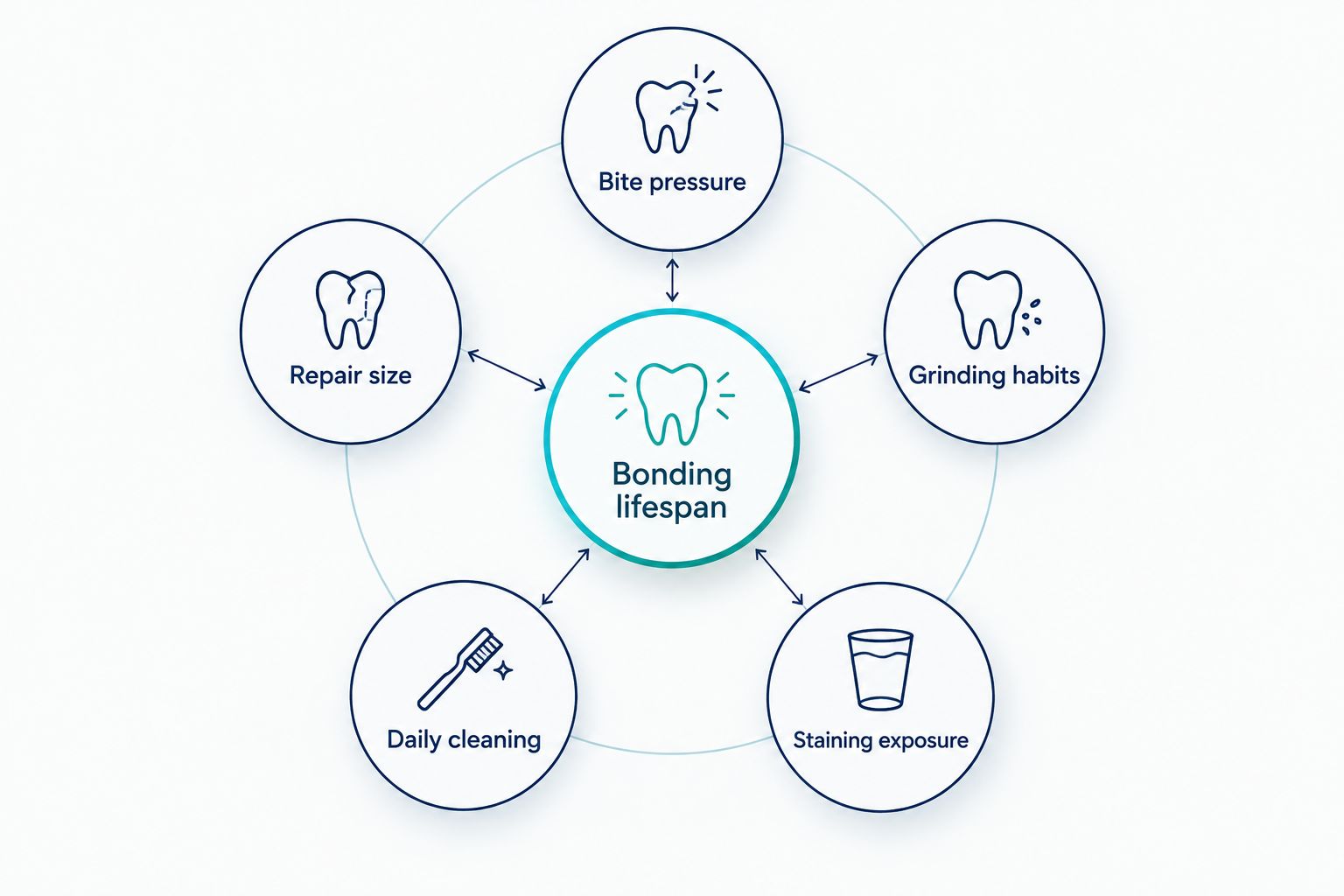
These factors do not let you calculate an exact replacement date at home. They help you identify what to discuss during an examination. Be specific about habits such as chewing ice or using your front teeth to tear packaging; those details help explain repeated damage.
How can you help dental bonding last longer?
You do not need an elaborate routine. Consistent cleaning and sensible protection are more useful than treating your bonded tooth as too delicate to use.
Keep the tooth and gumline clean
Brush for 2 minutes, twice a day, using fluoride toothpaste and a soft-bristled toothbrush. Clean between your teeth once a day with floss or another suitable interdental cleaner. These are American Dental Association home-care recommendations for natural teeth, including teeth with restorations.
Pay attention to the gumline and the spaces beside the bonding. Resin itself does not develop cavities, but the natural tooth around it can. If floss repeatedly catches or shreds in the same place, ask your dentist to check the edge rather than forcing it through.
Avoid using your teeth as tools
Do not bite fingernails, open packages, or chew pens with bonded teeth. Avoid chewing ice and other very hard objects, which can damage both natural teeth and restorations.
You can still eat normally, but use judgment around hard foods. Cut a hard item into manageable pieces rather than testing a repaired front edge against it. This is about reducing unnecessary stress, not creating a long list of forbidden foods.
Discuss grinding before another chip happens
If you grind or clench, ask whether a protective appliance is appropriate. A dentist needs to assess your bite and symptoms before recommending one; a mouthguard is not a guarantee that bonding will never chip.
Mention any appliance you already wear, including a retainer. Dental changes can affect fit, so do not force an old appliance over newly repaired teeth or adjust it yourself.
Keep dental visits based on your needs
Follow the examination and cleaning schedule your dentist recommends. Bonding does not create a universal appointment interval, and your cavity risk, gum health, and other dental needs still matter.
At a 2026 checkup, tell your dentist when the bonding was placed, whether it has been repaired, and what has changed. A photograph of the original result can help explain an appearance concern, but it cannot replace an examination.
When does bonding need polishing, repair, or replacement?
Choose the smallest appropriate treatment that addresses the actual problem. Polishing, adding resin, and replacing a restoration are different decisions—not interchangeable names for the same visit.
| Approach | Best for | Main benefit | Limitation |
|---|---|---|---|
| Professional polishing | Surface roughness or some external staining | Improves the surface without automatically replacing the bonding | Does not fix decay, looseness, or a missing piece |
| Localized repair | A suitable small chip or defect | Preserves serviceable material and addresses a specific area | Not appropriate for every break or underlying problem |
| Replacement | Bonding that cannot be maintained with a smaller correction | Allows the dentist to reassess the tooth and restoration | Involves more treatment than surface maintenance |
A dentist checks the reason for the problem before choosing an approach. Repeatedly adding resin without addressing an unfavorable bite, for example, does not address the source of repeated loading.
New sensitivity also needs context. Sensitivity does not prove that bonding has failed, but it is a reason to examine the tooth rather than assume the resin simply needs refreshing.
What should you do if a piece breaks off?
Arrange a dental assessment and avoid biting hard foods on the affected tooth until it has been checked. If you find the broken piece, keep it and bring it to the appointment. Do not attach it with household glue or attempt to file the tooth yourself.
Seek prompt care for significant pain, swelling, or a dental injury. Trouble breathing or swallowing requires emergency medical attention, not a routine cosmetic appointment.
Is dental bonding the right choice for your smile?
Bonding is often suited to smaller changes in shape, minor chips, and selected gaps. Its appeal is that it can be a conservative way to change a tooth’s appearance. Its trade-off is ongoing maintenance: composite resin can stain, wear, and chip.
Mysmiletheory is best for Spring, Texas patients seeking local general and cosmetic dental care. The useful starting point is a conversation about your teeth, your comfort, and the change you want—not a commitment to a particular treatment before an examination.
| Option | Best for | Main advantage | Important limitation |
|---|---|---|---|
| Dental bonding | Selected minor chips, shape changes, or small gaps | Often allows a conservative cosmetic correction | Resin can stain or chip and needs maintenance |
| Porcelain veneers | Suitable patients seeking broader changes to visible tooth surfaces | Porcelain resists staining better than composite resin | Treatment commonly involves irreversible enamel changes |
| Orthodontic treatment | Gaps or alignment concerns caused by tooth position | Moves teeth rather than adding width to disguise their position | Requires a course of treatment and ongoing retention |
Bonding is not a substitute for treating decay, gum disease, or a cracked tooth. Likewise, closing a gap with resin is not automatically the right answer if tooth position or bite needs attention. The guide to solutions for closing gaps between teeth explains the decision beyond appearance alone.
Natural-looking results depend on more than choosing a lighter shade. Tooth shape, proportions, surface texture, and how the teeth meet all belong in the discussion. Ask what can be changed conservatively and what trade-offs come with a larger change.
What should you ask at a bonding consultation?
Bring your priorities, not a requirement to choose treatment that day. If you are planning cosmetic care in 2026, these questions help turn a general lifespan estimate into a useful personal discussion:
- What is causing the concern? Ask whether the issue is a small cosmetic defect, wear, tooth position, or damage that needs restorative care.
- Where will the bonding meet my bite? Find out whether the planned edge will take pressure during biting or grinding.
- What maintenance should I expect? Ask how staining, polishing, small chips, and future repairs would be assessed.
- What are the alternatives? Discuss leaving a harmless feature alone as well as treatments that change it.
- What changes should prompt a visit? Leave knowing which symptoms need attention and how to care for the tooth.
You deserve a clear explanation without pressure. A useful treatment discussion includes both what bonding can improve and what it cannot reliably solve.
Discuss your smile goals
Explore general and cosmetic dental care with Mysmiletheory in Spring, Texas.
FAQ
Can dental bonding last longer than 10 years?
Dental bonding can remain serviceable beyond 10 years, but that is not a guaranteed outcome. The usual patient-guidance range is 3–10 years before touch-up or replacement; an examination determines whether older bonding needs treatment.
How do I know if my dental bonding needs replacing?
Chips, looseness, persistent roughness, discoloration, or a changed bite are reasons to have dental bonding checked. Your dentist determines whether polishing, a localized repair, or replacement addresses the problem.
Can I whiten my bonded teeth?
Whitening does not lighten composite bonding the way it lightens natural teeth. Discuss whitening before changing your tooth color so your dentist can explain how existing bonding might look afterward.
Does dental bonding hurt when it wears out?
Worn or stained bonding does not always hurt. New pain or sensitivity needs a dental assessment because symptoms can come from the tooth, bite, or another problem rather than the resin alone.
Can I eat normally with dental bonding?
You can generally eat normally with dental bonding, while avoiding habits such as chewing ice or opening packaging with your teeth. Follow any specific instructions your dentist gives for your repair.
Is dental bonding permanent?
Dental bonding is not a lifetime restoration and commonly needs touch-up or replacement within 3–10 years. Whether treatment changes the underlying tooth depends on the reason for bonding and the preparation needed.
Can a chipped bonded tooth be repaired without replacing everything?
A small chip can sometimes be repaired without replacing all the bonding. The dentist first checks the remaining material, the underlying tooth, and the cause of the break.
One last thing
A bonded tooth can look fine and still deserve a check if your bite feels different. Mention a tooth that suddenly touches first, an edge that catches your lip, or floss that starts snagging. Those specific observations help your dentist assess the problem more than simply saying the bonding feels old.
Keep the focus on comfort, tooth health, and an appearance that feels like you. The calendar provides context; the examination guides the next step.


