

Invisalign treatment takes a personalized course of tooth movement, not a fixed amount of time that applies to every smile. Your finish date depends on your starting alignment, bite, treatment goals, and how consistently you wear your aligners. For your 2026 planning, remember that the initial estimate is not a guaranteed completion date, and retainers remain part of care after active treatment ends.
- How long does Invisalign take? Your alignment, bite, aligner wear, and treatment response determine your timeline.
- Invisalign requires consistent daily wear; removing aligners too often can interrupt planned tooth movement.
- An initial aligner series is not always the complete treatment; additional aligners can extend active care.
- Mysmiletheory offers general, cosmetic, restorative, and family dental care for patients in Spring, Texas.
How long does Invisalign treatment take?
The most useful Invisalign timeline is the estimate based on an examination of your teeth and bite. A small visible gap and a bite problem do not necessarily require the same movements, even when both seem minor in a photograph.
If you are beginning with a general dental visit, Mysmiletheory offers general, cosmetic, restorative, and family dentistry in Spring, Texas. Ask which concerns need attention before orthodontic treatment and who should assess your alignment.
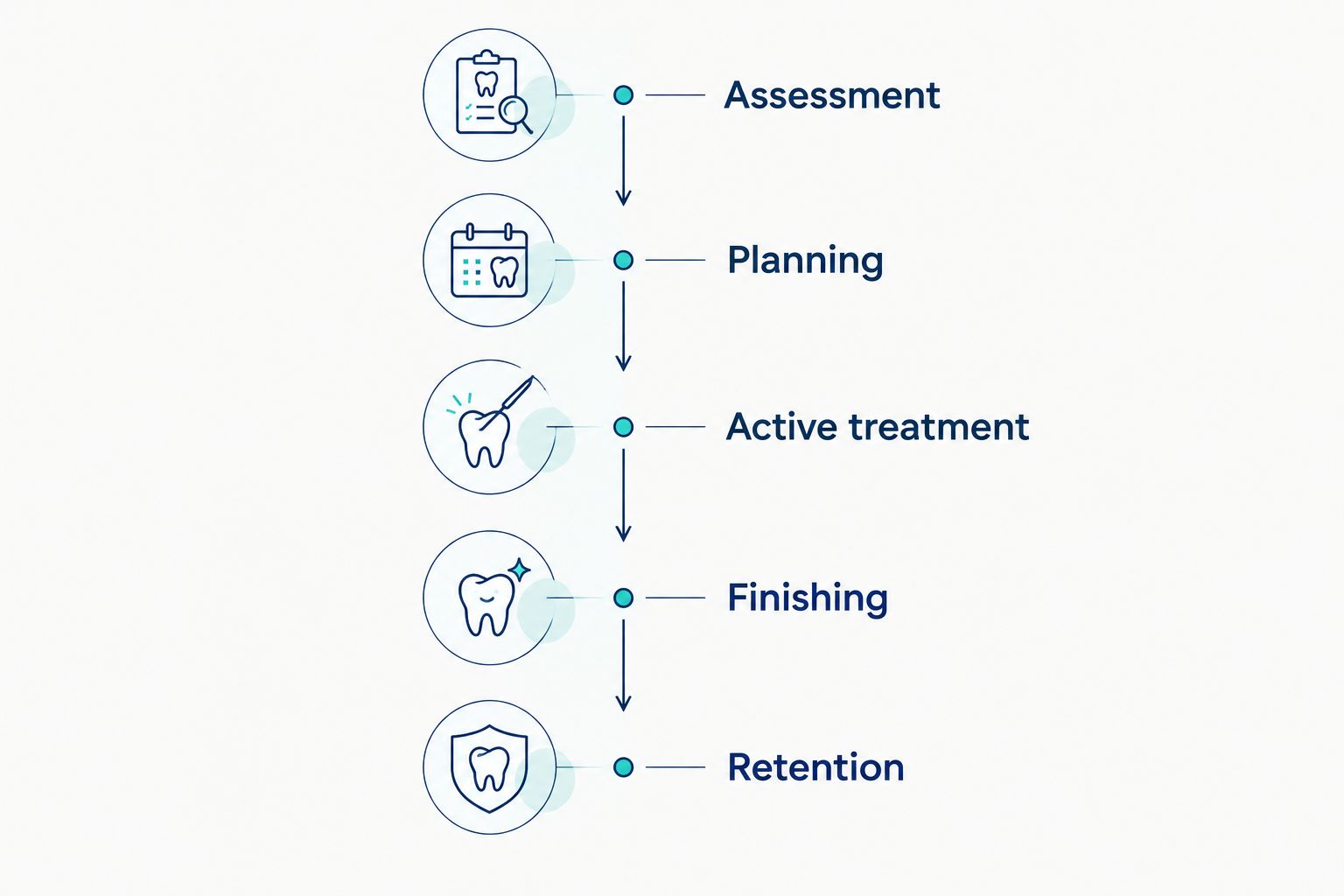
Your treatment timeline has several distinct parts:
- Assessment. The treating clinician checks your teeth, gums, bite, and suitability for aligners. Dental problems that need treatment come before a reliable orthodontic schedule.
- Planning. Records and a proposed sequence of tooth movements help establish your estimated treatment length. Discuss what the estimate includes.
- Active treatment. You wear your prescribed aligners and attend progress checks. Your clinician decides when you should move to the next set.
- Finishing. Your clinician checks whether your tooth positions and bite meet the treatment goals. Additional aligners, often called refinements, extend this stage when needed.
- Retention. Retainers help hold your teeth in their new positions. This is ongoing maintenance, not another stage of active straightening.
A treatment estimate should distinguish the first aligner series from the expected overall course. Otherwise, you and your clinician can be talking about different finish dates without realizing it.
Why this matters
An Invisalign timeline affects everyday choices: meals, work, travel, appointments, and plans for an important occasion. It also affects expectations. Seeing straighter front teeth does not necessarily mean your bite has reached its planned position.
If you are considering treatment in 2026, plan around a clinical assessment rather than an event deadline. Tell your clinician about the date that matters to you, but keep the health and stability of your teeth at the center of the decision.
You deserve a clear explanation of what is being corrected, how progress will be checked, and what happens if treatment takes longer than expected. A useful plan makes those questions comfortable to ask.
What determines your personal treatment timeline?
The factors below explain why someone else's experience is not a dependable forecast for your smile. They also give you specific questions to bring to a consultation.
- The movements required. Closing spaces, correcting rotated teeth, and changing the way upper and lower teeth meet require different treatment planning. Visible crookedness alone does not describe the whole job.
- Your teeth and gum health. Cavities, gum disease, and other concerns need evaluation before treatment. Active dental problems can change when orthodontic care should begin or continue.
- Your daily aligner wear. Aligners need consistent contact with your teeth to deliver their planned movement. Long or frequent breaks interfere with that process.
- How your teeth respond. Teeth do not always follow a digital plan exactly. Progress checks help the clinician identify when the plan needs adjustment.
- Additional finishing work. Further aligners can be needed to improve tooth positions or the bite. A first series is not a promise that no additional treatment will follow.
- Interruptions and follow-up. Lost trays, damaged aligners, missed checks, and unresolved fit problems can disrupt the planned sequence. Report problems rather than trying to solve them by skipping ahead.
These factors explain variation; they do not let you calculate your own finish date. Your treating clinician needs to assess them together.
How many hours a day do you need to wear Invisalign?
Invisalign's published patient guidance generally recommends 20–22 hours of aligner wear per day. Your treating clinician's instructions govern your individual plan, including when to remove aligners and when to change sets.
Within a 24-hour day, that recommendation leaves limited time for meals, drinks other than water, and cleaning. The practical challenge is not just remembering to put aligners in at bedtime. It is putting them back promptly throughout the day.
Build a routine that fits your life:
- Keep your aligner case with you when eating away from home.
- Follow your clinician's instructions for cleaning your teeth and aligners.
- Notice whether long meals or frequent snacks are extending time without trays.
- Ask how to handle your particular work schedule or sports activities.
- Contact your treating office if discomfort or fit prevents normal wear.
The benefit of removable aligners is flexibility during meals and oral hygiene. The trade-off is responsibility: removable does not mean optional. Wearing trays inconsistently and then advancing to the next set is not a substitute for the prescribed schedule.
Does each new aligner mean treatment is on schedule?
Changing trays means you have reached a scheduled change point, not that every tooth has necessarily completed its planned movement. Your clinician checks whether the aligners fit and whether your teeth are following the plan.
Published Invisalign patient guidance describes aligner changes commonly occurring every 1–2 weeks, depending on the prescribed treatment. Do not use that general interval to choose your own change date. A longer wear period or another adjustment requires individual instructions.
Bring up a tray that lifts away from a tooth, a lost attachment, a crack, or a change in how your teeth meet. Some issues are straightforward to address, but moving ahead without advice can make the treatment harder to manage.
At a 2026 consultation, ask how progress will be monitored and whom to contact between appointments. Clear instructions are more useful than trying to judge progress from daily mirror checks.
Is a shorter cosmetic treatment the same as Invisalign?
No. Moving teeth and changing their visible shape are different goals. If your concern is a small gap or an uneven edge, a dentist needs to determine whether the issue involves tooth position, tooth shape, the bite, or a combination.
The table below compares purposes, not promised treatment lengths. None of these choices is a shortcut that suits every smile.
| Option | Best for | Main advantage | Main limitation |
|---|---|---|---|
| Invisalign | Suitable patients who need tooth movement and can follow an aligner routine | Moves teeth through a planned sequence using removable trays | Requires consistent wear, monitoring, and retention afterward |
| Dental bonding | Selected small shape changes, chips, or gaps | Changes tooth contours without orthodontically moving teeth | Does not correct the underlying position of teeth or a bite problem |
| Veneers | Selected cosmetic changes to visible tooth shape and appearance | Changes the visible surfaces of suitable teeth | Usually involves irreversible tooth preparation and does not replace needed orthodontic care |
Choose the treatment that addresses the cause of your concern, not simply the one that sounds quickest. Covering a gap is different from moving the teeth that create it.
For a closer look at the everyday commitment involved, read Is Invisalign worth it?. Use that discussion to prepare questions, not to decide whether you qualify without an examination.
What should you ask before accepting a treatment estimate?
A useful estimate explains both the goal and the conditions needed to reach it. You should understand what the plan is trying to change before you agree to its schedule.
Bring these questions to your visit:
- What specific tooth movements and bite changes does my plan include?
- Does the estimate cover only the first aligner series or anticipated finishing as well?
- What would lead you to recommend additional aligners?
- How will you check that my teeth are following the plan?
- What should I do if I lose a tray or cannot wear it as instructed?
- When will we discuss retainers and the routine after treatment?
If you are arranging care around a wedding, graduation, or move in 2026, share that information early. Ask what can reasonably be planned, without treating the occasion as a reason to rush tooth movement.
Mysmiletheory is best for Spring patients seeking a personal dentist for general, cosmetic, restorative, and family dental care. A general dental visit is a place to discuss your smile concerns and ask what assessment or referral fits your needs; it does not establish eligibility for Invisalign by itself.
Start with your smile questions
Discuss your dental concerns and ask about the next assessment for your smile.
Will additional aligners make treatment take longer?
Additional aligners extend active treatment beyond the series you have already completed. They are used when further movement is needed to reach the agreed tooth positions or improve the bite.
Needing more aligners does not, by itself, mean treatment has failed. It means the clinician has identified something that still needs attention. Ask what the additional series is intended to correct and how it changes your estimated finish date.
Avoid comparing your number of trays with a friend's. Tray counts do not describe the same movements, starting conditions, or wear instructions across different people.
Does treatment end when your teeth look straight?
Active treatment ends when your treating clinician confirms that the planned result has been reached, not simply when your front teeth look better. Your bite and the fit of your teeth together matter, too.
Retention follows. Teeth can move after orthodontic treatment, so retainers help maintain the result. Ask for clear instructions about wearing, cleaning, checking, and replacing your retainers.
Before any cosmetic finishing, make sure the clinicians involved understand the sequence. Changing tooth shape can affect how a retainer fits, so bonding or other planned dental work needs coordination with your retention plan.
FAQ
How long does Invisalign take for a small gap?
A small gap does not establish a reliable treatment length by itself. Your clinician also needs to assess tooth positions, the bite, gum health, and whether moving the teeth will create or reveal other spaces.
How many hours should I wear Invisalign each day?
Invisalign's published patient guidance generally recommends 20–22 hours per day. Follow your treating clinician's instructions and ask for help if your routine makes that difficult.
Can I change my Invisalign trays early to finish faster?
Do not change Invisalign trays early unless your treating clinician instructs you to. Teeth need time to follow the planned sequence, and a tray that feels loose is not permission to advance.
What happens if my Invisalign trays stop fitting?
Contact your treating clinician if your Invisalign trays stop fitting as instructed. Describe the problem and follow the office's advice rather than skipping trays or forcing a different set into place.
Will I need more aligners after my first set?
Additional aligners are sometimes needed after the initial series to complete planned tooth movements or improve the bite. Ask whether your estimate includes anticipated finishing and how your clinician decides when it is needed.
Do retainers count as Invisalign treatment time?
Retainers are the maintenance stage after active tooth movement, rather than another aligner series for straightening. Ask your clinician to explain active treatment time separately from your ongoing retention routine.
Can Mysmiletheory tell me whether Invisalign suits my smile?
Mysmiletheory provides general, cosmetic, restorative, and family dental care in Spring, Texas. Ask about an assessment of your alignment concerns and whether an orthodontic evaluation or referral is the appropriate next step.
One last thing
The last aligner is not the most useful milestone to plan around. Ask what must be true before your clinician considers treatment complete, including tooth positions, bite, and a retention plan you understand.
For your 2026 smile plans, that question gives you something more dependable than a countdown: a clear definition of the result you are working toward. You can want a noticeable improvement and still give your teeth the time and care they need.


