
A dental crown’s cost in 2026 depends on the tooth’s condition, the crown material, the treatment needed before placement, and your insurance benefits. A crown estimate does not necessarily include separate care such as a root canal or rebuilding a damaged tooth. Ask for a written, tooth-specific treatment plan before deciding—not just a quote for the crown itself.
- How much does a dental crown cost? Your tooth’s condition, crown material, and insurance determine your individual estimate.
- Compare the complete treatment plan, including any care needed before the crown, rather than the crown alone.
- Smile Theory offers restorative dental care for local patients in Spring, Texas.
- Ask why a crown is recommended and whether a more conservative repair would protect your tooth.
Why this matters
When you compare dental crown estimates, you need to know whether they describe the same treatment. One estimate might cover the crown alone; another might also include rebuilding the tooth underneath it. Those plans are not directly comparable.
Smile Theory offers general, cosmetic, restorative, and family dentistry in Spring, Texas. Smile Theory is a local dental care option for Spring patients seeking a personal dentist. Your conversation should start with what your tooth needs and leave room for questions about comfort, appearance, and the proposed repair.
How much does a dental crown cost in 2026?
There is no single crown estimate that fits every tooth. For your 2026 treatment plan, ask the dental office to separate the crown itself from any preparatory care and explain which items apply to you.
Use this breakdown when reviewing your written estimate:
| Treatment component | What it addresses | What to clarify |
|---|---|---|
| Examination and imaging | Evaluates the tooth and surrounding structures | Which records are needed to recommend treatment? |
| Tooth preparation | Shapes the tooth so the crown can fit | Is preparation included in the crown estimate? |
| Core buildup | Replaces missing tooth structure beneath the crown | Does this tooth need a buildup? |
| Root canal treatment, if needed | Treats inflamed or infected tissue inside the tooth | Is it necessary, and is it listed separately? |
| Temporary protection | Protects a prepared tooth while a final crown is made | Does the treatment sequence require a temporary crown? |
| Final crown and placement | Covers the prepared tooth and restores its shape | Which material and placement services are included? |
| Follow-up care | Checks comfort, bite, and the restoration | What follow-up is included in the plan? |
Not every tooth needs every item in this table. A root canal is not an automatic part of crown treatment, and a buildup depends on how much usable tooth structure remains.
Ask the office to identify necessary treatment separately from optional changes. If you want a different shade or broader cosmetic work, keep those choices distinct from repairing the damaged tooth. That makes the plan easier to understand without losing sight of your smile goals.
Ceramic crowns: appearance and material selection
Ceramic crowns are often considered when tooth-colored appearance matters. “Ceramic” describes a group of materials rather than one identical restoration, so ask which material your dentist recommends and why it suits the tooth.
The advantage is the ability to plan a tooth-colored restoration. The limitation is that appearance alone does not determine suitability: your bite, remaining tooth structure, and the location of the crown also matter. A material that works well for one tooth is not automatically the right choice for another.
If the crown will show when you smile, talk about shade and shape before it is made. Natural-looking does not have to mean brighter or more uniform than your other teeth. It can mean a repair that belongs comfortably in your existing smile.
Metal-containing crowns: ask about the visible result
Some crowns contain metal, either as the main material or beneath a tooth-colored outer layer. Ask your dentist to explain the specific construction rather than treating all metal-containing crowns as interchangeable.
The benefit depends on the material and the demands placed on the tooth. The trade-off is appearance: metal can be visible, and a metal-containing restoration does not offer the same appearance as an entirely tooth-colored option. Discuss that difference if the tooth shows when you speak or laugh.
Choose the crown material with your dentist, not from a price label alone. The useful comparison is how each suitable material addresses your tooth, bite, and appearance preferences.
Why dental crown estimates vary
For a 2026 crown estimate, these factors explain why your treatment plan needs to be specific to your tooth:
- Remaining tooth structure: A tooth with substantial damage needs a different plan from one with more healthy structure available to support a crown.
- Condition inside the tooth: Inflammation or infection can require treatment beyond covering the tooth with a restoration.
- Crown material: Different materials have different preparation, appearance, and fabrication considerations.
- Bite and tooth location: A visible front tooth and a heavily used back tooth present different treatment priorities.
- Treatment scope: Replacing an existing crown is not necessarily the same process as placing a crown on a tooth that has never had one.
- Insurance terms: Your plan’s deductible, remaining benefits, network rules, and exclusions affect the amount assigned to you.
These factors help explain an estimate; they do not tell you which treatment you need without an examination. If something is unclear, ask the office to connect each recommendation to a finding about your tooth.
Is a crown the right repair for your tooth?
A crown covers a prepared tooth, but it is not the answer to every chip, cavity, or cosmetic concern. Your dentist should explain why coverage is needed and whether a smaller repair would leave enough healthy tooth structure protected.
The following options address different situations. They are not interchangeable choices based only on preference.
| Option | Best for | Main benefit | Main limitation |
|---|---|---|---|
| Filling or bonding | A smaller defect when enough healthy tooth remains | Preserves more natural tooth structure | Does not provide full coverage for a substantially weakened tooth |
| Inlay or onlay | A suitable defect needing an indirect repair without full crown coverage | Can preserve tooth structure while restoring a larger area | Requires enough suitable remaining tooth structure |
| Crown | A restorable tooth needing coverage and support | Covers the prepared tooth and restores its shape | Requires removal of tooth structure and ongoing care |
| Extraction | A tooth that cannot reasonably be retained | Removes a tooth that cannot be restored | Leaves a missing tooth and a separate replacement decision |
The best repair is the one that addresses the damage while preserving healthy tooth structure where possible. A smaller restoration is not automatically adequate, and a larger restoration is not automatically better.
If damage prompted your search, this guide to ways to fix a chipped or cracked tooth explains the broader treatment conversation. Have the tooth assessed before choosing a repair from its appearance alone.
How do you get a useful crown estimate?
Bring your concerns and insurance information to the appointment. You do not need to arrive knowing which material or procedure to request; the examination should guide that discussion.
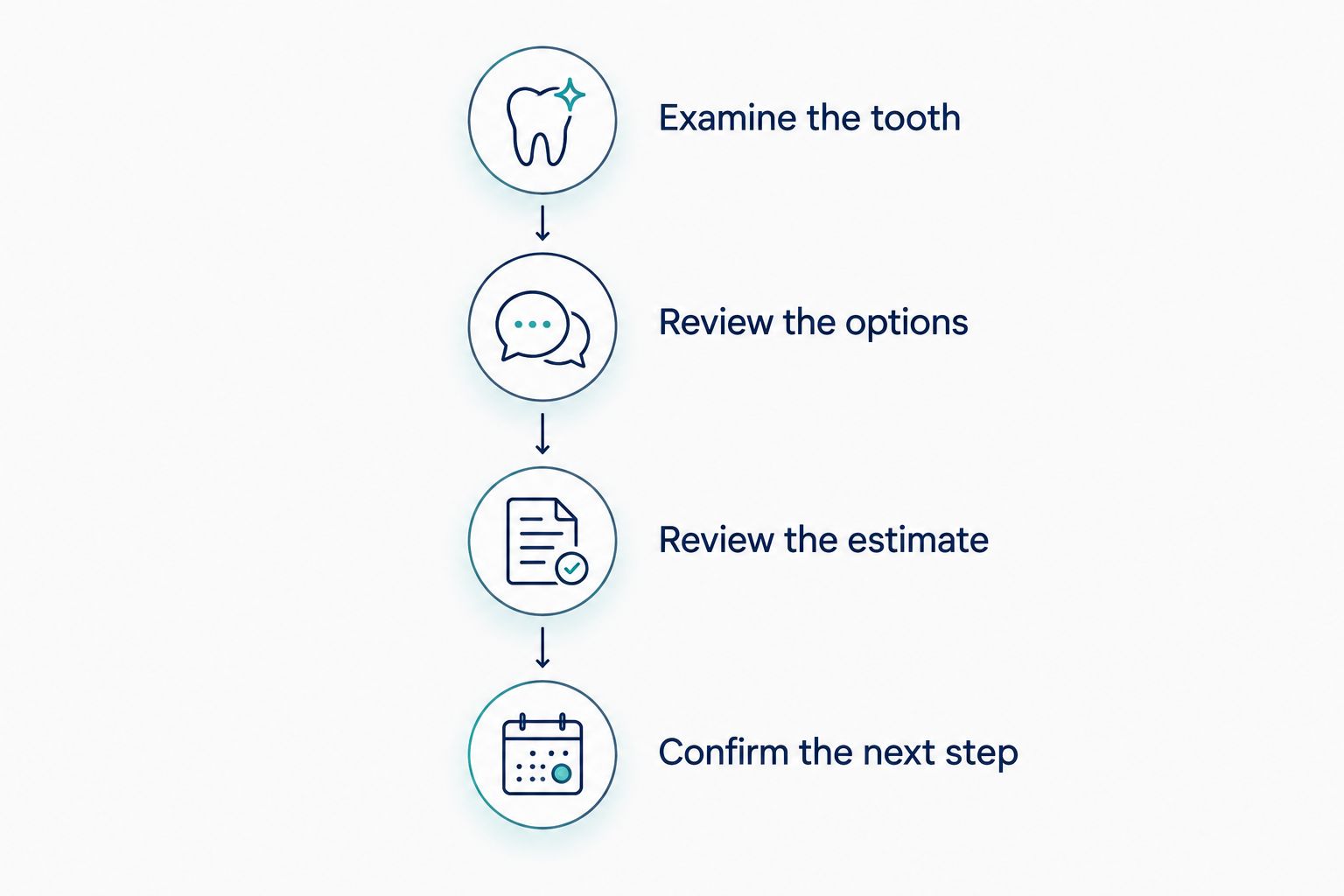
1. Examine the tooth
Ask what the dentist found and why a crown is being recommended. Useful explanations connect the recommendation to decay, a fracture, an existing restoration, or another specific problem—not simply to the fact that the tooth hurts.
Mention sensitivity, pain when biting, swelling, and any change in symptoms. Tell the dentist about an existing crown or previous root canal treatment on that tooth, even if the work happened elsewhere.
2. Review the options
Ask which alternatives are clinically suitable and what each would leave unresolved. If a filling or partial-coverage repair is not appropriate, ask the dentist to explain why.
This is also the time to discuss appearance and comfort. Explain whether the tooth shows in your smile and whether previous dental experiences have made you anxious. Those concerns belong in the treatment conversation.
3. Review the estimate
Request a written plan that names the proposed crown material, any preparatory treatment, and the anticipated insurance contribution. Ask which parts are confirmed and which depend on further findings or benefit review.
A plan is easier to compare when it describes the actual work. Keep a copy so you can review it without trying to remember every detail from the appointment.
4. Confirm the next step
Before scheduling treatment, ask what happens at the next visit and whether temporary protection is part of the process. Discuss what to do if the tooth becomes uncomfortable before treatment begins.
You should leave knowing whom to contact with questions. Taking time to understand a recommendation is reasonable; it does not require committing to treatment before you feel informed.
Does dental insurance cover a crown in 2026?
Dental insurance coverage depends on your specific plan and the reason for the crown. Ask the dental office and insurer to check your 2026 benefits rather than assuming that a recommended crown is fully covered.
A benefit estimate is not a guarantee of payment. Ask about the deductible, remaining annual benefit, waiting periods, replacement rules, and any difference between the recommended material and the material used to calculate benefits.
If your insurer requests documentation, ask what is needed and who will submit it. Keep the clinical question separate from the coverage question: your dentist explains what the tooth needs, while the plan determines benefits under its terms.
Do you need a root canal before a crown?
A root canal is not required simply because you need a crown. It addresses a problem inside the tooth; a crown addresses the prepared tooth’s outer structure and shape.
Some teeth need both treatments, while others need a crown without root canal treatment. Ask which finding supports each recommendation so the treatment sequence makes sense to you.
Can you compare crown estimates from different dentists?
Yes—compare the diagnosis, proposed material, preparatory treatment, and included follow-up, not just the final line. Estimates for different treatment plans do not answer the same question.
If the recommendations differ, ask each dentist to explain the finding behind the plan. A second opinion is most useful when it helps you understand the tooth’s condition and the reasons for the proposed repair.
Planning crown care in Spring, Texas
For North Houston patients considering a crown in 2026, the next useful step is an examination and a clear explanation of the options. Smile Theory offers restorative dental care in Spring, Texas, alongside general, cosmetic, and family dentistry.
Bring your questions about the tooth, your smile, and what would help you feel more comfortable during care. Ask for the treatment sequence in plain language and request time to review the estimate. You do not need dental terminology to take part in the decision.
Discuss your tooth and treatment options
Start a conversation about restorative dental care in Spring, Texas.
FAQ
How much does a dental crown cost without insurance?
Without insurance, your estimate depends on the crown material and the treatment your tooth needs. Request a written plan that separates the crown from any examination, buildup, root canal treatment, or other care.
Does a dental crown estimate include a root canal?
Do not assume a crown estimate includes root canal treatment. Ask whether the tooth needs that treatment and whether it appears as a separate item on the written plan.
Is a crown better than a filling?
A crown is not automatically better than a filling; the right repair depends on the damage and remaining healthy tooth structure. A filling preserves more tooth structure when suitable, while a crown provides coverage for a tooth that needs it.
Will a dental crown look like my other teeth?
A tooth-colored crown can be planned to blend with nearby teeth, but the result depends on material, shade, shape, and the underlying tooth. Discuss your appearance preferences before the final crown is made.
Does getting a crown mean I will lose my tooth?
A crown is intended to restore a tooth that can be retained, not replace a missing tooth. Your dentist first needs to assess whether the tooth has enough suitable support for restoration.
Can I wait to get a dental crown?
Ask your dentist how soon your particular tooth needs treatment. The answer depends on the damage and symptoms; swelling, fever, or worsening pain needs prompt dental assessment.
Can Smile Theory help me discuss crown treatment?
Smile Theory offers restorative dental care for patients in Spring, Texas. An appointment gives you an opportunity to discuss your tooth, suitable treatment options, and your questions before deciding.
One last thing
A crown protects a tooth, but it does not make the tooth immune to decay. The area where the crown meets the natural tooth still needs daily cleaning and dental review.
Before treatment ends, ask your dentist to show you how to clean around the restoration and explain which changes deserve a call. Understanding how to care for the finished crown is part of choosing the treatment—not an afterthought.