
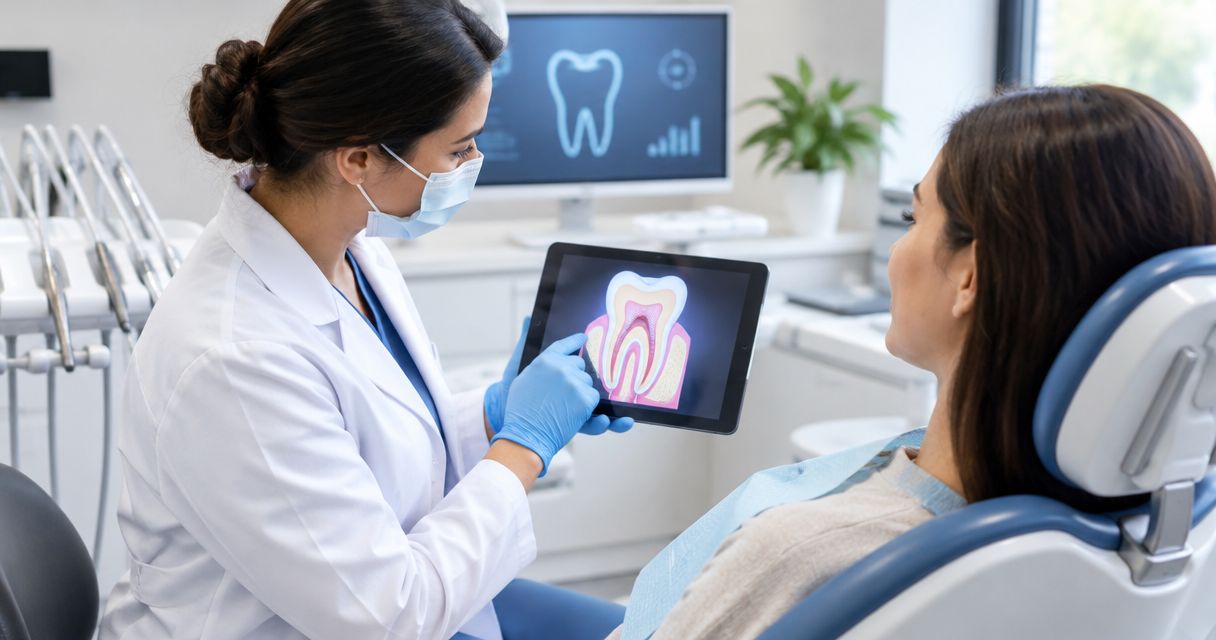
A root canal’s cost in 2026 depends on the tooth, the complexity of treatment, and your dental benefits; a personalized, written estimate is the clearest way to understand your share. The root canal procedure and the final filling or crown are separate parts of care, so confirm whether your estimate includes both. Compare the complete plan to restore your tooth—not just the root canal portion.
- For how much does a root canal cost, request a complete estimate covering treatment, restoration, and insurance adjustments.
- A crown or filling after root canal treatment can be a separate part of your dental plan.
- Smile Theory offers general and restorative dentistry for local patients in Spring, Texas.
- Ask whether the estimate includes evaluation, imaging, specialist care, and the final restoration.
How much does a root canal cost in 2026?
Your root canal estimate should reflect your diagnosis and the work needed to make the tooth usable again. A front tooth, a back tooth, and a previously treated tooth do not necessarily require the same care. Insurance also changes what you pay, rather than what treatment your tooth needs.
For patients seeking a personal dentist in Spring, Texas, Smile Theory offers general, restorative, cosmetic, and family dental care. Start with an evaluation and a conversation about your concerns, including comfort and the full treatment plan.
Use this breakdown when reviewing an estimate:
| Part of care | What it addresses | What to confirm |
|---|---|---|
| Examination and imaging | Identifying the affected tooth and planning care | Whether these are included or listed separately |
| Root canal treatment | Cleaning and sealing the space inside the tooth | Which tooth is being treated and who will provide treatment |
| Temporary protection | Protecting the tooth between stages of care | What you need before the final restoration |
| Final filling or crown | Sealing and restoring the treated tooth | Which restoration is recommended and whether it is included |
| Follow-up care | Checking healing and addressing concerns | What follow-up is planned and what it covers |
An estimate is useful only when you know where the treatment plan ends. Ask whether it ends after the root canal or after the tooth has its final restoration.
Why this matters
When a tooth hurts, you want relief and a clear next step. A brief estimate can leave important questions unanswered, especially if one clinician treats the inside of the tooth and another restores it afterward.
Understanding those stages helps you compare plans fairly. It also helps you arrange appointments without assuming that pain relief means the tooth is ready for normal chewing.
Your 2026 treatment plan should explain what is needed now, what comes next, and which parts depend on findings during care. You deserve that explanation in everyday language.
What changes the scope of root canal treatment?
The tooth’s condition matters more than a generic online estimate. These are the main clinical and coverage details to discuss with your dentist:
- Tooth location and anatomy. Back teeth generally have more complex internal spaces than front teeth. The dentist assesses the individual tooth rather than relying on location alone.
- Previous treatment. A tooth that already had a root canal needs a different evaluation from a tooth being treated for the first time.
- Remaining tooth structure. Decay, an existing filling, or a fracture affects how the tooth can be restored afterward.
- Who provides treatment. Ask whether your care will stay with your dentist or include an endodontist, a dentist with advanced training in root canal treatment.
- The final restoration. A filling and a crown serve different restorative needs. The recommendation depends on the tooth’s condition and chewing demands.
- Your dental benefits. Network rules, deductibles, coverage limits, and remaining benefits affect your estimated responsibility.
Ask your dentist to connect each recommendation to a finding. For example, the explanation for a crown should describe why the remaining tooth needs that protection—not simply state that a crown follows every root canal.
Front teeth, back teeth, and previously treated teeth
These situations are not interchangeable. Understanding the difference helps you ask useful questions without trying to diagnose the tooth yourself.
| Treatment situation | What deserves attention | Helpful question |
|---|---|---|
| Front tooth | Internal anatomy and remaining tooth structure | What restoration will this tooth need afterward? |
| Back tooth | Internal complexity and chewing forces | How will the tooth be protected when I bite? |
| Previously treated tooth | Why symptoms or infection have returned | Is retreatment appropriate, and should a specialist evaluate it? |
| Cracked or broken tooth | Whether the tooth can be restored predictably | Does the crack affect the outlook for saving it? |
A root canal addresses damaged or infected tissue inside a tooth. It does not repair every type of fracture. If a break is part of your concern, the guide to restorative treatments for a cracked or broken molar explains the restoration questions to bring to your visit.
The first decision is whether the tooth can be restored—not which procedure has the smallest initial estimate. Your dentist should explain the outlook before you commit to treatment.
Does a root canal estimate include a crown?
Do not assume a crown is included. Ask for the root canal and the final restoration to be identified separately, even when they appear in the same treatment plan.
A crown covers the visible portion of a tooth and helps protect weakened structure. A filling replaces a smaller area of missing tooth structure. Neither is automatically the right choice for every treated tooth.
| Restoration | Best suited to | Benefit | Limitation |
|---|---|---|---|
| Filling | Teeth with enough sound structure for the dentist’s recommended repair | Restores the opening without covering the entire visible tooth | Does not provide the same coverage as a crown |
| Crown | Teeth that need broader protection because of lost or weakened structure | Covers the tooth and restores its shape for biting | Requires additional preparation and its own treatment planning |
Your dentist should explain how the recommendation relates to your tooth. Ask whether an existing crown can remain or whether a new restoration is needed; that decision requires an examination.
If temporary material is placed, follow the chewing instructions you receive. Temporary protection is not a substitute for completing the recommended restoration.
How do you get a clear written estimate?
You do not need to know dental terminology to ask for a useful plan. Bring these questions to your appointment and request an explanation of anything that feels unclear.
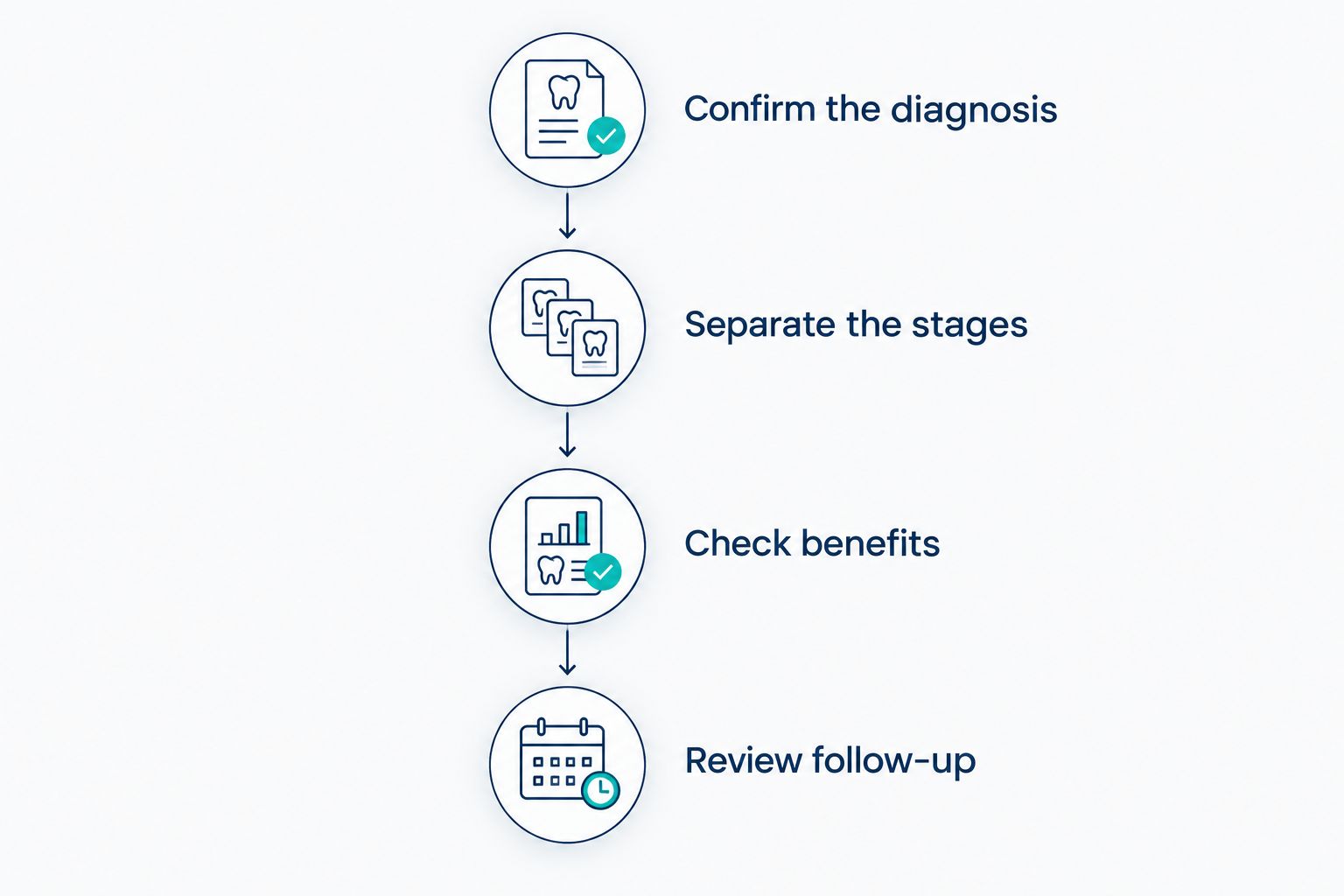
- Confirm the diagnosis. Ask which tooth needs care, what the examination shows, and whether root canal treatment is recommended.
- Separate the stages. Identify evaluation, root canal treatment, temporary protection, and the final restoration.
- Check benefits. Ask which portions will be submitted to your dental plan and what assumptions support the estimate.
- Review follow-up. Find out who will restore the tooth, when that should happen, and whom to contact with concerns.
Before accepting an estimate in 2026, ask what would trigger a change. A clear answer distinguishes planned care from additional treatment that would require a separate discussion.
You can also ask for time to review a nonurgent decision. If treatment is urgent, have the dentist explain what should happen promptly and why.
Start with a personal dental visit
Discuss your tooth, comfort concerns, and the steps needed to restore your smile.
How does dental insurance affect your responsibility?
Dental insurance benefits depend on your specific plan. Coverage for the root canal does not automatically establish coverage for the crown, and a benefit estimate is not a guarantee of final payment.
When checking your 2026 benefits, ask your insurer or benefits administrator:
- Is the treating dentist or specialist in network?
- Does a deductible apply to this treatment?
- Are there waiting periods or other plan limitations?
- How much of the annual benefit remains?
- Will the root canal and restoration be reviewed separately?
- Is a pretreatment estimate available?
Keep the distinction between a clinical recommendation and insurance coverage clear. Your dentist recommends care based on the tooth; your insurer applies the terms of your plan.
If care involves separate offices, check benefits for each provider. Also confirm who is responsible for arranging the final restoration so that this step does not get overlooked.
Is removing the tooth a better option than a root canal?
Removing a tooth and saving a tooth are different treatment paths, not interchangeable purchases. The right choice depends on whether the tooth can be restored, its supporting tissues, and your overall dental needs.
| Approach | Best suited to | Main benefit | Main limitation |
|---|---|---|---|
| Root canal and restoration | A tooth the dentist determines can be saved and restored | Preserves the natural tooth | Requires completing the restoration and ongoing care |
| Extraction | A tooth the dentist determines cannot be predictably retained | Removes the affected tooth | Leaves a space and requires a separate discussion about replacement |
Ask what each complete plan involves. If extraction is recommended, discuss the consequences of leaving the space and which replacement options fit your situation.
Compare the full care pathway, including recovery, restoration, and follow-up. Do not choose extraction solely because it appears simpler at the first appointment.
What should you do if you are in pain now?
Contact a dentist promptly for tooth pain, swelling, or a suspected infection. An examination is needed to identify the cause; symptoms alone cannot tell you whether a root canal is necessary.
Seek emergency medical care for difficulty breathing or swallowing, or rapidly spreading swelling. Do not wait for an online estimate when those symptoms are present.
Tell the dental office where the pain is, whether swelling is present, and whether the tooth has already been treated. Share your medications and relevant health conditions so the team can advise you appropriately.
FAQ
How much does a root canal cost without dental insurance?
Without dental insurance, request a written estimate for the complete treatment plan. Confirm whether it includes evaluation, imaging, root canal treatment, temporary protection, and the final filling or crown.
Does dental insurance cover a root canal in 2026?
Root canal coverage in 2026 depends on your specific dental plan. Check network status, deductibles, remaining benefits, and whether the final restoration has separate coverage terms.
Will I always need a crown after a root canal?
A crown is not required for every root-canal-treated tooth. Your dentist evaluates the tooth’s location, remaining structure, and chewing demands before recommending a filling or crown.
Should I see a dentist or a root canal specialist?
Start with a dental evaluation to determine who should provide treatment. Complex anatomy, previous root canal treatment, or other findings can lead to a referral to an endodontist.
Can I wait until my tooth stops hurting?
Do not use disappearing pain as proof that the tooth has healed. Contact a dentist for an assessment, especially if you have swelling, a damaged tooth, or symptoms that return.
Is a root canal better than pulling the tooth?
Saving the tooth is an option when the dentist determines it can be restored and maintained. Extraction is a different treatment path that also requires discussing the resulting space and possible replacement.
Can I talk about anxiety before agreeing to treatment?
Yes, tell your dental team about anxiety before treatment begins. Ask how they will explain each step, check your comfort, and respond if you need a pause.
One last thing
Feeling better and finishing treatment are not always the same milestone. The tooth still needs the restoration your dentist recommends, even when the original pain has settled.
Before leaving, ask one practical question: what needs to happen before this tooth is ready for normal chewing? For patients in Spring and North Houston, Smile Theory offers general and restorative dental care as part of a personal approach to dental health. Bring your questions—you do not need to have everything figured out before your visit.


