

Single tooth dental implant cost depends on the treatment needed to replace your tooth, so a personal examination and an itemized estimate are the right starting point. An implant-placement quote is not necessarily the total for a finished replacement tooth; ask whether it includes the connecting piece, crown, imaging, and any preparatory care. This 2026 guide explains what to compare before you decide.
- Compare single tooth dental implant cost using the complete treatment plan, not implant placement alone.
- An implant, connecting piece, and crown serve different purposes; ask which parts your estimate includes.
- Preparatory treatment and follow-up care belong in the discussion before you choose treatment.
- Mysmiletheory offers restorative dental care for Spring patients seeking a personal dentist.
Why this matters
You deserve to understand what your treatment involves before making a decision. Two estimates are only comparable when they describe the same starting conditions and the same finished result.
If you are still exploring options for replacing a single missing tooth, start with suitability rather than choosing by the first figure you hear. The useful comparison is a complete replacement plan, not an isolated procedure.
How much does a single tooth dental implant cost?
Your dentist determines the treatment estimate after assessing the missing tooth, surrounding teeth, gums, and supporting bone. For your 2026 comparison, request a written breakdown that separates the replacement itself from any care needed beforehand.
A conventional single-tooth implant restoration has 3 main parts: the implant placed in bone, the connecting piece called an abutment, and the visible crown. These parts work together, but an estimate does not automatically include all of them.
| Treatment element | What it does | What to ask |
|---|---|---|
| Examination and imaging | Help assess your mouth and plan treatment | Which assessments are included? |
| Implant placement | Places the support for the replacement tooth | Does the estimate cover placement only? |
| Abutment | Connects the implant to the crown | Is the connecting piece included? |
| Final crown | Forms the visible chewing surface | Is the finished crown included? |
| Preparatory care | Addresses treatment needs before placement | Is this required in my case? |
| Follow-up care | Checks healing and the completed restoration | Which appointments are included? |
Ask for the complete plan in writing. You should be able to identify what is planned, what remains conditional, and who will provide each stage.
Implant placement: the support beneath the tooth
The implant replaces the support normally provided by a tooth root. Placement is a surgical procedure, which makes the condition of the treatment site an important part of planning.
A placement-only estimate does not tell you everything about restoring the visible tooth. Ask where the surgical stage ends and the restorative stage begins, particularly if different clinicians are involved.
Best for understanding this stage: patients comparing surgical estimates. The benefit is clarity about placement; the limitation is that placement alone does not provide the finished chewing surface.
Abutment and crown: the finished replacement
The abutment connects the implant to the crown. The crown is the part you see when you smile and use when you chew.
For a visible tooth, discuss shape and shade as well as function. A natural-looking result depends on how the replacement relates to nearby teeth and gums, not simply on choosing a lighter color.
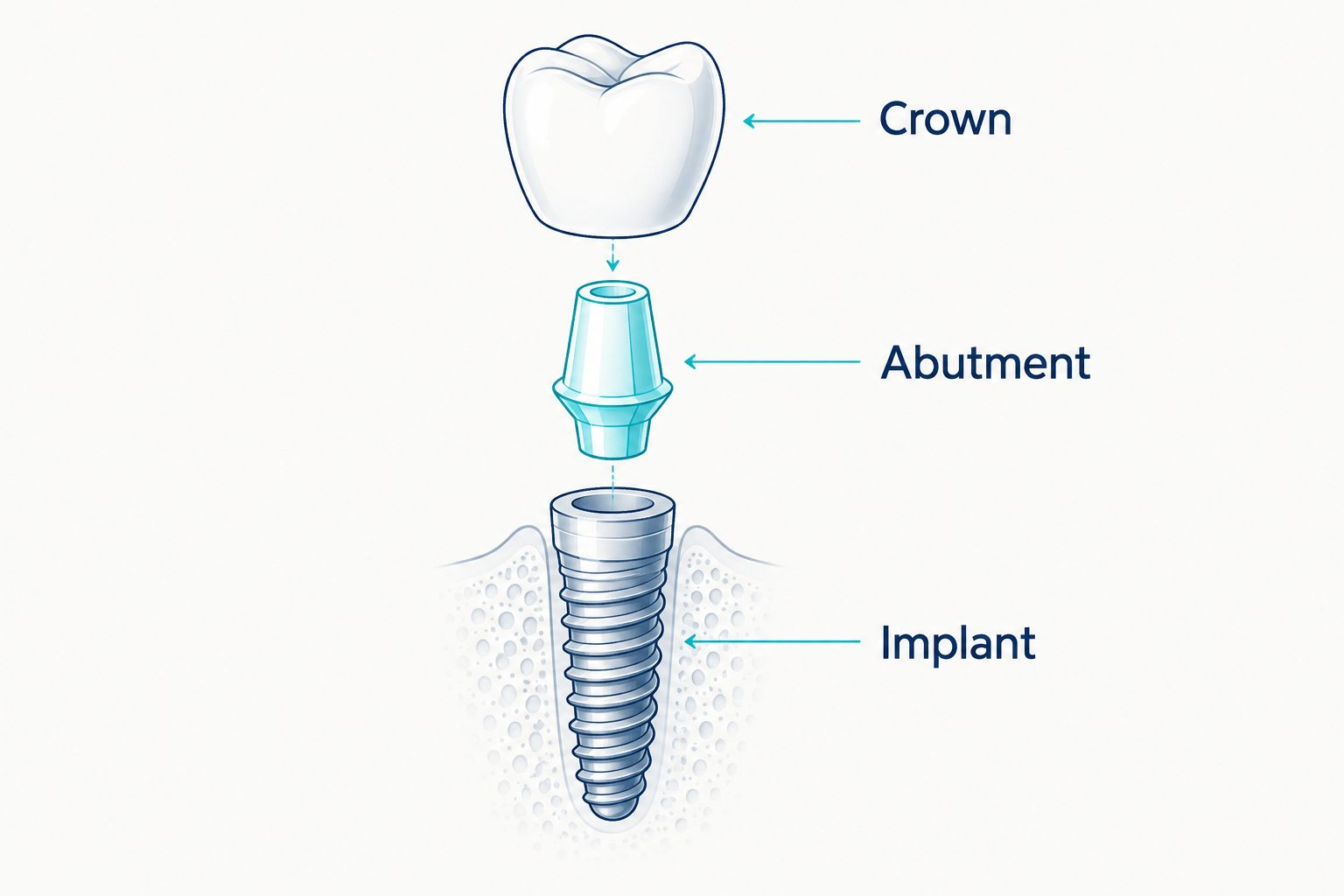
Best for understanding this stage: patients checking whether a quote covers a finished tooth. The crown completes the visible restoration, but it still needs cleaning, dental examinations, and attention if your bite changes or something feels loose.
Preparatory care: treatment before the implant
Some treatment plans include removal of a damaged tooth, treatment for gum disease, or procedures to improve the supporting bone. These are separate clinical needs, not automatic requirements for every missing tooth.
Ask your dentist to explain the reason for any recommended preparation in everyday language. You should understand what problem it addresses and how it affects the next stage.
If you already have a gap, that does not establish whether the site is ready for an implant. Readiness comes from an examination, not from how long the tooth has been missing.
Why single tooth dental implant cost varies
The treatment required to replace 1 missing tooth differs from person to person. These factors help explain why a general estimate and your personal plan are not interchangeable:
- The starting condition of the tooth: an existing damaged tooth and an already-healed gap require different planning.
- Gum health: inflammation or active gum disease needs assessment before treatment decisions.
- Supporting bone: the amount and position of bone affect implant planning and whether additional procedures are discussed.
- The replacement tooth: the crown must suit the space, your bite, and the appearance of nearby teeth.
- Comfort needs: local anesthesia and any additional comfort measures should be discussed separately and clearly.
- The treatment team: when care involves more than one clinician, you need to know which stages each estimate covers.
None of these factors establishes your treatment needs without an examination. Use them as questions for your appointment, not as a checklist for diagnosing yourself.
How do you compare implant estimates fairly?
For a useful 2026 comparison, bring each written plan to the discussion and check the same categories. A shorter estimate is not necessarily a simpler treatment plan.
- Confirm the endpoint. Ask whether the estimate ends with implant placement or a completed crown ready for use.
- Identify preparation. Separate confirmed treatment from procedures that depend on examination findings or healing.
- Check temporary care. Ask what you will use, if anything, while the final restoration is being planned and completed.
- Clarify follow-up. Find out who checks healing, fits the crown, and handles concerns between stages.
- Review exclusions. Ask what is outside the estimate and what circumstances would require a revised plan.
Keep a copy you can read at home. If a term is unfamiliar, ask the office to explain it before you agree to treatment.
What should you ask about comfort?
Tell your dentist if previous dental experiences have made you anxious. Ask what you should expect during the appointment, how discomfort is managed, and whom to contact afterward.
Do not assume a particular comfort option is included or appropriate for you. Your health history, medications, and planned procedure belong in that conversation.
Is an implant the only way to replace a missing tooth?
An implant is not the only option. A tooth-supported bridge or a removable partial denture can also replace missing teeth, and each involves different compromises.
Best for means best suited to your mouth and priorities—not best for everyone. The table below gives you a starting point for discussion, not a treatment prescription.
| Option | Best for discussion when | Main advantage | Main limitation |
|---|---|---|---|
| Single-tooth implant | You want a fixed replacement and are suitable for implant treatment | Does not rely on neighboring teeth for support | Requires surgery, healing, and ongoing maintenance |
| Tooth-supported bridge | A fixed replacement is preferred and neighboring teeth can support it | Does not require implant placement | Usually requires reshaping supporting teeth |
| Removable partial denture | You want to discuss a removable, nonsurgical replacement | Can replace a missing tooth without implant surgery | Must be removed for cleaning and feels different from a fixed tooth |
A conventional bridge replacing a single gap commonly uses 2 neighboring teeth for support. An implant avoids that arrangement, but its surgical requirements still matter.
Ask your dentist to explain the reasonable alternatives for your situation. The right choice should account for tooth health, cleaning needs, comfort, and what you are willing to maintain.
Does dental insurance cover a single tooth implant?
Dental insurance coverage depends on your specific plan and the proposed procedures. Ask the insurer to review the itemized treatment plan rather than assuming every stage has the same coverage.
For treatment planned in 2026, check the current policy documents and request a pretreatment review when available. A benefit estimate is not the same as a guarantee of payment.
Ask about exclusions, waiting periods, annual limits, and whether related procedures receive separate consideration. Keep the insurer's explanation with your written dental plan so you can distinguish treatment recommendations from benefit rules.
Can you get an implant and crown at the same appointment?
Immediate treatment is not appropriate for every patient. The condition of the site, implant stability, bite, and overall treatment plan affect whether an immediate temporary tooth is an option.
A temporary tooth is not necessarily the final crown. Ask which restoration is being discussed and what restrictions apply while the site heals.
Avoid making travel, work, or event plans around an assumed completion date. Your dentist should explain the proposed sequence and what must happen before each next step.
Where should you start in Spring, Texas?
Mysmiletheory is for Spring patients seeking a personal dentist for restorative dental care. If you are deciding how to replace a tooth, start by sharing what bothers you, what you hope to change, and any concerns about treatment.
You can visit Mysmiletheory to take the next step toward an appointment. Ask which restorative options fit your needs and whether any part of the proposed care requires a referral.
Bring your medication list, relevant dental records, and insurance information if you have it. You do not need to arrive knowing which treatment you want; a clear explanation of the alternatives is a useful first goal.
Start with a personal dental visit
Discuss your missing tooth, your concerns, and the restorative options that fit your needs.
FAQ
How do I find out my single tooth dental implant cost?
Request an examination and an itemized treatment estimate for the completed replacement tooth. Ask the office to separate implant placement, the abutment, the crown, and any preparatory care.
Does an implant quote include the crown?
An implant quote does not automatically include the crown. Ask whether the written estimate covers placement alone or the completed restoration, including the connecting piece.
Will I need a bone graft before a dental implant?
Not every patient needs a bone graft before a dental implant. Your dentist assesses the supporting bone and explains whether additional treatment is needed for the proposed implant site.
Is a dental implant better than a bridge?
Neither option is better for every patient. An implant avoids relying on neighboring teeth for support, while a bridge avoids implant surgery but usually requires changes to supporting teeth.
Can a single tooth implant look natural?
A single-tooth implant crown can be designed to blend with nearby teeth. Discuss tooth shape, shade, gum appearance, and your expectations before the final restoration is made.
Do dental implants still need regular checkups?
Dental implants need regular checkups and daily cleaning. The surrounding gums and supporting tissues still need care, and the crown and bite need review over time.
What should I bring to an implant consultation in 2026?
Bring your medication list, relevant dental records, insurance details, and questions to your 2026 consultation. Tell the dentist about health conditions, tobacco use, and previous dental concerns so these can inform the discussion.
One last thing
Ask what you will leave with at each stage—not just what the final tooth will look like. Understanding the temporary arrangement, healing checks, and final crown appointment makes the plan easier to follow.
Before agreeing to treatment in 2026, ask for a plain-language explanation you feel comfortable repeating back. You deserve to understand both the purpose of each step and what remains undecided.


