

Instead of trying to remember every instruction while feeling nervous, use a written plan for your sedation consultation, preparation, and recovery. Here’s what to expect on sedation dentistry appointment day: a health review, confirmation of your instructions, monitoring during treatment, and discharge only when your dental team says you’re ready.
- What to expect sedation dentistry appointment day: health checks, agreed sedation, monitoring, and a clear recovery plan.
- Mysmiletheory provides general and family dental care for patients seeking a personal dentist in Spring, Texas.
- Dental anxiety belongs in your consultation; explain your triggers before your treatment date.
- Follow your dental team’s fasting, medication, and transportation instructions—not a generic online checklist.
Why this matters
A calmer appointment starts with clear instructions, not a promise that you won’t feel nervous. Sedation planning depends on your health, the treatment, and the sedation method. Instructions that fit someone else’s appointment are not a substitute for yours.
Mysmiletheory is best for Spring patients seeking a personal dentist for general and family dental care. You can start with Mysmiletheory to discuss your dental concerns and ask about the care appropriate for you.
For your 2026 appointment, keep the treatment plan and preparation instructions together. Having one place to check them reduces last-minute guesswork, especially when a friend or family member is helping you get home.
Before you start
- Gather your health information. Bring your medication and supplement list, allergies, relevant medical conditions, and any previous problems with sedation or anesthesia. Mention pregnancy, sleep apnea, and breathing concerns.
- Arrange practical support. Ask whether you need a responsible adult to accompany you, drive you home, and stay with you afterward. Confirm the requirements before choosing your appointment date.
- Separate the consultation from the treatment visit. A sedation discussion does not automatically mean sedation happens that day. Confirm what the appointment includes, and do not take a sedating medicine unless the treating team has specifically instructed you to do so.
The non-obvious detail is that sedation does not replace every other part of dental care. You can still need local anesthetic to numb the treatment area. Ask how the team will manage both anxiety and discomfort so neither comes as a surprise.
Your consultation plan
Explain your anxiety and health history
- Describe what makes dental visits difficult. Name the trigger: injections, sounds, gagging, feeling trapped, a previous experience, or uncertainty about what happens next. You do not need to justify your fear.
- Explain what helps. Ask about a pause signal, advance explanations, or breaks when clinically appropriate. Tell the team whether detailed descriptions reassure you or make you more anxious.
- Review your complete health history. Include prescription medicines, over-the-counter medicines, supplements, alcohol use, cannabis use, and other substances. Accurate information helps the clinician assess interactions and risks.
- Describe previous reactions. Mention nausea, difficult waking, breathing problems, or an unexpected response to a medicine during earlier procedures.
Expected result: Your clinician understands your concerns and has the information needed to assess a suitable approach. You leave knowing what still needs review before treatment can be scheduled.
Discuss the sedation approach
Ask what method is being considered, who will administer it, and how you will be monitored. Sedation exists along a range of depths; the way medicine is given does not, by itself, tell you how awake you will be.
These are general categories, not a list of services offered by any particular clinic:
| Approach | Best for discussion when | Potential benefit | Limitation to understand |
|---|---|---|---|
| Nitrous oxide inhalation | You want to discuss lighter anxiety support | Its effects can be adjusted during care and generally wear off quickly after it stops | Nasal breathing is needed; suitability still requires assessment |
| Oral sedation | You want to discuss medicine taken by mouth | It can reduce anxiety without an IV for medicine delivery | Its effects are less easily adjusted once swallowed; transportation restrictions apply |
| IV sedation | Your clinician is considering medicine delivered through a vein | The clinician can adjust medicine during the procedure | It requires IV placement, monitoring, and a recovery plan |
No category is automatically the best choice for an anxious patient. The clinician must consider your health, the planned procedure, the intended sedation depth, and the setting.
For background before that conversation, read sedation options for anxious dental patients. Use the comparison to prepare questions, not to select or self-administer medicine.
Expected result: You can explain the proposed approach in plain language, including whether you are expected to remain responsive and what restrictions follow treatment.
Your preparation checklist
Confirm the written instructions
- Request instructions for your specific appointment. Separate the arrival time from any medicine timing or eating and drinking restrictions. Do not assume instructions from a previous visit still apply.
- Confirm food and drink rules. Ask exactly what is allowed and when restrictions begin. Rules differ by sedation approach and medical circumstances; do not add your own fasting period.
- Review medicines individually. Ask which medicines to take, which need an adjustment, and who should approve that adjustment. Do not stop a prescribed medicine on your own.
- Confirm your support person’s role. Ask whether that person must remain at the office and what help you will need at home.
- Ask about consent. Discuss the procedure, alternatives, and questions before any sedating medicine affects your ability to make decisions.
Expected result: Your 2026 preparation checklist answers what to eat or drink, what medicines to take, when to arrive, and who will help afterward.
Keep 2 copies of the instructions: one you can access yourself and one for your support person. This is an organizational suggestion, not a clinical requirement. Use the latest version if the dental team changes the plan.
Set up your recovery arrangements
Choose a quiet place to rest and decide who will handle responsibilities that require alertness. Ask your clinician when you can resume driving, work, caregiving, exercise, and other activities.
Do not assume a rideshare alone satisfies an escort requirement. If a responsible adult is required, confirm that arrangement directly with the office. Also ask whom to contact after treatment and what to do outside office hours.
Expected result: You have a confirmed route home, appropriate supervision, and clear recovery instructions rather than trying to organize them after sedation.
Your plan has a simple sequence: Health review, Written instructions, Day-of check, and Recovery support. Each stage needs to be settled before you move to the next.
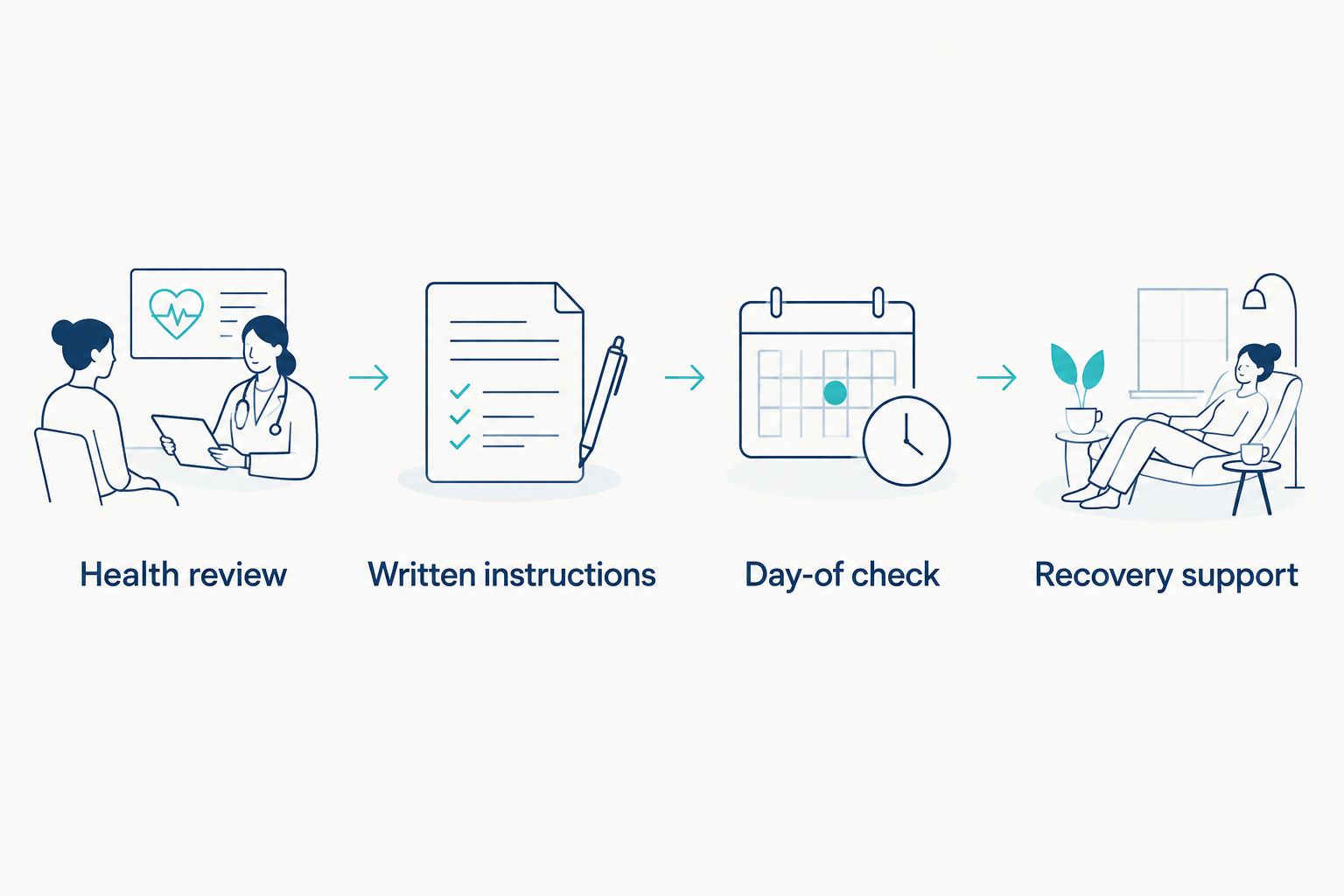
Your appointment-day plan
Complete the arrival check
- Report anything that changed. Tell the team about new medicines, illness, breathing symptoms, pregnancy, or changes to your medical history. Mention any alcohol or other substances used since the consultation.
- Confirm whether you followed the instructions. Be specific about your last food or drink and any medicines taken. If you missed a requirement, say so before treatment begins.
- Review the treatment and sedation plan. Ask remaining questions while you can fully participate in the discussion. Confirm your pause signal if you will remain responsive.
- Follow the team’s preparation directions. Depending on the plan, this can include baseline health measurements, monitoring equipment, a nasal mask, or an IV. Ask what each step is for if knowing helps you feel comfortable.
Expected result: The dental team has checked your readiness and confirmed whether treatment can proceed as planned. A change or postponement is a safety decision, not a failure on your part.
For a 2026 visit, bring your current medication list rather than relying on what the office recorded at an earlier appointment. Even a recently started nonprescription medicine belongs in the conversation.
Understand treatment and discharge
During treatment, the team monitors you according to the sedation approach and your clinical needs. If you remain responsive, use the agreed signal to communicate discomfort or ask for a pause. Sedation does not guarantee complete sleep, no memory, or a particular emotional experience.
Afterward, staff assess your recovery before discharge. Feeling awake is not proof that your judgment or coordination has returned to normal. Follow the restrictions even when you feel ready to do more.
Before leaving, ask your support person to listen to the recovery instructions with you. Instructions about the dental procedure itself—such as caring for a treated tooth or surgical area—are separate from restrictions related to sedation.
Expected result: You leave with the required support, written aftercare, and a clear contact route for concerns. Your team tells you when normal activities can resume; you do not have to guess.
When your health or treatment plan changes
A second workflow applies whenever something changes between the consultation and appointment day. Reconfirm the plan rather than silently continuing with the original instructions.
- Contact the dental team before the visit. Report a new medicine, illness, pregnancy, hospital visit, or change in the proposed dental treatment.
- Ask what needs reassessment. The team can determine whether medical information, preparation instructions, or appointment arrangements need updating.
- Replace outdated instructions. Share the revised version with your support person and confirm that transportation still fits the plan.
Best for: Anyone whose health, medicines, or planned procedure changes after the consultation. The benefit is an up-to-date plan; the trade-off is that reassessment can change the appointment arrangements.
Keep your 2026 instructions dated so you can distinguish the current plan from an older message. Never choose between conflicting instructions yourself—ask the treating team to resolve them.
Troubleshooting before and after your visit
You ate or drank outside the instructions
Contact the office and explain what you consumed and when. Do not hide it or decide that a small amount does not count. The clinician decides whether to proceed, adjust the plan, or reschedule.
Your ride cancels
Tell the office before treatment begins. If your plan requires an escort, arrange a suitable replacement or ask about rescheduling. Do not substitute driving yourself because you feel confident.
You are unsure whether to take a medicine
Contact the treating team before changing the dose or timing. Medicines for diabetes, blood thinning, or other conditions need individualized instructions. If the dental team needs input from your prescribing clinician, allow them to coordinate that decision.
Your anxiety increases at check-in
Tell the team before any medicine is given. Ask to revisit the explanation, pause signal, or plan for breaks. You can ask questions and discuss whether proceeding still feels right; you do not need to pretend you are comfortable.
You feel unwell after getting home
Use the discharge instructions and contact the treating team for unexpected symptoms. Call emergency services for trouble breathing, inability to wake normally, chest pain, or another apparent medical emergency. Do not wait for an office callback when emergency help is needed.
Customize your workflow
Bring 3 questions to your consultation: What will I experience? What must I do beforehand? Who will help me afterward? These questions keep the discussion focused without requiring you to learn technical terminology.
For your 2026 schedule, plan around the recovery restrictions before arranging work or family commitments. Avoid placing an important decision or demanding responsibility immediately after treatment unless your clinician has specifically cleared it.
Mysmiletheory’s general and family dental care gives Spring patients a place to discuss treatment concerns with a personal dentist. Explain your anxiety when arranging a visit and ask which comfort approaches fit your needs.
Discuss your dental concerns
Ask about your treatment needs, dental anxiety, and preparation for a visit.
FAQ
What should I expect on sedation dentistry appointment day?
Expect a review of your health and preparation, confirmation of the treatment plan, monitoring during care, and a recovery assessment before discharge. The exact experience depends on the sedation approach and your individual instructions.
Will I be asleep during dental sedation?
Dental sedation does not always mean you will be asleep. Ask your clinician what level of responsiveness is intended and how that differs from general anesthesia.
Can I eat before a sedation dentistry appointment?
Follow the eating and drinking instructions issued for your specific appointment. Requirements differ, so contact the treating team if the instructions are unclear or you have not followed them.
Can I drive myself home after dental sedation?
Do not drive unless the treating clinician has explicitly cleared you to do so. Oral and IV sedation generally require an escort and driving restrictions; confirm the requirements for your actual plan.
Should I stop my regular medicines before dental sedation?
Do not stop or change prescribed medicines without instructions from the appropriate clinician. Give the dental team your complete medication list so they can review what applies to your visit.
What if I am still anxious after discussing sedation?
Tell the dental team that you are still anxious and explain which part worries you. Ask about the expected sensations, a pause signal, and alternatives before deciding how to proceed.
How long does recovery from dental sedation take?
Recovery depends on the medicine, sedation depth, procedure, and your health. Follow the treating team’s activity and supervision instructions rather than using a generic recovery estimate.
One last thing
Feeling alert and being cleared to drive are not the same thing. The most useful final check is to ask your support person to repeat the recovery plan back with you before you leave. That catches misunderstandings while the dental team is still available to answer.


