
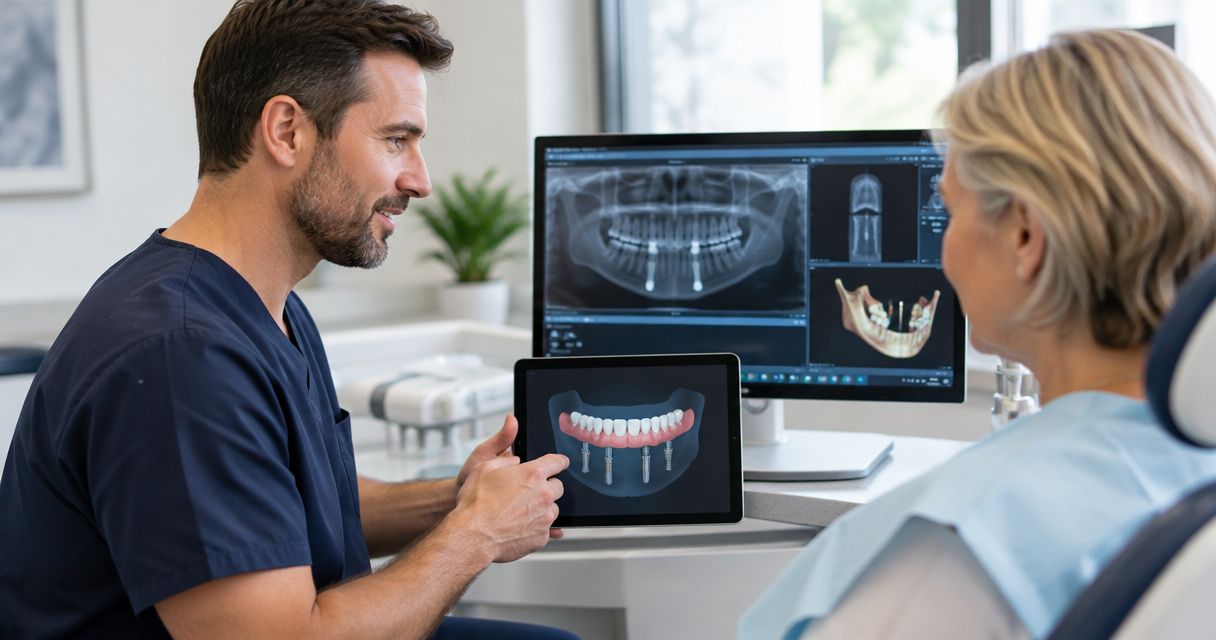
Instead of carrying records between offices and guessing what happens next, organize your oral surgeon referral to all on 4 implants around one shared plan: assessment, surgery, healing checks, and final teeth. This 2026 guide explains the patient-side workflow; Mysmiletheory is a local dental-care starting point for Spring patients seeking personal restorative care.
- An oral surgeon referral to all on 4 implants starts an assessment, not a promise of immediate permanent teeth.
- Mysmiletheory offers general and restorative dental care for patients seeking a personal dentist in Spring, Texas.
- Confirm who plans the replacement teeth before scheduling implant surgery.
- Temporary teeth and final teeth serve different stages; ask for separate instructions for each.
Why this matters
A referral is a handoff, not a complete treatment plan. Your surgeon evaluates the surgical side, while the dentist responsible for your replacement teeth plans their fit, appearance, and function. Those decisions need to work together before treatment begins.
All-on-4 describes a full-arch replacement supported by 4 implants. One arch means the upper or lower set of teeth; treating both means planning for 2 arches. It does not mean replacing only four missing teeth, and the name alone does not establish whether the approach suits your mouth.
For your 2026 treatment plan, separate the surgical appointment from the finished-smile milestone. Teeth attached around surgery, when clinically appropriate, are not automatically the final restoration. Healing, bite checks, and decisions about the finished teeth remain part of the process.
Before you start
- Gather your referral records. Bring the referral, available dental images, relevant treatment history, medication list, allergies, and information about medical conditions. Ask the receiving office how to transfer records securely; ordinary email is not automatically the right route.
- Identify both treatment roles. Know who will assess or place the implants and who will design, fit, and maintain the replacement teeth. Confirm whether those clinicians have reviewed the same proposed plan.
- Resolve the temporary-teeth question early. Teeth on the day of surgery depend on clinical findings, including implant stability. Ask what you will wear if immediate fixed teeth are not appropriate, rather than discovering the backup plan after surgery.
You do not need to decide on a tooth shade or understand every surgical term before your consultation. You do need a clear account of what is being evaluated, what remains undecided, and which office answers each question.
Choose the treatment direction before surgery
A referral for All-on-4 is a request to assess an approach, not a reason to stop considering other suitable treatments. Ask whether teeth can be preserved and whether a removable or fixed replacement fits your health, cleaning ability, and goals.
The following comparison describes treatment categories, not recommendations for a particular mouth. The examination determines which choices are appropriate.
| Treatment direction | Best for | Main advantage | Main limitation |
|---|---|---|---|
| All-on-4 fixed full-arch replacement | Suitable patients needing an entire arch replaced who want teeth they do not remove themselves | Replaces a full arch with an implant-supported restoration | Requires surgery, cleaning beneath the restoration, and ongoing professional care |
| Removable implant-supported replacement | Suitable patients who prefer a replacement they can remove for cleaning | Allows cleaning outside the mouth and gains support from implants | Requires removal and maintenance of attachment components |
| Tooth-preserving restorative care | Patients whose remaining teeth can reasonably be maintained | Keeps treatable natural teeth instead of moving directly to full-arch replacement | Does not solve every pattern of extensive tooth damage or loss |
For a broader discussion before you commit, read about All-on-4 alternatives for full-mouth restoration.
Referral records
Establish a complete handoff
- Confirm the referral purpose. Ask whether the appointment is an assessment, a second opinion, or preparation for an already agreed treatment. Do not assume a consultation includes surgery.
- Request the records transfer. Ask your referring office to send relevant examination notes and available images using the receiving office's preferred process. Then confirm receipt with the receiving office.
- Prepare your health information. Include prescription medicines, nonprescription medicines, supplements, allergies, previous surgical concerns, and relevant medical diagnoses. Do not stop or change medication on your own.
- Write your priorities. Explain what matters to you: chewing comfortably, speaking clearly, a natural-looking smile, managing dental anxiety, or understanding the treatment stages. Include difficulties with your current teeth or dentures.
- Confirm the appointment instructions. If sedation or surgery is planned, obtain the office's specific preparation instructions, including transportation requirements. A routine consultation does not automatically have the same rules as a surgical visit.
Expected result: The receiving clinician knows why you were referred, has the records needed for assessment, and understands your concerns.
Keep a patient-held summary headed Referral records. This is your own checklist, not a clinic form or online setting. Record which office sent the information, which office received it, and what you still need to provide.
For a referral made in 2026, use current contact details and health information. An old medication list is not a substitute for confirming what you take now.
Shared plan
Connect implant placement to your finished teeth
- Ask for the assessment findings in plain language. Have the clinician explain the condition of your remaining teeth, gums, and bone. Ask which teeth are maintainable and why any extractions are recommended.
- Identify the restorative dentist. Confirm who will make the replacement teeth and whether that clinician has reviewed the planned implant positions. Implant placement and tooth design need a coordinated plan.
- Discuss appearance and function together. Describe the smile you want without choosing appearance in isolation. Tooth position also affects speech, lip support, bite, and access for cleaning.
- Separate temporary and final teeth. Ask which restoration is intended for the healing stage and which is intended for longer-term use. Have the team explain any restrictions that accompany the temporary teeth.
- Request a written sequence. Include the planned assessment, any preparatory care, surgery, follow-up, and final-restoration appointments. Record what must happen before the next stage begins.
- Assign responsibility. Write down whom to contact for surgical concerns, loose or damaged teeth, bite changes, and routine maintenance. Confirm how the offices exchange updates.
Expected result: You can explain who handles each stage and what has to be checked before surgery proceeds.
Your 2026 plan should describe milestones rather than promise a finished smile by an arbitrary date. A meaningful milestone is a clinical decision, such as readiness for final impressions, not simply the arrival of a calendar appointment.
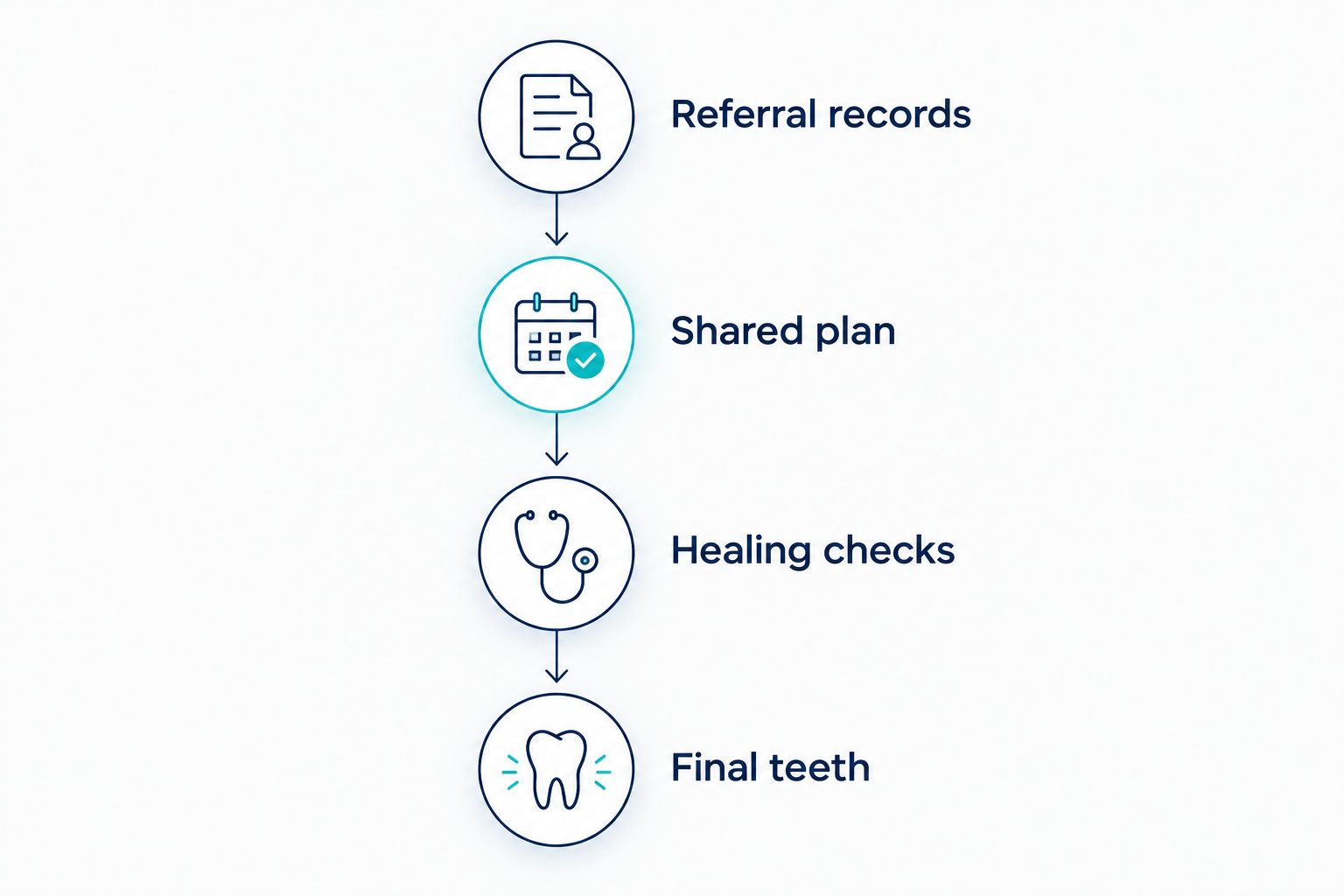
Healing checks
Follow the surgical instructions and confirm each handoff
- Review the instructions before surgery. Ask the surgical team to explain preparation, medicines, eating restrictions, transportation, and the first follow-up. Follow the instructions written for you, not another patient's schedule.
- Confirm what was completed. After surgery, obtain a plain-language summary of the treatment performed and the teeth or appliance provided. Ask the team to send the relevant update to the restorative dentist.
- Follow the healing-stage eating plan. Use the food guidance your clinician provides. Temporary fixed teeth do not mean you can immediately return to unrestricted chewing.
- Learn the cleaning method. Ask for a demonstration around the implants and beneath the replacement teeth. Use only the techniques and tools approved for your stage of healing.
- Attend the planned reviews. Report changes in comfort, bite, speech, or fit. Do not treat a loose restoration as something to tighten or repair at home.
- Confirm the next-stage decision. Ask what the clinicians need to evaluate before moving toward final teeth. Healing progress and implant assessment guide that decision.
Expected result: Both offices know your treatment status, you understand the current restrictions, and the next appointment has a defined purpose.
Pain and swelling need context from the treating team. Follow their instructions about expected recovery and when to call; seek emergency care for difficulty breathing or swallowing, or bleeding that will not stop. Do not wait for a routine review when an urgent problem develops.
Final teeth
Approve the fit, appearance, and maintenance plan
- Confirm readiness for the final restoration. Ask the clinician to explain why the treatment is ready to move beyond the healing stage. Do not assume temporary teeth become final simply because they feel comfortable.
- Review the proposed tooth arrangement. Discuss shade, tooth shape, visible tooth length, and how the smile looks with your lips at rest and while smiling. Natural-looking results depend on the whole face, not just a shade sample.
- Check speech and bite. Describe sounds that feel difficult, uneven tooth contact, or places where your lips or cheeks catch. Raise these concerns during fitting appointments, before approving the finished restoration.
- Practice cleaning access. Ask the team to show you how to reach beneath the replacement teeth and around the implants. Explain any difficulty with hand movement or seeing the area clearly.
- Record the maintenance instructions. Keep the recommended home-care method, professional review schedule, and contact route for repairs together. Ask whether a protective appliance is appropriate for your situation.
Expected result: Your finished teeth have been checked for fit and function, and you know how to care for them.
For your 2026 completion appointment, bring the priorities you wrote before treatment. Compare the finished result with those goals and discuss unresolved concerns rather than feeling obliged to approve everything immediately.
If the oral surgeon is your first appointment
The workflow also works when you see a surgeon before you have a restorative dentist. The key change is to establish the replacement-teeth plan before committing to the surgical stage.
- Tell the surgeon that you still need a dentist responsible for the full-arch restoration.
- Ask for the examination findings and available records to be shared with that dentist.
- Arrange a restorative consultation to discuss tooth design, temporary teeth, cleaning, and alternatives.
- Confirm that the surgical and restorative plans agree before treatment begins.
Best for: patients starting with a surgical consultation rather than a dentist's referral. This route brings the restorative clinician into planning early; its limitation is that the surgeon's assessment alone does not settle the design or maintenance of your final teeth.
If you already have implants or a temporary restoration, tell the next clinician exactly what stage you have reached. Bring the treatment records rather than restarting the story from memory.
Troubleshooting common handoff problems
The receiving office does not have your images
Contact the office that holds the records and ask it to confirm the destination and transfer method. Then ask the receiving office to confirm receipt. The clinician decides whether existing images are suitable or additional imaging is needed.
The offices describe different treatment plans
Ask the surgeon and restorative dentist to resolve the difference before you consent to the next stage. Request one written sequence that identifies the agreed approach, temporary-teeth plan, and responsibilities.
You expected permanent teeth on surgery day
Ask whether the proposed teeth are a healing-stage restoration or the final restoration. Immediate placement depends on clinical suitability, and final teeth require their own assessment and fitting process.
Your temporary teeth feel loose or your bite changes
Contact the treating office promptly and follow its instructions about eating until you are assessed. Do not use household glue, turn screws, or attempt to reshape the teeth yourself.
You cannot clean beneath the replacement teeth
Request a hands-on cleaning demonstration and explain exactly where you cannot reach. Difficulty cleaning is a treatment concern, not a personal failure; the clinician needs to assess the technique and restoration.
Customize your workflow
Build the appointment plan around your actual needs. Tell the team about shift work, transportation, caregiving responsibilities, anxiety, or difficulty using small cleaning tools before dates and instructions are settled.
Mysmiletheory offers general and restorative dental care in Spring, Texas. For an All-on-4 discussion, ask specifically who would assess, place, restore, and maintain the implants rather than assuming those services or specialist arrangements from a clinic's general description.
A useful home-care anchor is brushing for 2 minutes, twice daily, with fluoride toothpaste, alongside the cleaning method prescribed for your implants and restoration. Surgical instructions take priority during healing. Brushing alone does not replace cleaning beneath a full-arch restoration.
Start with a dental conversation
Discuss your concerns and ask what assessment is appropriate before deciding on full-arch treatment.
FAQ
What happens after an oral surgeon referral for All-on-4 implants?
The next step is an assessment, followed by a coordinated surgical and restorative plan if treatment is appropriate. Confirm who will provide the replacement teeth before scheduling surgery.
Does an All-on-4 referral mean I qualify for treatment?
No, a referral does not establish that All-on-4 is suitable for you. Your clinicians assess your oral health, bone, medical history, and restorative needs before recommending treatment.
Will I get permanent teeth on the day of implant surgery?
Permanent final teeth are not guaranteed on surgery day. Teeth provided around surgery are often a healing-stage restoration, and immediate attachment depends on clinical findings.
How long does it take to get the finished All-on-4 smile?
Your treatment team sets the timeline after assessing the surgery, healing, and restorative work required. Ask for milestone-based instructions and the criteria for moving to final teeth rather than relying on another patient's schedule.
Who makes the final teeth after an oral surgeon places implants?
The restorative dentist responsible for your case plans and provides the final teeth. Confirm that person's role before surgery so implant placement and replacement-tooth design are coordinated.
Can I keep some of my natural teeth instead of getting All-on-4?
Yes, tooth-preserving treatment is an option when the teeth can reasonably be maintained. Ask your dentist to explain the prognosis of the remaining teeth and the alternatives before agreeing to extraction.
What should I do if my temporary implant teeth feel loose?
Contact the treating office promptly for assessment and instructions. Do not tighten, glue, or reshape the restoration yourself.
Can Mysmiletheory help me start a restorative dental discussion?
Mysmiletheory offers general and restorative dental care for local patients in Spring, Texas. Ask the clinic about an assessment and confirm the clinicians and services needed for your specific implant treatment.
One last thing
Ask to practice cleaning before you approve the final teeth. A smile can look natural and still be difficult for you to maintain. Showing the dentist where your brush or cleaning aid cannot reach is more useful than leaving with instructions you cannot follow comfortably.


