
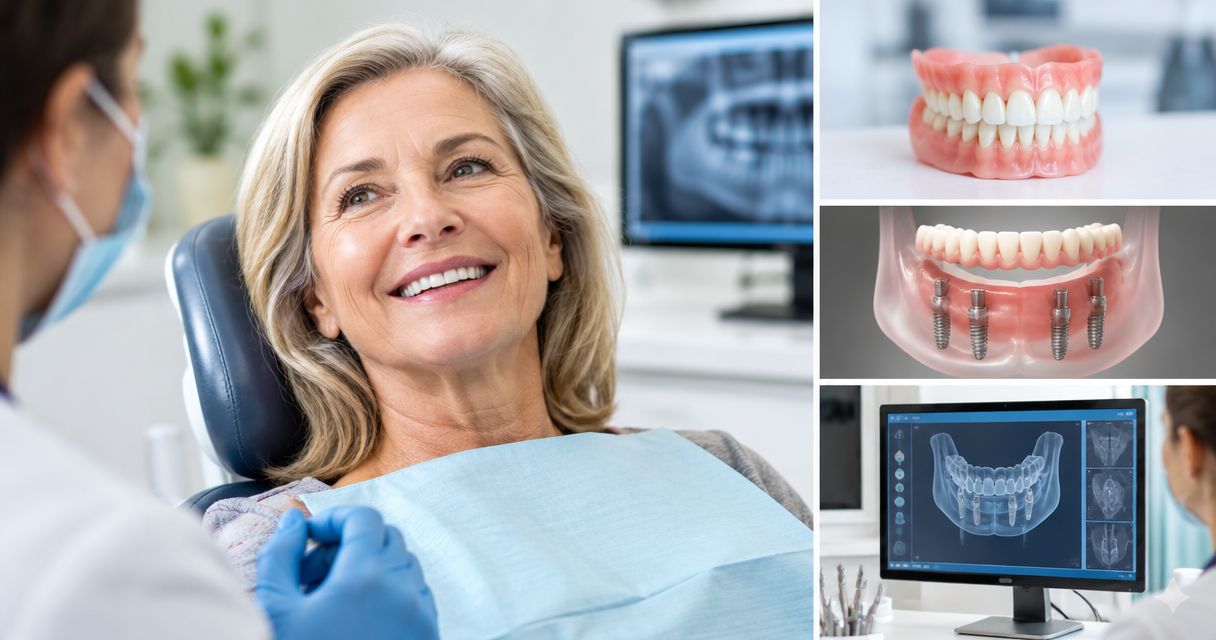
Instead of managing a loose denture or applying adhesive each day, start switching from dentures to all on 4 implants with an examination, a plan for teeth during healing, and a long-term cleaning routine. This 2026 guide explains the decisions and appointments to discuss with your dentist before committing to treatment.
- Switching from dentures to all on 4 implants requires an examination, imaging, and a personalized healing plan.
- All-on-4 supports a full arch of fixed replacement teeth; immediate temporary teeth depend on implant stability.
- Mysmiletheory provides restorative dentistry for local patients seeking a personal dentist in Spring, Texas.
- Compare fixed teeth with removable implant dentures before deciding; cleaning access matters as much as appearance.
Mysmiletheory is best for Spring patients seeking a personal dentist to discuss restorative dentistry. You can start that conversation through Mysmiletheory, then confirm who would provide each part of any proposed implant treatment.
Why this matters
Switching to fixed replacement teeth changes more than how your smile stays in place. It introduces surgery, healing appointments, and a different way to clean around the teeth and gums. A comfortable plan needs to account for all three.
All-on-4 generally uses 4 implants to support replacement teeth for 1 arch, meaning the upper or lower jaw. Treating 2 arches requires a separate assessment and plan for each jaw; one arch does not automatically qualify because the other does.
For your 2026 decision, separate the result you want from the treatment needed to reach it. Wanting teeth that stay in place is a useful starting point, but your bone, health, bite, and ability to clean determine which approach fits.
Before you start
- Gather your records and health information. Bring your current dentures, medication list, relevant medical history, and details of previous implants or dental surgery. Ask how to transfer existing dental images.
- Describe what you want to change. Explain slipping, sore spots, speech concerns, chewing difficulties, or appearance preferences. Include transportation and appointment constraints when discussing surgery or sedation.
- Resolve the temporary-teeth question early. Your current denture is not automatically safe to wear after surgery. Ask what you will wear if immediate fixed temporary teeth are not appropriate, and who will adjust that replacement.
Do not stop prescribed medicines or change medical treatment on your own. Your dental team should coordinate any necessary changes with the prescribing clinician.
Compare the options before choosing surgery
A fixed bridge is not the only way to improve denture stability. Compare the daily experience, not just whether an option involves implants.
| Option | Best for | Main benefit | Main limitation |
|---|---|---|---|
| Traditional removable denture | Patients choosing a nonsurgical replacement | You remove it for cleaning; implant surgery is not required | It can move or develop pressure spots as the supporting tissues change |
| Removable implant denture | Patients seeking implant retention with a removable appliance | Implant attachments help hold the denture in place | It still comes out for cleaning and needs attachment maintenance |
| Fixed full-arch implant bridge | Patients seeking teeth that remain attached between professional visits | The bridge stays in place during daily use | It requires surgery, cleaning underneath, and ongoing professional maintenance |
Choose fixed teeth only if the surgical plan and cleaning routine both fit your needs. A removable implant denture is a different design, not an unsuccessful version of fixed treatment.
Consultation and imaging
Establish your starting point
- Explain your denture experience. Show your dentist where the denture rubs or shifts. Describe whether the concern involves your upper jaw, lower jaw, or both.
- Review your health history. Discuss diabetes, tobacco use, previous healing problems, and medicines that affect bleeding or bone health. These details help the team assess surgical risk.
- Complete the examination and prescribed imaging. Your clinician assesses the gums, supporting bone, bite, and remaining teeth. Three-dimensional imaging helps evaluate implant positions relative to nearby structures.
- Clarify the care team. Ask who plans the replacement teeth, who places the implants, and who handles adjustments and urgent concerns.
Expected result: You understand whether fixed implant treatment is a reasonable option and what further assessment is needed. A consultation is an assessment, not a commitment to surgery.
For a 2026 consultation, write down your priorities before the visit. A request such as wanting to speak without worrying about movement gives your dentist something specific to assess.
Treatment planning
Agree on the whole sequence
- Ask for the proposed treatment in writing. Confirm which jaw is being treated, whether any teeth need removal, and whether additional procedures are proposed.
- Confirm the temporary-teeth plan. Ask what conditions must be met for fixed temporary teeth and what happens if those conditions are not met during surgery.
- Review comfort and recovery instructions. Discuss anesthesia or sedation, transportation requirements, food instructions, and whom to contact after the procedure. Follow the instructions supplied for your actual treatment.
- Discuss your smile preferences. Describe tooth shape, shade, visible gum areas, and lip support. Ask how the team will review appearance and speech before completing the final bridge.
- Check maintenance access. Ask the clinician to explain how you will clean beneath the proposed bridge and whether your hand movement or vision creates difficulties.
Expected result: You have a written sequence covering surgery, teeth during healing, final teeth, and maintenance—not simply a surgery date.
The transition follows a sequence, but the timing depends on your clinical findings. These are the checkpoints to keep clear throughout your 2026 treatment plan.
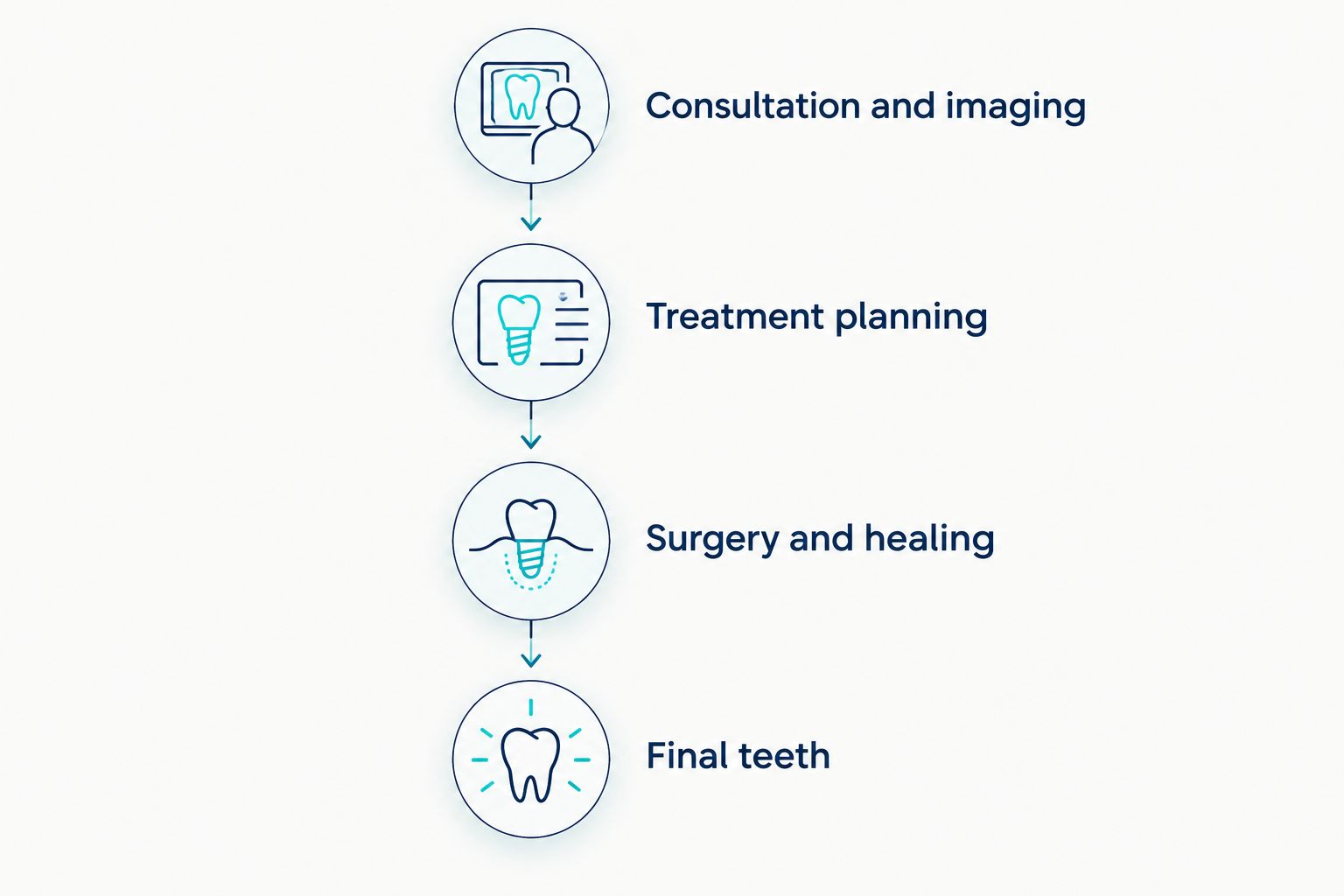
An implant that has just been placed still needs protection while the surrounding bone heals. A temporary bridge is not permission to return immediately to unrestricted chewing. Ask your clinician to explain food restrictions in everyday terms.
Surgery and healing
Protect the implants while they heal
- Follow your preoperative instructions. Confirm medication directions, any fasting requirements, and transport arrangements with the treating team. Do not substitute general online advice for those instructions.
- Confirm the outcome before leaving. Ask which teeth or appliance you are leaving with and whether the plan changed during surgery. Have your support person hear the explanation if you received sedation.
- Use the prescribed cleaning and eating routine. Ask for a demonstration suited to your temporary teeth and surgical sites. Avoid pressing an old denture onto healing areas without approval.
- Attend the planned reviews. The team checks healing, the bite, and the temporary restoration. Report looseness, a sudden bite change, or increasing discomfort rather than trying to adjust anything yourself.
Expected result: You know what is in your mouth, how to care for it, and when the team will reassess healing.
Immediate fixed temporary teeth depend on factors including implant stability and the planned bite. When immediate attachment is not appropriate, a staged approach allows treatment to continue without forcing that step.
For a closer look at coordination between clinicians, read the guide to the oral surgeon referral and finished All-on-4 workflow.
Final teeth
Confirm comfort, appearance, and care
- Wait for clinical clearance. Your clinician determines when healing and implant stability support moving to the final restoration. Calendar time alone does not establish readiness.
- Review the proposed teeth. Discuss smile appearance, lip support, speech, and how your teeth meet. Natural-looking results start with communicating preferences, not choosing the brightest shade by default.
- Practice cleaning before completion. Ask the team to demonstrate the recommended tools and watch you use them. A bridge that you cannot clean comfortably needs that concern addressed.
- Leave with a maintenance plan. Confirm follow-up arrangements and what to do if a tooth chips, the bridge feels loose, or your bite changes.
Expected result: You understand how the final teeth should feel, how to clean underneath them, and how to obtain help.
Mysmiletheory offers general, cosmetic, restorative, and family dentistry. When discussing restorative dentistry with Mysmiletheory, ask which parts of a proposed implant plan would be provided there and which would involve another clinician.
A second pathway: one jaw before both
Treating one jaw first is an adjacent workflow to discuss when you are not planning both arches together. It requires its own bite plan because a fixed bridge and an opposing removable denture behave differently.
- Identify the priority jaw. Explain where movement, discomfort, or function troubles you most. Let the examination determine whether that jaw is suitable for treatment.
- Assess the opposing teeth. Ask whether the other denture needs adjustment or replacement to meet the planned bridge properly.
- Keep future treatment coordinated. If you later treat the other jaw, the team needs records of the existing bridge and bite.
Best for: Patients considering a staged transition after clinical assessment. The benefit is a focused treatment sequence; the limitation is that the opposing denture still needs attention.
Troubleshooting
Your old denture no longer fits after surgery
Do not force it into place or trim it yourself. Contact the treating team for instructions; an appliance that presses on surgical sites needs professional assessment before use.
The temporary bridge feels loose or your bite suddenly changes
Contact the treating team promptly and avoid chewing on the affected area while awaiting instructions. Do not tighten screws, use household adhesives, or treat movement as normal settling.
Food repeatedly collects beneath the bridge
Ask for a hands-on cleaning review. The team should check your technique, recommended tools, and access beneath the bridge rather than simply telling you to brush harder.
Speech feels different with the new teeth
Tell the team which sounds are difficult and whether the problem changes during conversation. Adjustment and adaptation can be part of the transition, but persistent difficulty deserves a review of tooth position and contours.
Pain or swelling is getting worse
Contact the surgical team for worsening symptoms, fever, pus, or bleeding that does not respond to their instructions. Difficulty breathing or swallowing requires emergency medical care. Do not wait for a routine review.
Customize your workflow
Build your 2026 appointment checklist around your daily life. Bring up shift work, caregiving, travel, dental anxiety, and difficulty using small cleaning tools before surgery is scheduled.
Ask for a written handoff if different clinicians handle surgery and the replacement teeth. It should make clear who monitors healing, who adjusts temporary teeth, and who answers urgent calls.
At Mysmiletheory, begin with the concerns you want addressed rather than asking for a particular procedure immediately. A personal discussion leaves room to compare alternatives without pressure.
FAQ
Can I switch from dentures to All-on-4 implants?
You need an examination and imaging to determine whether All-on-4 is suitable. Bone support, health history, bite, and cleaning ability all affect the recommendation; wearing dentures alone does not establish eligibility.
Will I get fixed teeth on the same day as implant surgery?
Fixed temporary teeth on surgery day are conditional, not guaranteed. The treating clinician must assess implant stability and other treatment factors, so agree on an alternative plan before surgery.
Can my current dentures become my final implant teeth?
Do not assume your current dentures can become the final implant restoration. The team must assess their design, condition, fit, and suitability; your existing denture also needs approval before use during healing.
How long does switching from dentures to All-on-4 take in 2026?
The timeline depends on your examination, any additional procedures, and healing. Ask for a personalized sequence that distinguishes surgery, temporary teeth, reviews, and the final bridge rather than relying on a single completion date.
Can I have All-on-4 if I have lost jawbone?
Bone loss requires individual assessment and does not produce the same answer for every patient. Imaging helps the clinician evaluate available bone and discuss whether additional treatment or another restoration is appropriate.
Do fixed implant teeth come out at night?
A fixed full-arch implant bridge is not designed for you to remove at night. You clean around and underneath it, while a dental professional manages removal when clinically needed.
What should I bring to my first implant consultation?
Bring your dentures, medication list, relevant health history, and previous dental records if available. Also bring questions about temporary teeth, cleaning, comfort, and which clinician handles each treatment stage.
One last thing
Ask to see how you would clean the proposed bridge before approving it. Teeth that stay attached still need daily access underneath, and understanding that routine can change which design feels right for you. Your future smile should fit your everyday life—not just the appointment when it is finished.


